
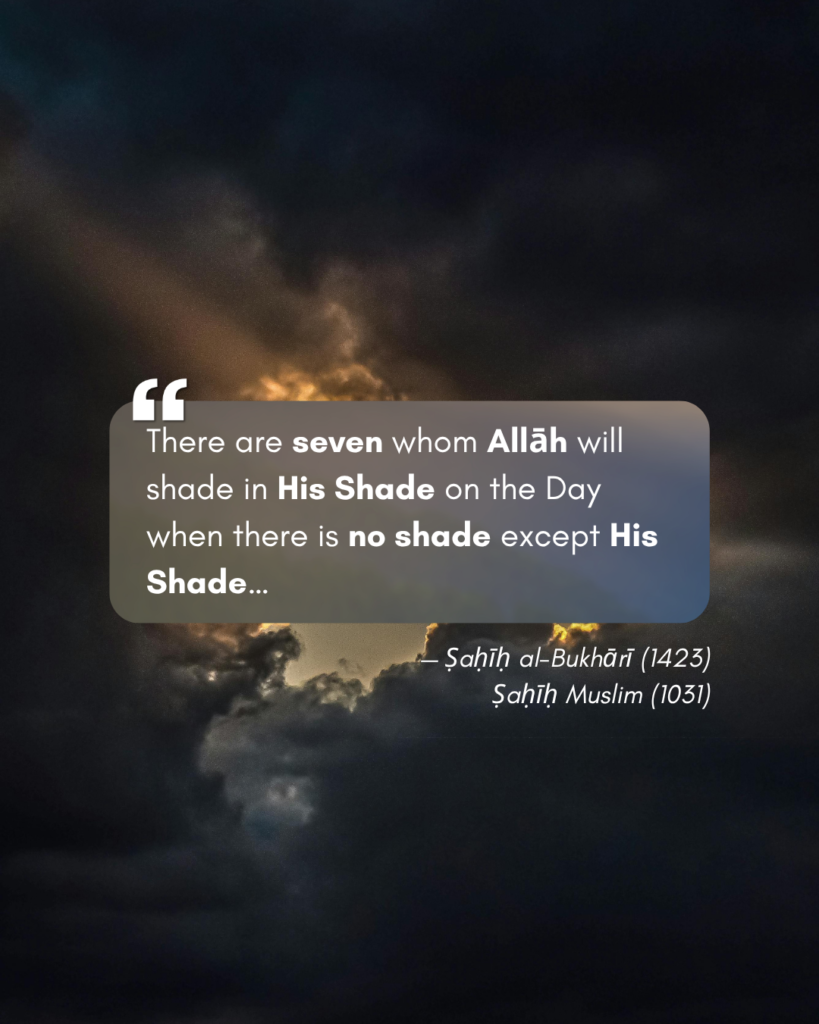
On the Day of Judgment, the sun will be brought close to creation. People will be drowning in their own sweat according to their sins. There will be no shade anywhere except the shade granted by Allah on that Day—described in some narrations as the shade of His Throne.
Rasūlullāh ﷺ said:
“There are seven whom Allah will shade in His Shade on the Day when there is no shade except His Shade: a just ruler; a youth who grew up in the worship of Allah; a man whose heart is attached to the mosques; two men who love each other for Allah’s sake, meeting for that and parting upon that; a man who is called by a woman of beauty and position [for illegal intercourse], but he says: ‘I fear Allah’; a man who gives in charity and hides it, such that his left hand does not know what his right hand gives; and a man who remembered Allah in private and so his eyes shed tears.”
— Ṣaḥīḥ al-Bukhārī (1423) and Ṣaḥīḥ Muslim (1031)
Subḥānallāh. These seven come from every walk of life. Let us walk through them, one by one, with the broader teachings that support each.
1. A Just Ruler
The first is the just ruler. The scholars explain that this is not limited to the Khalifah or the Sultan. It includes anyone given authority over others—a father over his family, a manager over his employees, a supervisor over his team, a teacher over his students. Anyone who says: “I have the power to overlook this wrongdoing, to favor this person, to remain silent against injustice—but I will not. I fear Allah.”
Rasūlullāh ﷺ said:
“Those who act justly will be with Allah on pulpits of light at the right Hand of the Most Compassionate, Exalted be He, and both His Hands are right. They are those who are just in their judgment and towards their people and what is under their charge.”
— Ṣaḥīḥ Muslim (1827), narrated by ‘Abdullāh ibn ‘Amr
And he ﷺ said:
“When a judge gives a decision, having tried his best to decide correctly and is right, there are two rewards for him; and if he gave a judgment after having tried his best to arrive at a correct decision but erred, there is one reward for him.”
— Ṣaḥīḥ Muslim (1716a), narrated by ‘Amr ibn al-‘Āṣ
The one who puts himself at risk to stand against wrongdoing, knowing it may cost him his position or his safety, and still says “This is wrong” — that person has tasted the reality of justice that the tyrants of this world will never understand.
2. A Youth Who Grew Up in the Worship of Allah
The second is the youth who grew up in the worship of Allah. This is a special kind of person—one who protected their youth for Allah at a time when desires are strongest and temptations are everywhere.
Allāh ﷻ says in the Qur’ān, praising the young men of the cave:
“Indeed, they were young men who believed in their Lord, and We increased them in guidance.”
— Sūrah al-Kahf (18:13)
Rasūlullāh ﷺ also advised us about the value of youth:
“Take advantage of five before five: your youth before your old age, your health before your sickness, your wealth before your poverty, your free time before you are preoccupied, and your life before your death.”
— Musnad Aḥmad (28004), narrated by Ibn ‘Abbās, classed as ṣaḥīḥ by al-Albānī in Ṣaḥīḥ al-Jāmi’ (1077)
The virtue of this category is established by the fact that Allah included it among the seven who will be shaded on the Day of Judgment.
And for those of us who may not have been raised this way, there is still hope. Rasūlullāh ﷺ said:
“One who guides to something good has a reward similar to that of its doer.”
— Ṣaḥīḥ Muslim (1893), narrated by Abū Mas’ūd al-Ansārī
So even if you did not spend your own youth in worship, you can encourage, support, and facilitate another young person to do so. You can be the reason a young person finds the path to Allah. And by the mercy of Allah, you will share in their reward, bi’idhnillāhi ta’ālā.
3. A Man Whose Heart Is Attached to the Mosques
The third is the one whose heart is attached to the mosques. This means having a constant longing for the masjid and returning to it regularly for prayer and remembrance. These are the people who organize their lives around prayer, making every effort to be at the mosque as much as possible.
Rasūlullāh ﷺ said:
“Should I not tell you of that by which Allah obliterates the sins and elevates the ranks? Performing the ablution thoroughly despite difficulties, taking many steps to the mosques, and waiting for the next prayer after observing a prayer. That is the ribāṭ (constant guard).”
— Ṣaḥīḥ Muslim (251a), narrated by Abū Hurayrah
The one whose heart is attached to the masjid does not see prayer as a burden. They recognize the peace and tranquility that comes from spending time in the house of Allāh.
For women, the scholars explain that the same reward can be attained by having her heart attached to the masjid while praying at home (as that is better for her), or by encouraging the men in her household to attend.
4. Two Who Love Each Other for Allah’s Sake
The fourth are two people who love each other for Allah’s sake, meeting for that and parting upon that. There are many reasons why we could care for someone in this life—sometimes selfish, sometimes selfless. The one who loves solely for Allah’s sake is selfless in their love.
Rasūlullāh ﷺ narrated that Allāh ﷻ said:
“Those who love one another for My glory will have pulpits of light, and the Prophets and martyrs will envy them.”
— Reported by at-Tirmidhī (2390), narrated by Mu’ādh ibn Jabal, classed as ḥasan ṣaḥīḥ by at-Tirmidhī, and declared ṣaḥīḥ by al-Albānī in Ṣaḥīḥ al-Jāmi’ (1801)
And in Ṣaḥīḥ Muslim, the Prophet ﷺ said:
“Allāh, the Exalted, says on the Day of Resurrection: ‘Where are those who loved each other for My glory? Today I will shade them in My Shade on the Day when there is no shade but My Shade.'”
— Ṣaḥīḥ Muslim (2566), narrated by Abū Hurayrah
Imagine that. Allāh Himself asks about them. He announces their presence to all of creation.
5. The One Who Resists Temptation for Fear of Allah
The fifth is the man who is called by a woman of beauty and position, and he says: “I fear Allah.”
This is the moment of integrity. The doors are locked. No one will know. The only One watching is Allāh. And he chooses Allāh.
This is the same quality that elevated Yūsuf ‘alaihissalam. The scholars explain that this hadith applies equally to a woman who is called by a handsome man of status and refuses for the fear of Allāh. The quality is taqwā, not gender.
Rasūlullāh ﷺ said:
“Three eyes will not see the Hellfire: … an eye that lowers its gaze from what Allah has forbidden.”
— Reported by al-Ṭabarānī in Al-Mu’jam al-Kabīr, narrated by ‘Ubādah ibn aṣ-Ṣāmit, classed as ṣaḥīḥ by al-Albānī in Ṣaḥīḥ al-Jāmi’ (3042)
The one who lowers their gaze, who turns away from what Allah has forbidden, who resists the call of desire when no one is watching—that eye will be protected from the fire.
6. The One Who Gives Charity in Secret
The sixth is the man who gives in charity and hides it, such that his left hand does not know what his right hand gives.
This is the one who protects his charity from any trace of showing off (riyā’). He gives for Allāh alone, and he guards that intention so fiercely that even his own other hand does not know.
Rasūlullāh ﷺ warned about the opposite. He said:
“There are three whom Allah will not speak to on the Day of Resurrection, nor will He look at them, nor will He purify them, and they will have a painful punishment: the one who reminds others of his charity…”
— Ṣaḥīḥ Muslim (106), narrated by Abū Hurayrah
Because charity given for show has no value. The one who announces it to seek praise has already received his reward in this world—the praise of people. And on the Day of Judgment, nothing remains for him.
The scholars explain that giving charity openly may sometimes serve an interest, such as encouraging others to follow the example. But the highest rank is the one who conceals it, seeking only the face of Allāh.
7. The One Who Remembers Allah in Private and Weeps
The seventh, and in many ways the most accessible, is the one who remembers Allah in private and his eyes shed tears.
Subḥānallāh, this one requires no wealth to give, no authority to wield, no battle to fight, no love to maintain, no youth to preserve. Just you and your Lord. Alone. Remembering Him.
And when the heart truly remembers, when the weight of His greatness, His mercy, His justice, His presence settles in the chest—tears come. Not forced. Not performed. They flow naturally from awe, fear, and hope.
Rasūlullāh ﷺ said:
“Three eyes will not see the Hellfire: an eye that weeps out of the fear of Allah…”
— Reported by al-Ṭabarānī in Al-Mu’jam al-Kabīr, narrated by ‘Ubādah ibn aṣ-Ṣāmit, classed as ṣaḥīḥ by al-Albānī in Ṣaḥīḥ al-Jāmi’ (3042)
And he ﷺ also said:
“The fire of Hell will never touch the eye that weeps out of the fear of Allah.”
— Reported by at-Tirmidhī (1633), narrated by Abū Hurayrah, classed as ṣaḥīḥ by al-Albānī in Ṣaḥīḥ al-Jāmi’ (7736)
No one sees those tears but Allah. And that is exactly why they are so valuable. No riyā’. No show. Just a servant and his Lord.
A Door Open to Everyone
So ask yourself: Which of these seven can you become today?
You may not be a ruler. You may not be young. You may not have wealth to give. You may not have found that friend yet. You may not face that specific temptation.
But you can be the one who remembers Allah in private until tears fall. That door is open to every single one of us.
And even if you missed the opportunity in your own youth, you can still earn the reward of this category. Rasūlullāh ﷺ said:
“One who guides to something good has a reward similar to that of its doer.”
— Ṣaḥīḥ Muslim (1893)
So encourage a young person. Facilitate their worship. Be the reason they find the path. And by Allah’s mercy, you will share in their reward.
Rasūlullāh ﷺ also said:
“The one who repents from sin is like one who never sinned.”
— Reported by Ibn Mājah (4250), narrated by ‘Abdullāh ibn Mas’ūd, classed as ḥasan by al-Albānī in Ṣaḥīḥ al-Jāmi’ (3805)
So even if you have not been these things in the past, you can start today. Right now.
Turn to Allah. Remember Him in private. Let your heart soften. Let your eyes overflow. And know that Allah sees those tears, and He has prepared a shade for you on the Day when there will be no shade but His.
May Allah azza wa jall make us among those shaded under His shade on the Day when there is no shade but His. May He protect our eyes from the fire, our hearts from heedlessness, and our intentions from showing off. And may He resurrect us with Rasūlullāh ﷺ and the righteous.
Āmīn yā Rabb al-‘Ālamīn, bi rahmatika yā Arḥam ar-Rāḥimīn.
Pingback: The Trust of the Final Ummah – "Convey From Me, Even If It Is One Verse"