We all know the story of Yūsuf ‘alaihissalam. The well. The slavery. The temptation. The prison. The palace. The reunion.
We have heard it countless times. But today, we will notice something different. A divine rhythm woven into the same story. A pattern of hardship and ease that repeats itself from beginning to end. And how every hardship was the means for the next ease—which was greater. How every hardship was an ease in itself as well.
The story of Yūsuf ‘alaihissalam begins in the Qur’ān with a verse that sets the stage:
“Indeed, in the story of Yūsuf and his brothers there are signs for those who ask.”
— Sūrah Yūsuf (12:7)
Signs. Not just a tale. Lessons for every seeker who looks closely.
And one of the clearest signs in this story is the rhythm Allāh promises in Sūrah al-Sharh:
“So, surely with hardship comes ease. Surely with ˹that˺ hardship comes ˹more˺ ease.”
— Sūrah al-Sharh (94:5–6)
Hardship and ease are not opposites. They are companions. One does not end before the other begins. They arrive together, intertwined, like the turning of night and dawn.
No life demonstrates this divine rhythm more clearly than that of Yūsuf ‘alaihissalam. His story is not merely a tale of patience. It is a curriculum. A living map of how hardship gives way to ease, then greater hardship, then more ease, then even greater hardship, then the ultimate ease—while the heart remains anchored in Allāh.
And notice: every hardship he faced became the very means by which he reached the next ease. The well led to the caravan. The caravan led to the house of al-ʿAzīz. The false accusation led to prison. Prison led to the palace. And the palace led to the reunion with his family.
There was no shortcut. There was no leap from hardship to ease without the hardship itself being the bridge.
Moreover, every hardship carried ease within it. Even in the well, Allāh inspired him. Even in slavery, Allāh placed him in a position of trust. Even in prison, he became a caller to tawḥīd. The ease was not only at the end of the hardship. It was inside the hardship.
Betrayal – The Well That Became a Bridge
Yūsuf ‘alaihissalam was a beloved son. His father, Yaʿqūb ‘alaihissalam, was a prophet. His brothers were jealous. They conspired. They wanted to kill him. But one among them said:
“Do not kill Yūsuf. But if you must do something, throw him into the bottom of a well so perhaps he may be picked up by some travelers.”
— Sūrah Yūsuf (12:10)
They threw him into a well. Alone. Frightened. Cut off from every human connection. This was a great hardship.
But here is the ease within the hardship: they did not kill him. Had they killed him, the story would have ended. The dream would have died. But because they threw him into the well, his story continued. The well became the bridge to Egypt. The well became the beginning of his elevation.
And even as Yūsuf sat at the bottom of that dark hole, Allāh did not abandon him. He revealed to him:
“˹One day˺ you will remind them of this deed of theirs while they are unaware ˹of who you are˺.”
— Sūrah Yūsuf (12:15)
Revelation came to him in the well. Before rescue. Before justice. Before any sign of ease. This is the first lesson: Allāh’s reassurance often precedes His relief. The ease was already inside the hardship.
Slavery – The Market That Led to a Palace
A caravan came. They sent their water drawer. He lowered his bucket. He called out:
“Oh, what a great find! Here is a boy!”
— Sūrah Yūsuf (12:19)
They pulled Yūsuf out. They hid him as merchandise. Allāh records:
“And They ˹later˺ sold him for a cheap price, just a few silver coins—only wanting to get rid of him.”
— Sūrah Yūsuf (12:20)
From a well to a market. From the son of a prophet to a slave on a block. Rescued, then enslaved. This was a new hardship, different from the well. The pain of being sold, of being treated as goods, of losing every trace of his former life.
But Allāh immediately follows with the ease within the hardship:
“The man from Egypt who bought him said to his wife, “Take good care of him, perhaps he may be useful to us or we may adopt him as a son.””
— Sūrah Yūsuf (12:21)
A man in a foreign land, a slave in a strange house, yet Allāh placed him in a position of trust and honor. The house of al-ʿAzīz became his shelter. And then Allāh adds:
“And thus, We established Yūsuf in the land that We might teach him the interpretation of events [i.e., dreams].”
— Sūrah Yūsuf (12:21)
Even in slavery, Allāh was preparing him. Even in a foreign house, Allāh was teaching him. The hardship of slavery was the very means by which he reached Egypt. Without the market, no Egypt. Without Egypt, no palace.
And then the verse that captures the divine rhythm perfectly:
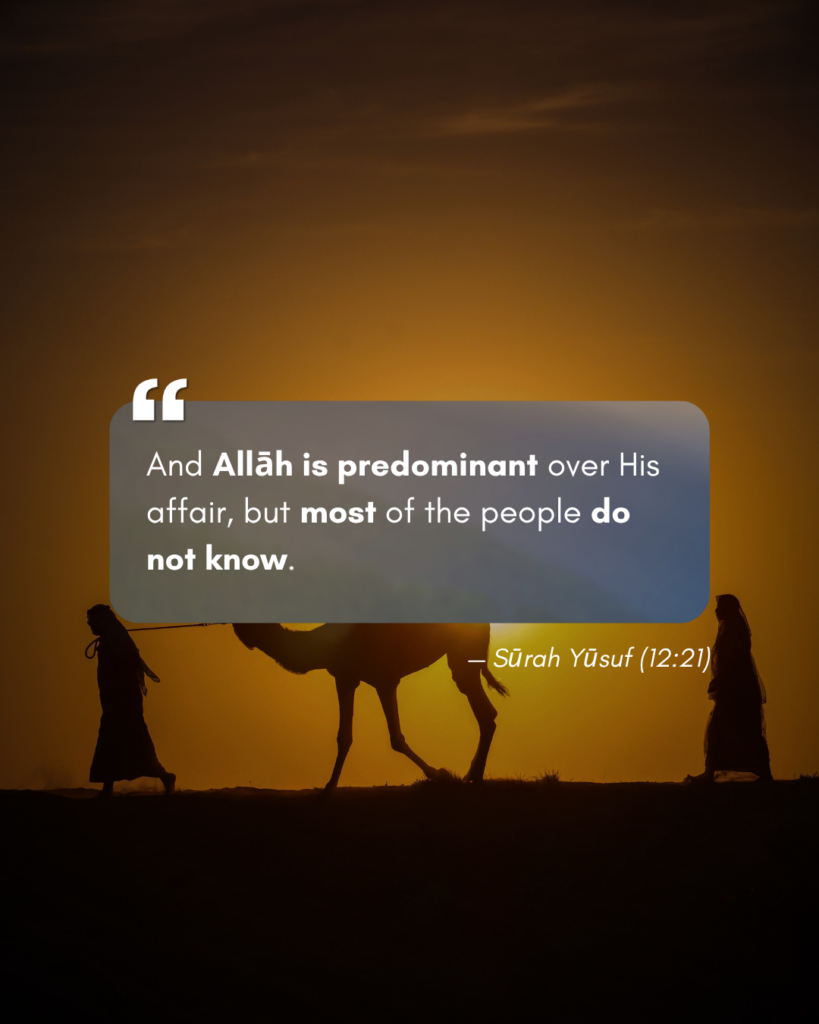
“And Allāh is predominant over His affair, but most of the people do not know.”
— Sūrah Yūsuf (12:21)
What looked like a disaster was Allāh’s command unfolding. What looked like an end was a beginning.
Temptation – The Door That Led to Prison
Years passed. Yūsuf grew. Allāh gave him wisdom and beauty. The wife of al-ʿAzīz was drawn to him. She locked the doors. She called him to herself. No one would know. No one would witness. The only One watching was Allāh.
And Yūsuf said:
“Allah is my refuge! It is ˹not right to betray˺ my master, who has taken good care of me. Indeed, the wrongdoers never succeed.”
— Sūrah Yūsuf (12:23)
He chose Allāh over desire. He chose prison over sin. But the pursuit did not stop. She schemed. She threatened. She gathered the women of the city. She proved her desire.
And then Yūsuf ‘alaihissalam made a du’ā that reveals the depth of his understanding of hardship and ease:
“My Lord, prison is more to my liking than that to which they invite me. And if You do not avert from me their plan, I might incline toward them and [thus] be of the ignorant.”
— Sūrah Yūsuf (12:33)
Look at this du’ā. He is asking Allāh for prison. The world looks at prison and sees only hardship. Yūsuf looks at prison and sees ease. Because the real hardship was not prison. The real hardship was the temptation. The real hardship was being called to sin. Prison, by comparison, was a refuge. A protection. An ease.
And Allāh answered him:
“So his Lord responded to him and turned away their plan from him. Indeed, He is the All-Hearing, the All-Knowing.”
— Sūrah Yūsuf (12:34)
He asked for prison. Allāh granted him prison. The very thing he requested was given to him.
“Then it appeared to them after they had seen the signs that he [i.e., al-ʿAzeez] should surely imprison him for a time.”
— Sūrah Yūsuf (12:35)
To the world, this was injustice. To Yūsuf, this was an answered du’ā. He asked. Allāh gave. And prison became his fortress. His place of safety. His pulpit.
This is the deepest understanding of hardship and ease. What the world calls hardship, the believer may call mercy. What the world calls punishment, the believer may call protection. The real hardship would have been to stay in that house, to face that temptation again, to risk falling into sin. Prison was the ease. He asked for it. And Allāh, in His mercy, gave it to him.
Prison – The Dungeon That Became a Pulpit
Years in prison. Not months. Years. Hope deferred. Justice delayed. The one who refused sin was punished. The innocent was imprisoned. How easy it would have been to despair. How easy to say: “Where is Allāh in this? I asked for prison and now I am trapped.”
But Yūsuf did not despair. He did not complain to anyone except his Lord. And even in prison, he did not retreat. He became a caller to tawḥīd.
Two young men entered prison with him. They had dreams. They asked for interpretation. And Yūsuf did not simply give them an answer. He used the moment to call them to Allāh:
“O my fellow-prisoners! Which is far better: many different lords or Allah—the One, the Supreme? Whatever ˹idols˺ you worship instead of Him are mere names which you and your forefathers have made up, a practice Allah has never authorized.”
— Sūrah Yūsuf (12:39-40)
Hardship became a pulpit. The prison was the very means by which he reached the palace. Without the prison, he would never have met the king’s servants. Without the prison, he would never have interpreted the dreams. Without the prison, he would never have been brought to the king.
He told one of the young men:
“Mention me in the presence of your master.”
— Sūrah Yūsuf (12:42)
But Shayṭān made him forget. Years passed. Yūsuf remained in prison. More hardship. More waiting.
Yet even this delay was ease. Because the timing of his release was not random. It came exactly when the king needed him. It came exactly when the dream required his interpretation. It came exactly when the whole of Egypt would witness his rise.
Allāh does not delay except for wisdom. Every extra day in prison was preparation for a greater elevation.
Elevation – From Dungeon to Palace
Then, suddenly, the turn. The king dreamed a dream. Seven fat cows eaten by seven lean ones. Seven green ears of corn and seven dry ones. The chiefs of the land were perplexed. No one could interpret it.
The servant who had been with Yūsuf remembered him. He went to the prison. Yūsuf interpreted the dream without hesitation: seven years of plenty, then seven years of famine.
The messenger returned to the king. And the king said:
“Bring him to me.”
— Sūrah Yūsuf (12:50)
But when the messenger came to Yūsuf, he did not rush to leave. He said:
“Return to your master and ask him what is the case of the women who cut their hands. Indeed, my Lord is Knowing of their plan.”
— Sūrah Yūsuf (12:50)
He refused to leave until his innocence was proven. Until the truth was established. Until those who had slandered him confessed.
The king investigated. The women confessed. The wife of al-ʿAzīz admitted:
“Now the truth has come to light. I sought to seduce him, and indeed, he is among the truthful.”
— Sūrah Yūsuf (12:51)
Then the king sent for him again. Yūsuf came. He spoke with the king. And the king said:
“Indeed, you are today established [in position] and trusted.”
— Sūrah Yūsuf (12:54)
Then Yūsuf made his request:
“Appoint me over the storehouses of the land. Indeed, I will be a knowing guardian.”
— Sūrah Yūsuf (12:55)
And Allāh records:
“And thus We established Yūsuf in the land to settle therein wherever he willed. We touch with Our mercy whom We will, and We do not allow to be lost the reward of those who do good.”
— Sūrah Yūsuf (12:56)
From a well to a market. From a market to a house. From a house to prison. From prison to the palace. Yūsuf became the minister of Egypt. The ultimate ease after the ultimate hardship.
And notice: every hardship was necessary. Without the well, no caravan. Without the caravan, no Egypt. Without the false accusation, no prison. Without the prison, no palace. Without the refusal to leave until his name was cleared, no honor. Allāh wove every difficulty into the next elevation.
Reunion – The Test of Power
Then came the final test. Years of famine. His brothers came to Egypt seeking food. They did not recognize him. He recognized them.
He tested them. He demanded they bring their younger brother. He planted his cup in their bags. He accused them of theft. And then, when they were at the point of despair, he revealed himself:
“Do you know what you did with Yūsuf and his brother when you were ignorant?”
— Sūrah Yūsuf (12:89)
They asked:
“Are you indeed Yūsuf?”
He said:
“I am Yūsuf, and this is my brother. Allāh has certainly favored us. Indeed, he who fears Allāh and is patient, then indeed, Allāh does not allow to be lost the reward of those who do good.”
— Sūrah Yūsuf (12:90)
Power was in his hands. He could have taken revenge. He could have humiliated them. Instead, he said:
“No blame will there be upon you today. May Allāh forgive you; and He is the most merciful of the merciful.”
— Sūrah Yūsuf (12:92)
The test of power was passed. Forgiveness, not revenge. Mercy, not retaliation.
It is easy to let go when you have no power and no authority, because you have no other choice. But to forgive and let go when you have the power and authority in your hands—that is the quality of Yūsuf ‘alaihissalam. These are the qualities that Allāh ʿazza wa jall loves in His sincere servants.
The Lesson
And with that, we learn how the life of Yūsuf ‘alaihissalam is filled with the rhythm of hardship and ease. Hardship, then ease. Greater hardship, then more ease. Even greater hardship, then the ultimate ease. And through every stage, he remained patient. He trusted Allāh. He never despaired. And he forgave when he had the power to punish.
Indeed, Allāh As-Samī’ Al-Baṣīr does not allow the efforts and rewards of His righteous servants to be lost.
Rasūlullāh ﷺ said:
“The people who receive the most severe trials are the prophets, then the next best, then the next best.”
— Sunan at-Tirmidhī (2398), classed as ṣaḥīḥ by al-Albānī
And he ﷺ said:
“The greatest reward comes with the greatest trial. When Allāh loves a people, He tests them. Whoever accepts that earns His pleasure, and whoever is angry with that earns His wrath.”
— Sunan at-Tirmidhī (2396), classed as ḥasan by al-Albānī
Yūsuf accepted every trial. He did not question Allāh’s wisdom. He did not demand justice on his timeline. He trusted. He remained patient. He turned to his Lord. And in the end, Allāh gave him the best of replacements.
The Rhythm Continues
Your life may feel like a well today. Dark. Lonely. No way out.
But know this: the ease is already with the hardship. The hardship itself is the bridge to the next ease. You cannot see it yet. Neither could Yūsuf when he was at the bottom of that well. But Allāh was already weaving the next stage.
Do not despair. Do not demand to see the whole map. Take one step. Trust the One who wrote the rhythm. And know that every hardship you endure with patience and trust in Allāh will become, by His mercy, the very means of your elevation.
May Allāh azza wa jall grant us the patience of Yūsuf ‘alaihissalam, the trust that never wavers, and the conviction that hardship and ease are both from Him—and both a path to His pleasure. And may He make us of those who forgive when they have the power, and who turn to Him alone in every trial.
Āmīn yā Rabb al-‘Ālamīn, bi rahmatika yā Arḥam ar-Rāḥimīn.
For a deeper exploration of the five divine tests, the story of Yūsuf ‘alaihissalam, and how Sūrah al-Kahf trains the believer to see through illusion, you can read the full book for free at:
🔗 https://www.pathstopurity.org/the-platform/
Password: Alhamdulillah