Some truths are so large that they require entire libraries to unfold. And some truths are so fundamental that they can be held in three short verses. Sūrah al-ʿAṣr belongs to the second category. It is among the shortest chapters in the Qurʾān, yet Imām al-Shāfiʿī, raḥimahullāh, said:
“If the people were to reflect upon Sūrah al-ʿAṣr, it would be sufficient for them.”
— Tafsīr Ibn Kathīr
The sūrah is a complete diagnosis of the human condition and a complete prescription for its cure, all delivered in the span of three breaths. It swears an oath. It delivers a verdict. And then, without pause, it opens a door.
Wa al-ʿAṣr,
inna al-insāna la-fī khusr,
illā alladhīna āmanū wa ʿamilū aṣ-ṣāliḥāti wa tawāṣaw bil-ḥaqqi wa tawāṣaw bi-aṣ-ṣabr.
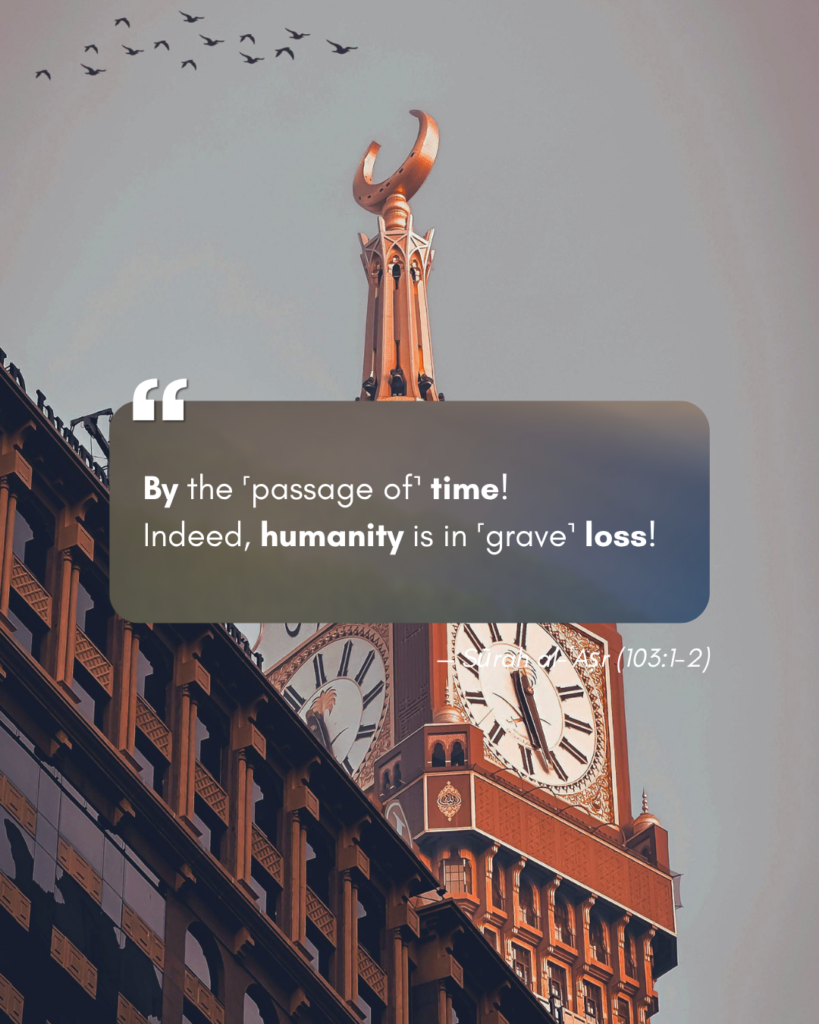
“By the ˹passage of˺ time! Indeed, humanity is in ˹grave˺ loss, except those who believe and do righteous deeds, and urge one another to truth, and urge one another to patience.”
— Sūrah al-ʿAṣr (103:1-3)
Every word in these three verses is load-bearing. Nothing is decorative. Nothing can be removed. The sūrah begins with an oath, delivers a universal verdict, and then lists the four conditions of salvation, not as optional virtues, but as the only available path out of the loss into which every human being is born.
The Oath: By the Passage of Time
The sūrah opens with a single word: Wa al-ʿAṣr. By time. By the age. By the pressing of the afternoon. The word al-ʿaṣr carries in Arabic the sense of something being squeezed, the juice extracted from fruit, the last portion of the day being wrung out before sunset. Time is the press through which every life is squeezed. It cannot be held. It cannot be slowed. It can only be spent, and every moment that passes is a moment that will never return.
Al-Imām Ibn Jarīr al-Ṭabarī, raḥimahullāh, records that Allāh swears by time itself, the entire passage of the ages, the succession of day and night, the lifetime of every soul.
— Tafsīr al-Ṭabarī, Sūrah al-ʿAṣr, āyah 1
Al-Ḥāfiẓ Ibn Kathīr, raḥimahullāh, adds that this is the time in which all human deeds occur, the arena of action and accountability, and that Allāh swears by it precisely because it is the capital that every human being is squandering.
— Tafsīr al-Qurʾān al-ʿAẓīm, Sūrah al-ʿAṣr, āyah 1
The oath by time is not random. Allāh swears by the very thing that is slipping away, the thing that every person feels disappearing but cannot stop. The oath itself is a warning before the verdict is even spoken.
The Verdict: Mankind Is in Loss
Immediately after the oath, the sūrah delivers its verdict. There is no delay, no softening, no qualification.
Inna al-insāna la-fī khusr.
“Indeed, mankind is in loss.”
— Sūrah al-ʿAṣr (103:2)
The word khusr is not merely a loss in the sense of missing out on something extra. It is the loss of capital. It is the trader who started with everything and ended with nothing. It is the soul who was given a lifetime and spent it on what does not remain. The emphatic particle la makes the verdict absolute. Mankind is not merely at risk of loss. Mankind is drowning in it.
Imām al-Ṭabarī, raḥimahullāh, explains that khusr here is the loss of one’s share in the mercy of Allāh, the wasting of one’s life in disobedience and heedlessness. Every human being begins with the capital of a soul, a lifespan, a fitrah that knows its Lord. And every human being, by default, is spending that capital on what perishes.
— Tafsīr al-Ṭabarī, Sūrah al-ʿAṣr, āyah 2
The sentence is grammatically complete. It could end there, and the sūrah would be a terrifying message with no way out. But Allāh, Al-Hādī, the Guide, does not leave us in the verdict.
The Exception: Four Conditions of Salvation
Without a pause, without even a conjunction of delay like thumma (then) or fa (so), the sūrah opens the door:
Illā alladhīna āmanū wa ʿamilū aṣ-ṣāliḥāti wa tawāṣaw bil-ḥaqqi wa tawāṣaw bi-aṣ-ṣabr.
“Except those who believe and do righteous deeds, and urge one another to truth, and urge one another to patience.”
— Sūrah al-ʿAṣr (103:3)
The word illā, meaning “except,” is the rope thrown into the well at the exact moment the fall is declared. The verdict is universal. The exception is specific. And it rests on four pillars, each one carrying the next. These four are not descriptions of people who were never in loss. They are the path by which the lost are rescued.
1. Īmān: Belief That Is Replenished
The first condition is āmanū, they believe. But the īmān that saves is not a single profession that fades into passivity. It is a living, replenished reality that must be fed and renewed.
Allāh commands the believers in Sūrah al-Nisāʾ:
Yā ayyuhā alladhīna āmanū, āminū.
“O you who believed, believe…”
— Sūrah al-Nisāʾ (4:136)
The believers are already believers, yet they are commanded to believe again. This is because īmān is not a static possession. It increases and decreases. It requires ongoing renewal through knowledge, reflection, and obedience. The Ṣaḥābah, raḍiya Allāhu ʿanhum, understood this deeply. Muʿādh ibn Jabal, raḍiya Allāhu ʿanhu, would say, “Come, let us believe for an hour,” and they would sit together in remembrance of Allāh.
— Ṣaḥīḥ al-Bukhārī 1/10, Kitāb al-Īmān
Their īmān was never taken for granted. It was constantly replenished.
Rasūlullāh ﷺ also taught the means of this renewal:
“Renew your īmān.” It was said, “O Messenger of Allāh, how do we renew our īmān?” He said, “Say abundantly: Lā ilāha illā Allāh.”
— Musnad Aḥmad, ḥadīth no. 8710; graded ṣaḥīḥ by Shaykh al-Albānī in Ṣaḥīḥ al-Jāmiʿ, no. 2617
The īmān that rescues from loss is the īmān that lives on the tongue and in the heart, constantly renewed by dhikr. And this īmān benefits only the one who carries it. Allāh says:
Man yaʿmal ṣāliḥan fa-li-nafsihī.
“Whoever does righteousness does so for his own soul.”
— Sūrah al-Jāthiyah (45:15)
The believer’s īmān does not add to the majesty of Allāh, just as the disbeliever’s rejection does not diminish it. It is the soul’s only asset, and without it the soul is bankrupt.
The detailed discussion regarding not just īmān but also the Kalimah is explored in the article “Lā Ilāha Illallāh – Negating the World, Affirming the Ghayb“
2. ʿAmal Ṣāliḥ: Deeds That Prove the Belief and Fix the Relationship
The second condition is ʿamilū aṣ-ṣāliḥāti, righteous deeds. The word ṣāliḥāt comes from the root ṣa-la-ḥa, which literally means to fix, to mend, to set right something that has been corrupted. A righteous deed is called ṣāliḥ because it fixes the broken relationship between the servant and his Lord.
— This linguistic insight is taught by Shaykh Abu Bakr Zoud.
This is why Rasūlullāh ﷺ advised that after committing a wrongdoing, one should immediately follow it with a righteous deed. The sin fractures the relationship. The ʿamal ṣāliḥ is the immediate repair. He ﷺ said:
“Fear Allāh wherever you are, and follow up a bad deed with a good deed — it will wipe it out. And treat people with good character.”
— Jāmiʿ al-Tirmidhī, Abwāb al-Birr wa al-Ṣilah, Bāb mā jāʾa fī muʿāsharat al-nās, ḥadīth no. 1987; graded ḥasan ṣaḥīḥ by Shaykh al-Albānī
Even without a specific wrongdoing, the servant is called to draw near and strengthen the relationship through voluntary deeds. The ultimate expression of this is found in the Hadith Qudsi, where Allāh describes the journey of a servant who fixes and strengthens his bond with his Lord until it reaches the highest station:
“My servant does not draw near to Me with anything more beloved to Me than the religious duties I have obligated upon him. And My servant continues to draw near to Me with voluntary deeds until I love him. And when I love him, I am his hearing with which he hears, his seeing with which he sees, his hand with which he strikes, and his foot with which he walks. If he asks Me, I will surely give him, and if he seeks refuge in Me, I will surely grant him refuge.”
— Ṣaḥīḥ al-Bukhārī, Kitāb al-Riqāq, Bāb al-Tawāḍuʿ, ḥadīth no. 6502
This is the reality of ʿamal ṣāliḥ. It is the active, ongoing mending of the bond between the ʿabd and his Lord. Every prayer, every act of charity, every restraint of the tongue from foul speech is a repair to a relationship strained by heedlessness and sin. The one who does not strive to fix this relationship through deeds is the one described by the sūrah as being in khusr, not because Allāh is distant, but because the servant has chosen not to mend what he himself has broken.
3. Tawāṣaw bil-Ḥaqq: Mutual Urging to the Ultimate Truth
The third condition turns outward. Salvation is not a private affair. The believer must be embedded in a community of mutual reminding, urging one another to the truth. The word tawāṣaw is from waṣiyyah, a solemn exhortation, a parting counsel, the kind of word a dying man leaves to his children because nothing is more urgent.
And the truth they urge one another to is not just any truth. It is Al-Ḥaqq, the Ultimate Truth. Al-Ḥaqq is one of the Names of Allāh. He is the Truth, and what He has revealed is the truth.
“That is because Allāh is the Truth, and what they invoke besides Him is falsehood.”
— Sūrah al-Ḥajj (22:62)
To urge one another to Al-Ḥaqq is to urge one another to Allāh Himself, to His tawḥīd, to His obedience, to His remembrance, and to every word He has sent down. It is a mutual calling to the very foundation of existence.
Rasūlullāh ﷺ said:
“Convey from me, even if it is one verse.”
— Ṣaḥīḥ al-Bukhārī, Kitāb Aḥādīth al-Anbiyāʾ, Bāb mā dhukira ʿan Banī Isrāʾīl, ḥadīth no. 3461
The believer does not hoard the truth. He speaks it. He urges it upon those he loves. He receives it from those who love him. This is the daʿwah that every soul is commanded to carry, and it is the shield against the solitary decay of īmān. The one who isolates himself from the community of truth will slowly stop seeing the truth altogether.
This act of urging to truth is the essence of daʿwah, and the immense reward of this trade is explored in the article “The Best Tijārah – Why the Ṣaḥābah Left Makkah.”
The Ṣaḥābah, raḍiya Allāhu ʿanhum, modelled this. When one of them saw another slipping, he did not remain silent. He reminded, he urged, he counselled. Their brotherhood was not social. It was salvific. They understood that the mutual urging to truth was not a recommendation. It was a condition of their own survival.
4. Tawāṣaw bi-aṣ-Ṣabr: Mutual Urging to Patience
The fourth condition is patience. Truth cannot be held without patience. Daʿwah cannot be given without patience. The tongue cannot be restrained, the prayer cannot be maintained, the dunyā cannot be resisted, except through patience. And like truth, patience must be mutual. The believer who tries to be patient alone may eventually break. The believer who is surrounded by others urging him to patience will endure.
Allāh speaks at length about patience in Sūrah al-Baqarah. He begins with a declaration that strikes the heart with both warning and hope:
“And We will surely test you with something of fear and hunger and loss of wealth and lives and fruits. But give glad tidings to the patient.”
— Sūrah al-Baqarah (2:155)
The five tests are promised by the Lord of the worlds. They are not random. They are not signs of abandonment. They are the curriculum of the believer. And just when the heart might sink at the mention of them, Allāh says, Wa bashshir, give glad tidings. The tidings are for the ṣābirīn, those who are patient. And Allāh then describes who they are:
“Those who, when a calamity strikes them, say: Indeed, we belong to Allāh, and indeed to Him we will return.”
— Sūrah al-Baqarah (2:156)
The patient ones are those whose tongues are already trained in istirjāʿ. They do not wait for the calamity to decide their response. Their statement is ready because their hearts know where they came from and where they are going. These verses, and the promise that follows them, have been unpacked in full in the article “From Calamity to Glad Tidings: The Promise of Allāh.”
The mutual urging to patience is the community practising istirjāʿ together, reminding one another that the calamity is from Him and the return is to Him.
Rasūlullāh ﷺ taught the specific duʿāʾ that turns calamity into a door:
“There is no Muslim who is afflicted with a calamity and says what Allāh has commanded him: Innā lillāhi wa innā ilayhi rājiʿūn, Allāhumma ajirnī fī muṣībatī wa akhlif lī khayran minhā, except that Allāh will grant him something better.”
— Ṣaḥīḥ Muslim, Kitāb al-Janāʾiz, Bāb mā yuqālu ʿinda al-muṣībah, ḥadīth no. 918
Patience is not silence. It is a statement, a prayer, a turning. And it is strengthened when the believer hears it from the lips of another. This is the mutual urging that the sūrah commands.
Time is pressing and mankind is in loss. The four conditions are the only rope. What remains is to ask the One who swore by time to make us among those who grasp it.
We ask You, Yā Ḥaqq, Yā Hādī, Yā Karīm, Yā Rabbi al-ʿĀlamīn, to make us among those who believe, who do righteous deeds, who urge one another to the Ultimate Truth, and who urge one another to patience. Do not let our time slip away in heedlessness. Do not let us be among those who are in loss. Make this sūrah a living reality in our hearts, and make it a witness for us on the Day when neither wealth nor children will avail. Amīn yā Rabb al-ʿĀlamīn, bi-raḥmatika yā Arḥam ar-Rāḥimīn.