The Kalimah (Lā Ilāha Illallāh) is not just a statement we utter. It is a complete worldview. A perceptual reset. A declaration that reorients everything.
It begins with negation: Lā Ilāha – There is no god.
And then affirmation: Illallāh – Except Allāh.
What are you negating?
Let the question settle.
Allāh answers in Sūrah al-Insān:
“˹For˺ indeed, We ˹alone˺ created humans from a drop of mixed fluids, ˹in order˺ to test them, so We made them hear and see.”
— Sūrah al-Insān (76:2)
Notice the structure. Allāh mentions the test (nabtalīhi). Then immediately, with the letter Fā (which in Arabic indicates immediacy), He says: fa ja’alnāhu samī’an baṣīrā – so We made him hearing and seeing.
The test is not separate from perception. Perception is the platform of the test. The test is conducted through what you hear and see. The test is: what do you do with what you hear and see? Do you believe what your eyes tell you, or do you believe what Allāh has told you about what your eyes see?
So you are negating the perceived world as an authority over truth – not its existence, but its right to sit in judgment over what Allāh has said. Your senses. Your own perception. The consensus of the crowd. The power of tyrants. The beauty of the world. None of these are reliable. None of these can be the ground of your certainty.
Now the question arises: if you cannot trust your senses, then who do you trust? If the outward world is unreliable, where do you turn?
You turn inward.
Ibn Al-Qayyim (rahimahullāh) said:
“He who knows himself, knows his Lord.”
The journey inward is the answer. When you strip away the illusions of the perceived world, when you stop relying on your eyes and ears as the ultimate judges of truth, you are left with something deeper. You are left with the fitrah. But the fitrah, while innate, is guided, corrected, and confirmed by revelation – it does not stand alone as its own authority. You are left with the innate recognition that there is a Creator, that this world cannot be all there is, that your perception is limited and your senses are finite.
And what does Fir’awn say?
He stood on his throne and said:
“Am I not the king of Egypt? And these rivers flow beneath me.”
Meaning: I feed you. I provide for you. Ana Rabbukum al-A’lā – I am your Lord, the Most High. Ma’ādh Allāh.
Then he asked:
“Afalā tubṣirūn?” – Do you not see?
Look at my power. Look at my rivers. Look at my armies. Seeing is believing.
He demanded that belief be based on sight. This is from the foundations of kufr. Elevating the perceived world to the status of ultimate truth. Measuring Allāh’s statement against what the eyes see.
The basis of īmān is the opposite. Believing is seeing. You take Qawl Allāh (the statement of Allāh) and Qawl Rasūlillāh ﷺ as the absolute criterion, and you measure everything you see against that. You negate the perceived world. You negate whatever does not match what Allāh and His Messenger have said.
And this is why Allāh shatters the tyranny of means. Consider Mūsā ‘alaihissalam. Allāh asked him:
“And what is that in your right hand, O Mūsā?”
— Sūrah Ṭā Hā (20:17)
He said:
“It is my staff! I lean on it, and with it I beat down ˹branches˺ for my sheep, and have other uses for it.”
— Sūrah Ṭā Hā (20:18)
A staff. A stick. A means. But Allāh said:
“Throw it down, O Mūsā.”
— Sūrah Ṭā Hā (20:19)
So he threw it down, and behold, it became a snake, moving quickly.
Allāh took a simple staff – a means – and transformed it into a miracle. The staff did nothing on its own. It was Allāh who moved through it.
And consider Ibrāhīm ‘alaihissalam. He was thrown into a massive fire. The fire was a means of destruction. But Allāh commanded:
“O fire! Be cool and safe for Ibrāhīm!”
— Sūrah al-Anbiyā’ (21:69)
The fire did not burn. The means did not operate according to its nature. Because the One who controls the means is above the means.
This is the test. Will you see the staff and say, “This is just a stick”? Or will you see the staff and say, “Allāh can make it a snake”? Will you see the fire and say, “This will burn me”? Or will you see the fire and say, “Allāh can make it cool”?
The believer sees beyond the means to the One who wields them. The kāfir stops at the means and worships them.
And that means what you are affirming is the Ghayb (the Unseen) – the reality that Allāh and His Messenger have told you about, which your eyes cannot see but your heart knows is true. You are affirming that Allāh alone is Al-Ḥaqq (the Truth), and that His statement is the only criterion.
Allāh says:
“That is because Allāh is the Truth, and that which they call upon besides Him is falsehood.”
— Sūrah Luqmān (31:30)
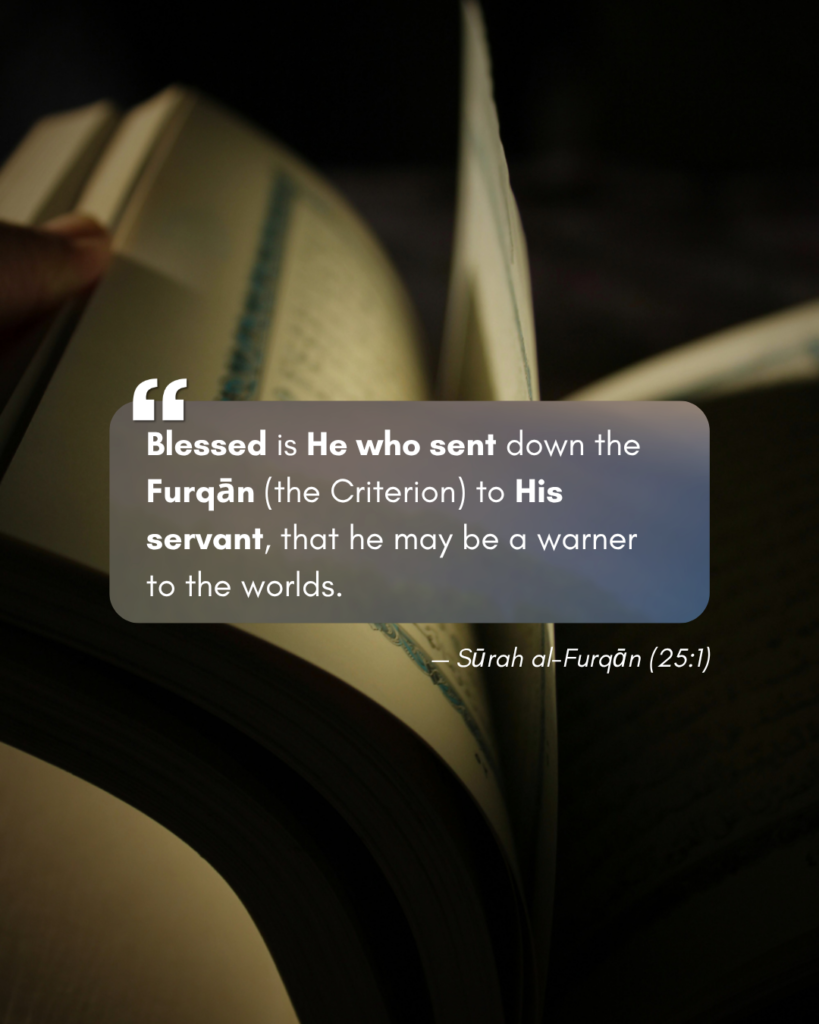
And Allāh calls the Qur’ān Al-Furqān – the Criterion that distinguishes right from wrong:
“Blessed is He who sent down the Furqān (the Criterion) to His servant, that he may be a warner to the worlds.”
— Sūrah al-Furqān (25:1)
The Qur’ān is not just a book of guidance. It is the scale. It is the judge. Everything else – every claim, every perception, every ideology – must be weighed against it. What matches it is truth. What contradicts it is falsehood, no matter how beautiful it appears.
The Two Pillars of the Kalimah
The Kalimah has two parts. Each part leads to a distinct spiritual station.
Lā Ilāha Illallāh leads to Inābah – turning back to Allāh in repentance, dependence, and devotion. You negate the perceived world, and you turn inward. You turn to Him alone. And Inābah leads to Īmān. Because the one who turns to Allāh, who relies on Him, who submits to His Furqān – that is the one whose faith is sound.
Muḥammadun Rasūlullāh leads to Niyābah – representing the Messenger ﷺ. The Ṣaḥābah used to say:
“Innī Rasūlu Rasūlillāhi ilaykum”
I am the messenger of the Messenger of Allāh
When you understand that you represent Rasūlullāh ﷺ, you learn how he was. What he would do. How he would do it. You study his life. You internalize his character. You try to follow him as best as you can. And that path of following – of representing – leads to Taqwā.
Notice the beautiful connection: Tawḥīd leads to Inābah which leads to Īmān. And following the Messenger leads to Niyābah which leads to Taqwā. The Kalimah trains both: your relationship with Allāh (negation and affirmation of the Ghayb) and your relationship with the Messenger (following and representing).
The scholars explain that Īmān and Ikhlāṣ are inseparable. You cannot have one without the other. The one who truly believes is the one who is sincere. And the one who is sincere is the one who truly believes.
Sincerity means purifying your perception. Not relying on your own eyes, your own desires, your own judgment. But relying solely on Allāh and His Messenger. Doing what pleases Him, even when your eyes tell you something else.
The Constant Return
This is not a one-time declaration. It is a constant return. The du’ā of the Prophet ﷺ captures this perfectly:
“Yā Muqallib al-qulūb, thabbit qalbī ‘alā dīnik.”
O Turner of hearts, keep my heart firm upon Your religion.
— Ṣaḥīḥ Muslim (2655)
And the meaning of another du’ā echoes the same need:
“Rabbanā lā takilnā ilā anfusinā ṭarfata ‘ayn.”
Our Lord, do not leave us to ourselves, even for the blink of an eye.
— Abu Dawud 4/324, Ahmad 5/42. Al-Albani graded it as good in Sahih Abu Dawud 3/959.
Because the moment Allāh leaves us to our own perception, to our own desires, to our own judgment – we will fail. We will look at the world and be deceived. We will see the tyrant’s power and tremble. We will see the false paradise and be tempted.
The Kalimah is your constant anchor back to the Ghayb. It is the perpetual reminder that nothing in this perceived world is worthy of your ultimate trust, your ultimate fear, or your ultimate hope. Only Allāh. And only what He and His Messenger ﷺ have said.
Why This Matters
Every day, we are bombarded with messages that tell us to trust what we see. The news says this is true. The algorithm says this is important. The powerful say, “Do you not see our success? Do you not see our strength?”
The Kalimah is your shield. It is the constant negation of the perceived world. And the constant affirmation that the Ghayb is the only reality worth building your life upon.
The one who truly internalizes Lā Ilāha Illallāh will stand on the Platform of Perception and pass the test. Because when the world shows him a desert, he trusts Allāh’s promise of water. When the world shows him a prison, he trusts Allāh’s plan for a palace. When the world shows him a tyrant, he says: “I do not see with your eyes. I see with the light Allāh has given me through His Furqān and through the example of His Messenger.”
He does not rely on himself for even a blink of an eye. He relies on Allāh. And he affirms Illallāh with every breath.
This article develops and expands upon themes discussed by Ousama Alshurafa, particularly regarding the Kalimah, perception, and the test of īmān. You can watch his talk referenced below.
For a deeper exploration of how perception itself is the platform of the test, how the basis of īmān is “believing is seeing” and the basis of kufr is “seeing is believing,” and how the stories of Hajar, Yūsuf, and Sūrah al-Kahf train the believer to see through illusion, read the full book for free at:
🔗 https://www.pathstopurity.org/the-platform/
Password: Alhamdulillah