There is a question in the Qur’ān that every soul will hear on the Day of Judgment. But it is also a question that reaches into the darkest corners of the heart right now, in this life, when the weight of sin feels too heavy and the voice of regret whispers that it is already too late.
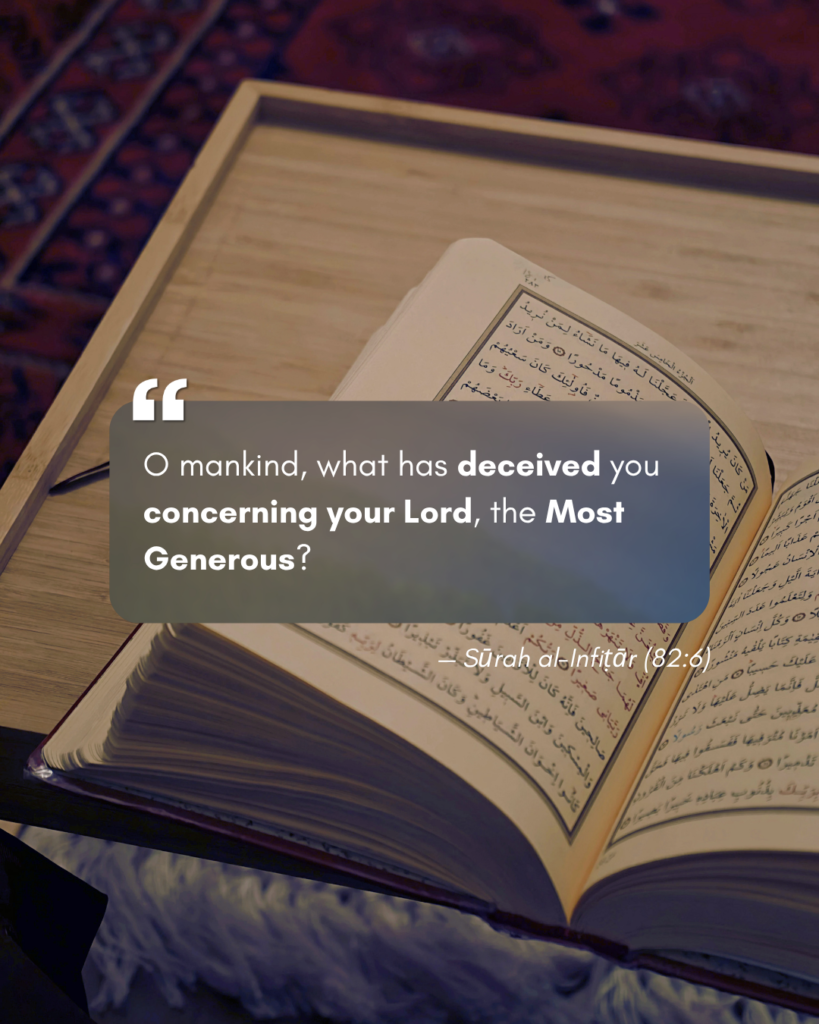
Yā ayyuhā al-insānu mā gharraka bi-Rabbika al-Karīm.
“O mankind, what has deceived you concerning your Lord, the Most Generous?”
— Sūrah al-Infiṭār (82:6)
The question is not asked by an angry judge. It is asked by Al-Karīm, the Most Generous, the One whose giving never stops, whose mercy is the default, whose forgiveness is not a limited resource that runs out. And the deception He asks about is not the arrogance of the one who thinks he does not need his Lord. It is the deception of the one who thinks his Lord does not want him back.
Shayṭān has a single, devastating lie that he whispers into the ear of every sinner: You are too far gone. You have done too much. He will not forgive you. Do not even try. This is the deception. This is the veil that Al-Karīm is asking about. What made you think My generosity has a limit? What made you believe My mercy would turn you away? Who told you that you were beyond the reach of Al-Ghafūr, Al-Raḥīm?
The Man Who Killed a Hundred Souls
There was a man among the Children of Israel who had killed ninety-nine people. His hands were soaked in blood. His soul was heavy with the weight of what he had done. And yet, something stirred in him. A desire to change. A hope, however faint, that perhaps there was a way back.
He went to a worshipper and asked, “Is there any repentance for me?” The worshipper, perhaps in his piety, could not fathom mercy that wide. He said, “No.” So the man killed him too, making it a hundred.
But the desire to repent did not die with that hundredth murder. It grew stronger. He went to a scholar and asked the same question: “Is there any repentance for me?” The scholar said, “Who can stand between you and repentance? Go to such-and-such a land, for there are people there who worship Allāh. Worship Allāh with them, and do not return to your land, for it is an evil land.”
The man set out. He took a step. Halfway on the journey, death came to him. The angels of mercy and the angels of punishment disputed over his soul. Allāh sent an angel to settle the dispute. He said: “Measure the distance between the two lands. To whichever he is closer, he belongs to its people.”
They measured the distance. They found that he was closer to the land of repentance by a single handspan. And Allāh, Al-Karīm, pulled him forward. He was forgiven.
“The angels of mercy took his soul.”
— Ṣaḥīḥ al-Bukhārī, Kitāb Aḥādīth al-Anbiyāʾ, Bāb ḥadīth al-ghār, ḥadīth no. 3470; Ṣaḥīḥ Muslim, Kitāb al-Tawbah, Bāb qubūl tawbat al-qātil wa in kathura qatlu, ḥadīth no. 2766
Ninety-nine lives, then a hundredth. And still, he was not turned away. Because the generosity of Al-Karīm does not have a threshold beyond which it stops. The only thing required is a step. A single, trembling step toward Him. And He takes it from there.
What Has Deceived You Concerning Your Lord?
The man who killed a hundred souls is not an exception. He is a witness. His story was preserved so that no believer would ever believe the lie that his sins are too great for his Lord.
Rasūlullāh ﷺ said, conveying the words of his Lord:
“O son of Adam, if your sins were to reach the clouds of the sky, and then you sought My forgiveness, I would forgive you and I would not mind.”
— Jāmiʿ al-Tirmidhī, Abwāb al-Daʿawāt, Bāb fī faḍl al-istighfār, ḥadīth no. 3540; graded ḥasan by Shaykh al-Albānī
And in another Hadith Qudsi, Allāh says:
“I am just as My slave thinks I am.”
— Ṣaḥīḥ al-Bukhārī, Kitāb al-Tawḥīd, ḥadīth no. 7405
Think well of your Lord. He is not waiting to catch you out. He is not looking for reasons to punish. He is Al-Karīm. He is Al-Ghafūr. He is Ar-Raḥīm. Your good opinion of Him is itself an act of worship that opens the doors of His mercy.
And every single night, when the world is asleep and the darkness covers the earth, the Lord of the heavens descends to the lowest heaven in a manner befitting His majesty, and He calls out:
“Who is calling upon Me, that I may answer him? Who is asking of Me, that I may give him? Who is seeking My forgiveness, that I may forgive him?”
— Ṣaḥīḥ al-Bukhārī, Kitāb al-Tahajjud, Bāb al-duʿāʾ fī ṣalāt al-layl, ḥadīth no. 1145; Ṣaḥīḥ Muslim, Kitāb Ṣalāt al-Musāfirīn, Bāb al-targhīb fī al-duʿāʾ wa al-dhikr fī ākhir al-layl, ḥadīth no. 758
Every night. Without exception. The same question, the same open door. The same gentle Lord asking the same sinners to come back. And He is not merely willing to forgive. He is shy to turn away a servant who raises his hands to Him.
Rasūlullāh ﷺ said:
“Your Lord is characterized by modesty and generosity. He is too shy, when His servant raises his hands to Him, to return them empty.”
— Sunan Abī Dāwūd, Kitāb al-Ṣalāh, Bāb al-duʿāʾ, ḥadīth no. 1488; graded ṣaḥīḥ by Shaykh al-Albānī
What has deceived you about this Lord? What made you think He would not take you back?
The Verse That Shatters Every Despair
And if all of this is not enough, there is a verse that Allāh revealed specifically for the one who thinks he has gone too far. It is not for the righteous who never slipped. It is for the one who looks at his past and sees wreckage.
Qul yā ʿibādi alladhīna asrafū ʿalā anfusihim lā taqnaṭū min raḥmatillāh. Inna Allāha yaghfiru adh-dhunūba jamīʿā. Innahu huwa al-Ghafūru ar-Raḥīm.
“Say: O My servants who have transgressed against themselves, do not despair of the mercy of Allāh. Indeed, Allāh forgives all sins. Indeed, it is He who is the Forgiving, the Merciful.”
— Sūrah al-Zumar (39:53)
Look at the address: Yā ʿibādī. O My servants. He still calls you His servant. He did not say “O criminals.” He did not say “O sinners.” He said, “O My servants.” The relationship is not broken. The door is not locked. He is still your Lord, and you are still His ʿabd.
And the command is absolute: Lā taqnaṭū. Do not despair. Despair is not from Allāh. Despair is the final victory of Shayṭān. The one who despairs has believed the lie. The one who hopes has believed his Lord.
Turn Back Now
So turn back now. Not tomorrow. Not after you fix yourself. Not when you feel worthy. You will never feel worthy. That is the point. The worthiness comes from Him, not from you. The step you take toward Him is the only worthiness He requires.
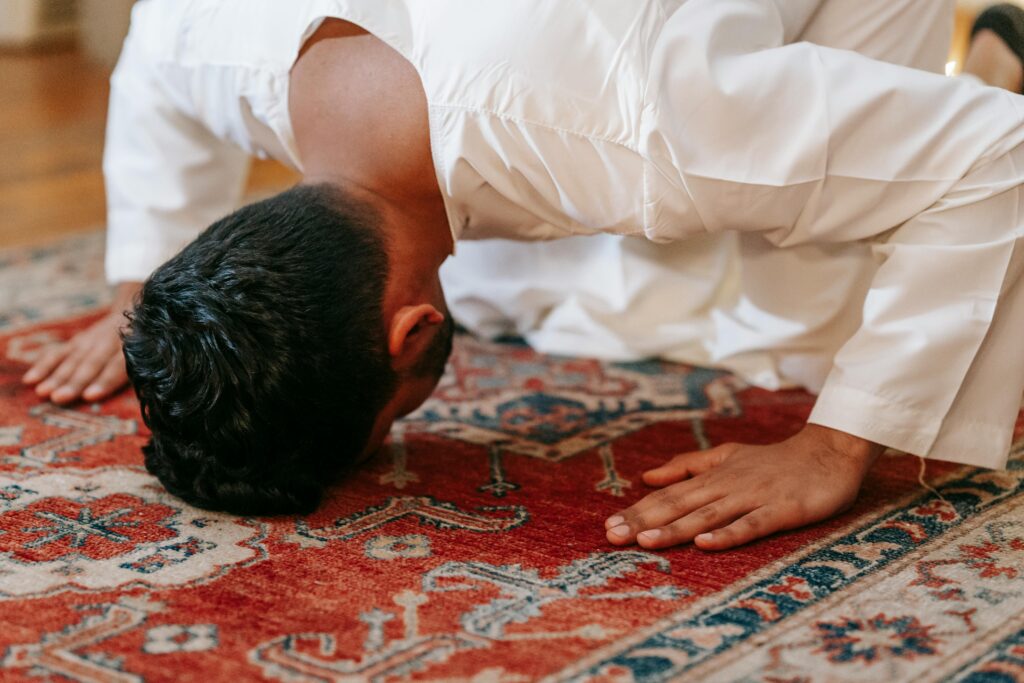
Start small. Start with ṣalāh. The first thing you will be asked about on the Day of Judgment is your prayer. Let it be the first thing you return to now.
Rasūlullāh ﷺ said:
“The first thing for which a servant will be brought to account on the Day of Resurrection is his ṣalāh. If it is sound, then the rest of his deeds will be sound. If it is corrupt, then the rest of his deeds will be corrupt.”
— Sunan al-Tirmidhī, Abwāb al-Ṣalāh, Bāb mā jāʾa fī anna awwala mā yuḥāsabu bihi al-ʿabd yawm al-qiyāmah al-ṣalāh, ḥadīth no. 413; graded ṣaḥīḥ by Shaykh al-Albānī in Ṣaḥīḥ al-Tirmidhī
It only takes a few minutes. Five times a day. A standing before your Lord that realigns everything else. Do not let the weight of your past keep you from those few minutes. The same Lord who forgave a murderer of a hundred souls will hold your hand as you learn to pray again. He will meet your stumbling with His mercy. He will meet your inconsistency with His patience.
And know that when you take one step toward Him, He takes more toward you than you can imagine. Rasūlullāh ﷺ said:
“Allāh says: Whoever draws near to Me by a handspan, I draw near to him by an arm’s length. Whoever draws near to Me by an arm’s length, I draw near to him by a fathom’s length. And whoever comes to Me walking, I come to him running.”
— Ṣaḥīḥ al-Bukhārī, Kitāb al-Tawḥīd, Bāb qawl Allāh taʿālā wa yuḥadhdhirukum Allāhu nafsahu, ḥadīth no. 7405; Ṣaḥīḥ Muslim, Kitāb al-Dhikr wa al-Duʿāʾ, Bāb al-ḥathth ʿalā dhikr Allāh, ḥadīth no. 2675
Your step matters. No matter how small. No matter how weak. The direction is what counts. And the direction is toward Him.
So turn back now, before the sun rises from the west. Turn back now, before the soul reaches the throat. Turn back now, while your gentle Lord is still asking, “Who deceived you, My servant, about My generosity?” Turn back now, and do not despair in the mercy of your Lord, Al-Ghafūr, Ar-Raḥīm.
The door is open. The night call is still sounding. And Al-Karīm has not stopped waiting.
We ask You, Yā Karīm, Yā Ghafūr, Yā Raḥmān, Yā Ḥayy, Yā Qayyūm, to turn our hearts back to You. Lift from us the lie that we are too far gone. Let us hear Your call in the last third of the night and rise to meet it. Fix our ṣalāh. Make it the anchor of our return. And when we meet You, let us meet You with sins like mountains, but with a good opinion of You, trusting that Your mercy will swallow every mountain and leave nothing behind. Amīn yā Rabb al-ʿĀlamīn, bi-raḥmatika yā Arḥam ar-Rāḥimīn.