Allāh ʿazza wa jall asks the believers a question that should stop every one of us in our tracks:
“Who is better in speech than one who calls to Allāh, does righteousness, and says, ‘Indeed, I am among the Muslims’?”
— Sūrah Fuṣṣilat (41:33)
No one. There is no one better in speech than the one who calls to Allāh.
And in Sūrah aṣ-Ṣaff, Allāh reveals the reward for this call:
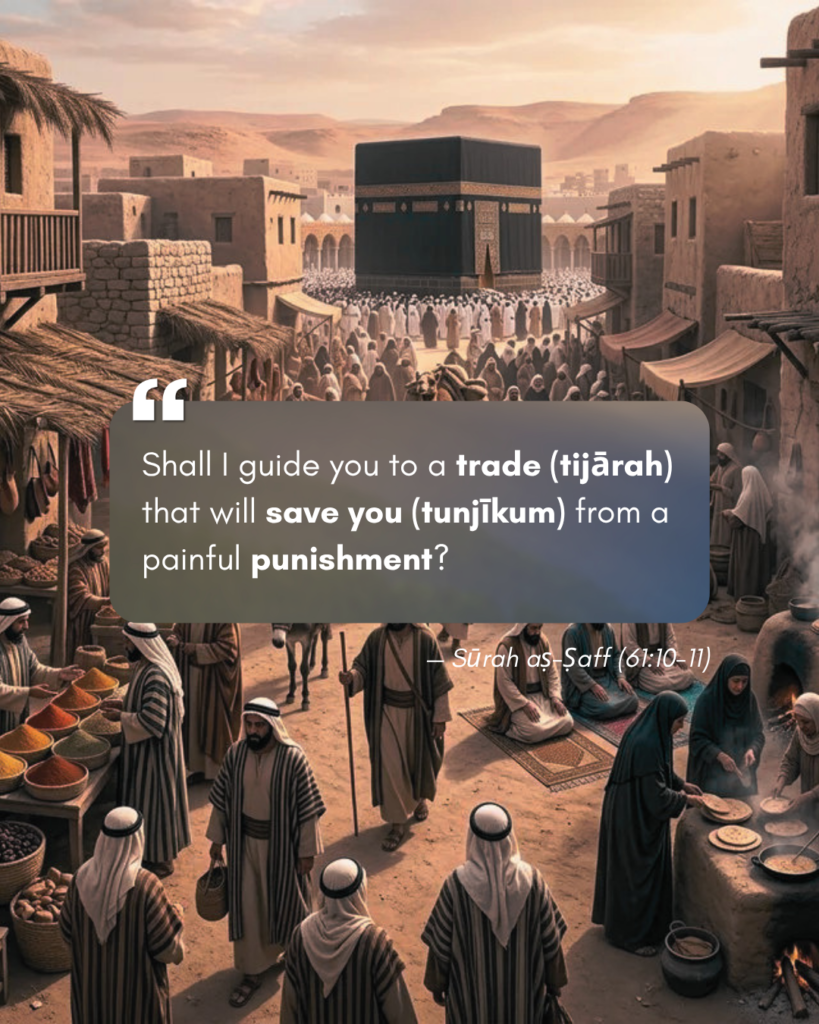
“O you who believe! Shall I guide you to a trade (tijārah) that will save you (tunjīkum) from a painful punishment? That you believe in Allāh and His Messenger, and strive (tujāhidūna) in the path of Allāh (fī sabīlillāh) with your wealth (amwālikum) and your lives (anfusikum). That is better for you, if only you knew.”
— Sūrah aṣ-Ṣaff (61:10-11)
Tijārah. Trade. Commerce. An exchange. In this world, trade is about risk and return. You invest capital. You hope for profit. But here, Allāh offers a trade with guaranteed returns. No loss. No bankruptcy. Only salvation.
And what is the capital of this trade? Īmān, belief in Allāh and His Messenger. And jihād, striving in His path with your wealth (amwālikum) and your lives (anfusikum).
But what does jihād mean here? It is not only the battlefield. Among the greatest forms of jihād today is jihād of da’wah. Conveying the message. Calling people to Allāh. Striving against falsehood with truth, against ignorance with knowledge, against deception with clarity.
The Ṣaḥābah Understood This Trade
Consider this. According to scholars such as al-Suyuti, the Ṣaḥābah numbered around 124,000. But at the conquest of Makkah, only about 10,000 were present. Where were the rest?
They were scattered across the earth. In Yemen. In Bahrain. In Syria. In Egypt. In Persia. They had left the blessed city of Makkah, where one ṣalāh in Masjid al-Ḥarām is equivalent to 100,000 prayers elsewhere, to live among tribes who did not know Allāh. To teach. To call. To strive. To die.
Why would they leave such reward?
Because they understood something we have forgotten. Da’wah is the best of trades. Striving in the path of Allāh, even if it means leaving the holiest place on earth, is better than staying in comfort.
And they knew that in this trade, even death is not a loss. It is shahādah. Martyrdom. The ultimate profit.
From Hukm to Ḥikmah – The Prophetic Way of Calling
If you ask someone, “What is the ruling (hukm) for the one who abandons the ṣalāh?” they will likely answer, “Kāfir.” And that may be the legal ruling.
But if you ask someone who has been touched by gentleness, he will say:
“I will take them with me to the masjid.”
This is not hukm. This is ḥikmah. Wisdom. And interestingly, both words come from the same root. The Qur’ān tells the story of the People of the Cave, and when they sent one of them to the city, Allāh instructed:
“Let him be gentle (wal-yatalattaf).”
— Sūrah al-Kahf (18:19)
Gentleness. Subtlety. Kindness in approach.
The ruling tells you where the line is. But wisdom tells you how to bring someone back across it. The Ṣaḥābah did not just know the hukm. They embodied the ḥikmah. They left Makkah not to condemn those who did not pray, but to call them. To walk with them. To sit with them. To pray beside them.
This is what Allāh meant by the best trade. You do not push people away. You draw them close. You strive with your wealth and your life, yes, but the first striving is with your heart: gentleness, patience, and the courage to say, “Come with me.”
Commanding Good and Forbidding Evil – The Two Wings of Da’wah
And Allāh commands the believers:
“Let there be from you a nation calling to good, commanding what is right, and forbidding what is wrong. And it is they who are successful.”
— Sūrah Āli ‘Imrān (3:104)
Da’wah is not only inviting people to truth. It is also forbidding falsehood. And what better truth to call to than Allāh Himself? What greater falsehood to forbid than shirk and disobedience? When you speak a word of truth to a wrongdoer, when you gently remind someone who has strayed, when you correct an injustice with your tongue, you are fulfilling nahy ʿan al-munkar. And this is part of the best trade.
Rasūlullāh ﷺ said:
“Whoever among you sees an evil, let him change it with his hand. If he is not able, then with his tongue. If he is not able, then with his heart, and that is the weakest of faith.”
— Ṣaḥīḥ Muslim (49)
Speaking the truth with your tongue is an act of jihād. It is striving with your life and your words. And it is all part of the trade that saves you from a painful punishment.
The Qa’idah of Multiplication
And here is the secret of this trade. The principle that Allāh built into the very fabric of da’wah. The generosity of Allāh that magnifies your small effort into something unimaginable.
Rasūlullāh ﷺ said:
“One who guides to something good has a reward similar to that of its doer.”
— Ṣaḥīḥ Muslim (1893), narrated by Abū Mas’ūd al-Ansārī
Think about that. If you remind someone to pray, and they start praying, you receive reward according to your khushū‘. But the one who guides, reminds, and brings that person back receives the full reward of those deeds, without any decrease from the one who performs them.
This is a qa’idah in the Qur’ān. It is not a random blessing. It is a deliberate structure. Why? Because of the efforts of Rasūlullāh ﷺ.
The Prophet ﷺ called people to Allāh for 23 years. He endured harm. He was rejected. He was wounded. And yet, every single person who embraces Islam until the end of time, every convert, every repentant sinner, every soul who says Lā Ilāha Illallāh, receives the reward of their own faith. But the Prophet ﷺ receives a reward equal to all of them. And it does not diminish their reward at all.
Allāh built this system to encourage da’wah. He wants you to know that your small word, your gentle reminder, your one shared verse can become the seed of a forest of deeds. And you will be rewarded for every leaf that grows.
The Obligation Continues
In previous nations, it was enough to simply worship Allāh. Allāh ʿazza wa jall says:
“I did not create jinn and mankind except to worship Me.”
— Sūrah adh-Dhāriyāt (51:56)
But for this Ummah, the final nation, our role carries a heavier trust. Rasūlullāh ﷺ is the seal of the prophets. There is no messenger after him. So the duty of carrying his message continues through us. Da’wah is not merely a noble act. It is a personal obligation upon every believer in some capacity.
The Prophet ﷺ said in his final sermon:
“Convey from me, even if it is a single verse.”
— Ṣaḥīḥ al-Bukhārī (3461)
This instruction was not for the elite or the learned alone. It was for the Ummah as a whole. Our silence cannot be an excuse when we carry even a word of truth.
For a deeper understanding of this sacred trust, read the full article:
The Trust of the Final Ummah – “Convey From Me, Even If It Is One Verse”
https://www.pathstopurity.org/the-trust-of-the-final-ummah/
May Allāh ʿazza wa jall make us of those who call to Him with wisdom and sincerity. May He accept our small efforts and magnify them by His mercy. May He grant us the reward of every soul He guides through us, and may He forgive us for the words we did not say when we should have said them.
And may He resurrect us with Rasūlullāh ﷺ and the Ṣaḥābah, those who left their homes, their wealth, their comfort for the sake of this trade, and make us among them in Jannah.
Āmīn yā Rabb al-‘Ālamīn.