﷽
Before there was a bush that burned without being consumed, before there was a staff that split the sea, before there was a mountain where a man heard Allāh speak to him directly, there was a young man sitting alone under a tree in a foreign land with nothing to eat and nowhere to go, doing the only thing he knew how to do: speaking to his Lord. It was the du’ā of Mūsā in Madyan.
The story of Mūsā ʿalayhissalām is not only the story of a Prophet. It is the story of a man who spoke to Allāh long before Allāh chose to speak back to him. And he did so, because turning to Allāh in difficulty was simply who he was.
This quality, repeated across every crisis of his life, is what prepared him for the moment when the One he had been speaking to all along chose to answer out loud. It is one of the reasons in my reflections behind why he became Kalīmullāh: the one whom Allāh spoke to directly.
A Man Shaped by Crisis
Mūsā ʿalayhissalām was born into a tyrant’s decree designed to kill him. By the grace of Allāh, he survived it. Through his mother’s faith, in a basket thrown in the river, and upon being collected by the wife of the tyrant himself. He grew up in the palace of the man who wanted him dead, with a tongue burned by a coal placed in his hand as an infant, in a household where acknowledging Allāh alone was treason against the state. This has been covered in the earlier article on the du’ā of Mūsā’s people.
By the time we meet him as a young man in Sūrah al-Qaṣaṣ, Mūsā ʿalayhissalām has already lived more crisis than most people see in a lifetime. What the sūrah now shows us is how he responds to each new one.
The Killing: His First Du’ā in Crisis
He went out into the city and found two men fighting: one from his own people and one Egyptian. The man from his people called for help. Mūsā ʿalayhissalām struck the Egyptian, and the blow was fatal.
وَدَخَلَ ٱلْمَدِينَةَ عَلَىٰ حِينِ غَفْلَةٍ مِّنْ أَهْلِهَا فَوَجَدَ فِيهَا رَجُلَيْنِ يَقْتَتِلَانِ هَـٰذَا مِن شِيعَتِهِۦ وَهَـٰذَا مِنْ عَدُوِّهِۦ ۖ فَٱسْتَغَـٰثَهُ ٱلَّذِى مِن شِيعَتِهِۦ عَلَى ٱلَّذِى مِنْ عَدُوِّهِۦ فَوَكَزَهُۥ مُوسَىٰ فَقَضَىٰ عَلَيْهِ ۖ قَالَ هَـٰذَا مِنْ عَمَلِ ٱلشَّيْطَـٰنِ ۖ إِنَّهُۥ عَدُوٌّ مُّضِلٌّ مُّبِينٌ
Wa dakhala al-madīnata ʿalā ḥīni ghaflatim-min ahlihā fa-wajada fīhā rajulayni yaqtatilāni hādhā min shīʿatihī wa hādhā min ʿaduwwih, fa-staghaṯahu alladhī min shīʿatihī ʿalā alladhī min ʿaduwwihī fa-wakazahu Mūsā fa-qaḍā ʿalayh. Qāla hādhā min ʿamalish-shayṭān, innahū ʿaduwwum-muḍillum-mubīn.
“And he entered the city at a time of inattention by its people and found therein two men fighting: one from his faction and one from among his enemy. And the one from his faction called for help to him against the one from his enemy, so Mūsā struck him and [unintentionally] killed him. [Mūsā] said, ‘This is from the work of Satan. Indeed, he is a manifest, misleading enemy.'”
— Sūrah al-Qaṣaṣ (28:15)
What happened immediately after is the first clear window into his character. He did not run first. He did not calculate first. He turned to Allāh first.
قَالَ رَبِّ إِنِّى ظَلَمْتُ نَفْسِى فَٱغْفِرْ لِى فَغَفَرَ لَهُۥٓ ۚ إِنَّهُۥ هُوَ ٱلْغَفُورُ ٱلرَّحِيمُ
Qāla Rabbi innī ẓalamtu nafsī faghfir lī, fa-ghafara lah. Innahū huwal-Ghafūrur-Raḥīm.
“He said, ‘My Lord, indeed I have wronged myself, so forgive me,’ and He forgave him. Indeed, He is the Forgiving, the Merciful.”
— Sūrah al-Qaṣaṣ (28:16)
Rabbi innī ẓalamtu nafsī faghfir lī. He named what he did as wrongdoing to his own soul and asked for forgiveness. And the response came immediately in the Qurʾān itself: fa-ghafara lah, and He forgave him.
Ibn Kathīr raḥimahullāh explains in his commentary on this āyah that Mūsā ʿalayhissalām made a resolution:
قَالَ رَبِّ بِمَآ أَنْعَمْتَ عَلَىَّ فَلَنْ أَكُونَ ظَهِيرًا لِّلْمُجْرِمِينَ
Qāla Rabbi bimā anʿamta ʿalayya fa-lan akūna ẓahīral-lil-mujrimīn.
“He said, ‘My Lord, for the favor You have bestowed upon me, I will never be an assistant to the criminals.'”
— Sūrah al-Qaṣaṣ (28:17)
Ibn Kathīr raḥimahullāh notes that this was a vow made to Allāh after receiving His forgiveness: he would not use his strength in the service of wrongdoers again. Forgiveness received, resolution made, and then he moved.
The Warning: His Second Du’ā
The next morning, the same man from his people got into another fight and called on Mūsā ʿalayhissalām again. Before the situation could develop, a man came running from across the city with news:
وَجَاءَ رَجُلٌ مِّنْ أَقْصَى الْمَدِينَةِ يَسْعَىٰ قَالَ يَا مُوسَىٰ إِنَّ الْمَلَأَ يَأْتَمِرُونَ بِكَ لِيَقْتُلُوكَ فَاخْرُجْ إِنِّي لَكَ مِنَ النَّاصِحِينَ
Wa jā’a rajulum-min aqṣal-madīnati yasʿā qāla yā Mūsā innal-mala’a ya’tamirūna bika li-yaqtulūka fakhruj innī laka minan-nāṣiḥīn.
“And a man came from the farthest end of the city, running. He said, ‘O Mūsā, indeed the eminent ones are conferring over you [intending] to kill you, so leave [the city]; indeed, I am to you of the sincere advisors.'”
— Sūrah al-Qaṣaṣ (28:20)
Mūsā ʿalayhissalām left immediately. And as he walked out of Egypt into the unknown, what did he say?
فَخَرَجَ مِنْهَا خَآئِفًا يَتَرَقَّبُ ۖ قَالَ رَبِّ نَجِّنِى مِنَ ٱلْقَوْمِ ٱلظَّـٰلِمِينَ
Fa-kharaja minhā khā’ifan yataraqqqab. Qāla Rabbi najjinī minal-qawmiẓ-ẓālimīn.
“So he left it, fearful and anticipating [apprehension]. He said, ‘My Lord, save me from the wrongdoing people.'”
— Sūrah al-Qaṣaṣ (28:21)
Ibn Kathīr raḥimahullāh explains in his commentary on this āyah that he left Egypt entirely alone, entering a state his heart was unaccustomed to, having known only a life of luxury, comfort, and leadership. The description khā’ifan yataraqqab, meaning fearful and looking around in apprehension, tells us he did not feel brave. He felt afraid. And while still walking in that fear, he spoke to his Lord.
This was the pattern. Whether in ease or hardship, seen or unnoticed, resolute or afraid, he spoke constantly to Allāh.
The Journey & The Well: Helping Before Asking
Al-Qurṭubī raḥimahullāh records in his commentary that the journey between Egypt and Madyan was eight days of walking through unfamiliar terrain without provisions or footwear, until the soles of his feet wore away. He arrived hungry and exhausted. And then, at a well in Madyan, he found something that stopped him before he could even ask for himself.
وَلَمَّا وَرَدَ مَاءَ مَدْيَنَ وَجَدَ عَلَيْهِ أُمَّةً مِّنَ النَّاسِ يَسْقُونَ وَوَجَدَ مِن دُونِهِمُ امْرَأَتَيْنِ تَذُودَانِ
Wa lammā warada mā’a Madyana wajada ʿalayhi ummatan minan-nāsi yasqūna wa wajada min dūnihimu-mra’atayni tadhūdān.
“And when he came to the water [i.e., well] of Madyan, he found there a crowd of people watering [their flocks], and he found aside from them two women holding back [their flocks].”
— Sūrah al-Qaṣaṣ (28:23)
He asked the women what was wrong. They explained: they could not water their flocks until the men had finished, and their father was an old man who could not come himself. Ibn Kathīr raḥimahullāh notes in his commentary on this āyah that they held their animals back to prevent themselves from being harmed by the crowd, and that Mūsā’s heart softened with compassion when he saw their plight.
Mūsā ʿalayhissalām, exhausted, hungry, fleeing with nothing to his name, saw two women in difficulty. And he helped them first. I reflected upon it and realized that this was from his character. He could not stand injustice. When the man previously asked for help back in Egypt, he jumped in and helped from his sense of justice, later realizing he was in the wrong. And here again, he is hungry and exhausted and has no clue what he’ll do or where he’ll go, but he sees two women in need and jumps in to help. That’s a quality I greatly admired about Mūsā ʿalayhissalām.
So he went to the well, drew water for their flocks, and then withdrew. But that’s what brings us to the centerpiece of the whole story.
The Du’ā
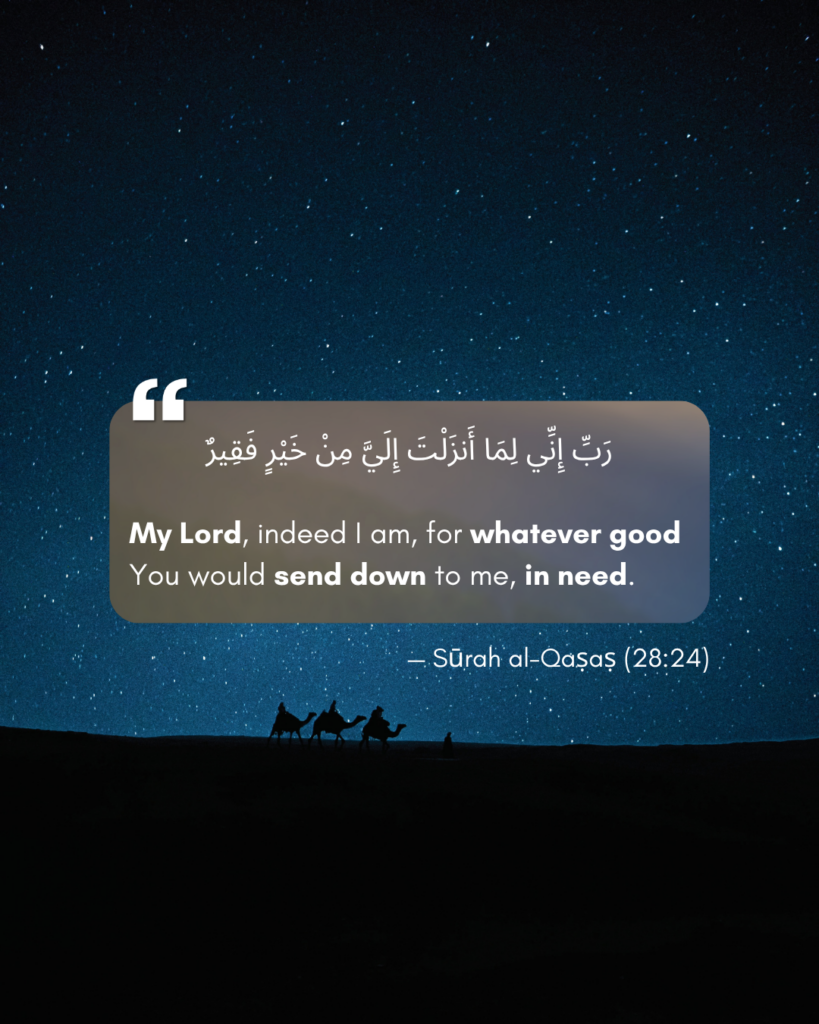
فَسَقَىٰ لَهُمَا ثُمَّ تَوَلَّىٰ إِلَى الظِّلِّ فَقَالَ رَبِّ إِنِّي لِمَا أَنزَلْتَ إِلَيَّ مِنْ خَيْرٍ فَقِيرٌ
Fa-saqā lahumā thumma tawallā ilaẓ-ẓilli fa-qāla Rabbi innī limā anzalta ilayya min khayrin faqīr.
“So he watered [their flocks] for them; then he went back to the shade and said, ‘My Lord, indeed I am, for whatever good You would send down to me, in need.'”
— Sūrah al-Qaṣaṣ (28:24)
He sat down in the shade of a tree. Alone. With nothing.
And the du’ā he made was not a list. He did not say: give me food. Give me shelter. Give me a way back to Egypt. Give me a plan. He said, in fewer words than a sentence: Rabbi innī limā anzalta ilayya min khayrin faqīr. My Lord, I am in need of whatever good You send down to me.
Ibn Kathīr raḥimahullāh explains in his commentary on this āyah that this was a du’ā of need and complete reliance, in which he acknowledged his dependence on Allāh for any good that might come to him. He was not specifying what he needed. He was acknowledging the need itself and leaving the form of the answer entirely to his Lord.
As a personal reflection on the language of this du’ā: faqīr is a word we use daily in South Asia without thinking about where it comes from. In Urdu, Bengali, and the languages around them, it means a beggar, someone extremely poor, someone with nothing. And that is exactly what it means in the Arabic here. Mūsā ʿalayhissalām was not saying “I could use some help.” He was saying: my Lord, to You I am a beggar. I am in need of literally any good You would send down to me.
Have you ever seen a beggar refuse even a penny? That is the kind of need he was expressing. Not a specific request with a specific amount. Not a plan he wanted Allāh to fund. Just the open hand of someone who knows he has nothing. But he is also someone who knows who his Lord is. He knows that even a little from his Lord is more than mountains from anyone else. He knows what could happen if al-Karīm ever looked at him with an eye of mercy.
And he is also someone who chose his words carefully: limā anzalta, for whatever You send down. The word anzala is the same root used throughout the Qur’ān for the descent of revelation. He placed his provision in the same grammatical frame as what comes down from Allāh. Whatever descends from You, in any form, I am in need of it. The du’ā is open. The hand extended, but not reaching for a specific thing. Just: I am Your needy one.
And he said it moments after sitting under a tree with nothing to his name.
The Answer
فَجَاءَتْهُ إِحْدَاهُمَا تَمْشِي عَلَى اسْتِحْيَاءٍ قَالَتْ إِنَّ أَبِي يَدْعُوكَ لِيَجْزِيَكَ أَجْرَ مَا سَقَيْتَ لَنَا
Fa-jā’athu iḥdāhumā tamshī ʿalā istiḥyā’in qālat inna abī yadʿūka li-yajziyaka ajra mā saqayta lanā.
“Then one of the two women came to him walking with shyness. She said, ‘Indeed, my father invites you that he may reward you for having watered for us.'”
— Sūrah al-Qaṣaṣ (28:25)
Before he had finished sitting, the answer arrived. And what it contained was not only food. It was shelter, hospitality, and a man who listened to his entire story and said:
قَالَ لَا تَخَفْ ۖ نَجَوْتَ مِنَ ٱلْقَوْمِ ٱلظَّـٰلِمِينَ
Qāla lā takhaf najawta minal-qawmiẓ-ẓālimīn.
“He said, ‘Fear not. You have escaped from the wrongdoing people.'”
— Sūrah al-Qaṣaṣ (28:25)
As a personal reflection on the parallel: Mūsā ʿalayhissalām had said while fleeing, Rabbi najjinī minal-qawmiẓ-ẓālimīn, save me from the wrongdoing people. The old man said, najawta minal-qawmiẓ-ẓālimīn, you have escaped from the wrongdoing people. His du’ā arrived answered in the mouth of a stranger, in the same words he had used to ask.
Was the Father Shuʿayb ʿalayhissalām?
Here the tafsīr tradition records a genuine disagreement that must be presented honestly. Ibn Kathīr raḥimahullāh discusses this in his commentary on Sūrah al-Qaṣaṣ: some early scholars held that this old man was Shuʿayb ʿalayhissalām, the Prophet sent to the people of Madyan. Others held that it was a righteous man of Madyan, but not the Prophet himself, because Shuʿayb ʿalayhissalām preceded Mūsā ʿalayhissalām by several generations and the timing would not align. Ibn Kathīr raḥimahullāh presents both views and does not settle definitively on either. The Qurʾān itself does not name this man.
The contemporary scholars who hold the view that the old man was Shuʿayb ʿalayhissalām point out that the years spent in Madyan were not merely labor. They were tarbiyah. A mentor raising a future prophet according to the perfect planning of Allāh. The years in the open land, tending sheep that cannot speak for themselves, learning to wait, learning to watch, learning to act only when it is needed, were exactly what Mūsā ʿalayhissalām needed after Egypt. And Allāh knows best.
What is certain from the text is that he was righteous, that he recognized Mūsā ʿalayhissalām’s character and honesty, and that he offered him what would change the trajectory of his life:
قَالَ إِنِّي أُرِيدُ أَنْ أُنكِحَكَ إِحْدَى ابْنَتَيَّ هَاتَيْنِ عَلَىٰ أَن تَأْجُرَنِي ثَمَانِيَ حِجَجٍ ۖ فَإِنْ أَتْمَمْتَ عَشْرًا فَمِنْ عِندِكَ
Qāla innī urīdu an unkiḥaka iḥdā ibnatayya hātayni ʿalā an ta’juranī thamāniya ḥijaj, fa-in atmamta ʿashran fa-min ʿindak.
“He said, ‘Indeed, I wish to wed you one of these, my two daughters, on the condition that you serve me for eight years; but if you complete ten, it will be [as a favor] from you.'”
— Sūrah al-Qaṣaṣ (28:27)
Eight years at minimum, ten at the fuller completion. Mūsā ʿalayhissalām accepted. And with that acceptance, a new chapter began: years in Madyan, tending flocks in the open wilderness.
The Shepherd’s Training
It is a detail that could pass by as ordinary, but upon reflecting on it deeply, I could connect it with what Rasūlullāh ﷺ said:
“Allāh did not send any prophet except that he shepherded sheep.” His companions asked, “And you?” He replied, “And I used to shepherd them for the people of Makkah for a few qirāṭ.”
— Ṣaḥīḥ al-Bukhārī (2262)
Ibn Ḥajar raḥimahullāh said in Fatḥ al-Bārī that the wisdom behind this is to train the Prophets in leadership before they are entrusted with it. Shepherding teaches patience, compassion, and the ability to gather a scattered flock, to know their different natures, and to protect them from wolves and thieves. These are the qualities of a prophet.
And it was carried into the Ummah itself. Rasūlullāh ﷺ said:
“Every one of you is a shepherd, and every one of you is responsible for his flock.”
— Ṣaḥīḥ al-Bukhārī (7138), Ṣaḥīḥ Muslim (1829).
This is not a description of one role, but of every role. The one who leads, the one who is led, the one who cares for a family, the one who manages wealth; each of them is a rāʿī, and each will be asked about what was under his care.
And this pattern runs through the best of this Ummah. Rasūlullāh ﷺ shepherded sheep before he ever led a nation. ʿUmar ibn al-Khaṭṭāb raḍiyallāhu ʿanhu shepherded his father’s flocks in his youth, and later, as the khalīfah, he walked the streets of Madīnah at night, checking on the needy. He said:
“If a sheep were to die on the banks of the Euphrates, I would fear that Allāh would ask me about it on the Day of Resurrection.”
— Abū Nuʿaym, Ḥilyat al-Awliyāʾ (1/53).
The shepherd’s instinct became the khalīfah’s conscience. And when we see Mūsā ʿalayhissalām at the well in Madyan, helping two women before he helped himself, we are watching the same quality that would later make him Kalīmullāh. The one who cares for the flock before he even knows where his next meal is coming from is the one being prepared to carry a message to a tyrant. The patience learned in the wilderness, the compassion for the weak, the willingness to stand between the flock and the wolf: these are the traits of the shepherd, and they are the traits of the Prophet.
And it is the same for us. Whether your “flock” is a family, a team, a community, or just the few people Allāh has placed in your path, the question of the shepherd is the same: Will you know them? Will you protect them? Will you guide them to what is good? And when you stand before Allāh, will you be able to say that you did not leave them to the wolves?
As a personal reflection on the sequence: a man raised in a palace, who had killed someone and fled, who had arrived in a foreign land with nothing, spent years tending sheep under the guidance of a righteous elder. He had learned to give service before asking for provision. He had learned to make du’ā from the shade of a tree with an empty hand. He was being shaped, without knowing it, for the moment when he would stand before a burning bush and hear the One he had been speaking to all along speak back to him. And indeed Allāh is the best of planners.
That moment came when he had completed his term and was traveling with his family:
فَلَمَّا قَضَىٰ مُوسَى ٱلْأَجَلَ وَسَارَ بِأَهْلِهِۦٓ ءَانَسَ مِن جَانِبِ ٱلطُّورِ نَارًا قَالَ لِأَهْلِهِ ٱمْكُثُوٓا۟ إِنِّىٓ ءَانَسْتُ نَارًا لَّعَلِّىٓ ءَاتِيكُم مِّنْهَا بِخَبَرٍ أَوْ جَذْوَةٍ مِّنَ ٱلنَّارِ لَعَلَّكُمْ تَصْطَلُونَ
Fa-lammā qaḍā Mūsal-ajala wa sāra bi-ahlihī ānasa min jānibiṭ-Ṭūri nāran qāla li-ahlihim-kuthu innī ānastu nāral-laʿallī ātīkum minhā bi-khabarin aw jadhwatim-minan-nāri laʿallakum taṣṭalūn.
“And when Mūsā had completed the term and was traveling with his family, he perceived from the direction of the mount a fire. He said to his family, ‘Stay here; indeed, I have perceived a fire. Perhaps I will bring you from there some information or burning wood from the fire that you may warm yourselves.'”
— Sūrah al-Qaṣaṣ (28:29)
He went toward a fire looking for warmth for his family. He arrived at something else entirely:
فَلَمَّا أَتَاهَا نُودِيَ مِن شَاطِئِ الْوَادِ الْأَيْمَنِ فِي الْبُقْعَةِ الْمُبَارَكَةِ مِنَ الشَّجَرَةِ أَن يَا مُوسَىٰ إِنِّي أَنَا اللَّهُ رَبُّ الْعَالَمِينَ
Fa-lammā atāhā nūdiya min shāṭi’il-wādil-aymani fil-buqʿatil-mubārakati minash-shajarati ay-yā Mūsā innī ana-llāhu Rabbul-ʿālamīn.
“But when he came to it, he was called from the right side of the valley in a blessed spot from the tree, ‘O Mūsā, indeed I am Allāh, Lord of the worlds.'”
— Sūrah al-Qaṣaṣ (28:30)
Kalīmullāh: The Name That Came From a Lifetime
Mūsā ʿalayhissalām is known by a title given to no other Prophet in the Qurʾān: Kalīmullāh, the one whom Allāh spoke to directly.
وَكَلَّمَ اللَّهُ مُوسَىٰ تَكْلِيمًا
Wa kallama-llāhu Mūsā taklīmā.
“And Allāh spoke to Mūsā with [direct] speech.”
— Sūrah al-Nisāʾ (4:164)
Al-Qurṭubī raḥimahullāh explains in his commentary on this āyah that the construction taklīmā, the verbal noun (maṣdar) reinforcing the verb, removes any possibility of a metaphorical reading (majāz). Allāh spoke to him directly. And this was his specific distinction above other Prophets in this regard.
Now trace the pattern backward. From the first moment we meet Mūsā ʿalayhissalām as a young man, he speaks to Allāh in every difficulty:
After killing: Rabbi innī ẓalamtu nafsī faghfir lī.
While fleeing: Rabbi najjinī minal-qawmiẓ-ẓālimīn.
In the shade with nothing: Rabbi innī limā anzalta ilayya min khayrin faqīr.
At the burning bush: Rabbi ishraḥ lī ṣadrī, and the long conversation that followed, which has been covered in the earlier article in this series.
He spoke to Allāh before he knew Allāh would answer. He spoke in guilt, in fear, in exhaustion, in hunger, in uncertainty. He did not wait for a confirmed channel before using the one he already had. He did not reserve his words for the moments when he felt worthy of being heard.
And when Allāh ʿazza wa jall chose to answer out loud at a burning bush, it was not the beginning of a relationship. It was the moment the relationship became audible.
And What About Us?
We know that du’ā is worship, and it is the best weapon of the believer. We have been taught that Allāh is All-Seeing, All-Hearing, All-Wise, All-Knowing, Most-Subtle, Most Generous, Most Merciful, Best Helper, Best Planner, and Competent over all things. We believe this. All of it. And still, when difficulty comes, many of us do not speak. We calculate. We plan. We consult people, check accounts, lie awake running scenarios. We rely on ourselves and we only reach for the du’ā at the end, and sometimes for some of us we never really go for the du’ā at all.
Mūsā ʿalayhissalām reached for it first, always, regardless of the situation or need. Whether walking in fear or in the shade of a tree with nothing to eat. He spoke to his Lord.
And the du’ā he made in Madyan is perhaps one of the most honest and might I say even raw of them all. He did not specify what he needed. He said: Rabbi innī limā anzalta ilayya min khayrin faqīr. Whatever good You send down, I am in need of it. I leave the form of the answer entirely to You.
There is a humility in that openness that most of our du’āʾs do not reach. We come to Allāh with a list: this specific job, that specific amount, this outcome, that door. Though always, every single time, what He has is better than what we asked for, and our lists are too narrow to receive it while our vision is too shallow to see it. Mūsā ʿalayhissalām left the form of the answer entirely open. And what came back was not just food. It was shelter, a family, years of preparation, and ultimately the moment when the One he had been speaking to all his life chose to speak back.
We also notice what he did before the du’ā. He helped the two women first. He was hungry, exhausted, fleeing, with nothing. And his first act at the well was not for himself. He watered their flocks. And then he sat down and asked. As a reflection on this sequence: he gave what he had before asking for what he needed. And what came back through the giving exceeded what he had given.
The du’ā of Madyan is the du’ā of complete poverty before Allāh. Not poverty of money. Poverty of self. Innī faqīr. I am in need. Not of one thing. Of whatever good comes from You.
That is the posture that prepares a person to hear what Allāh has to say.
And so we ask Him from a position of extreme poverty.
Yā Rabb, we come to You as Mūsā came to You in the shade of that tree: with our hands empty and our needs too many to name. Whatever good You send down to us, we are in need of it.
Yā Rabb, teach us to speak to You before we speak to anyone else. To rely upon You and not upon any of Your creations. When we are afraid, let our first word be to You. When we have wronged ourselves, let our first move be faghfir lī. When we do not know the way, let us say Rabbi najjinī before we calculate the route.
Yā Rabb, make our faqr before You real. Not a word we say at the opening of a du’ā but a state we carry: the understanding that everything we have is descended from You, the King, the Owner of all things in the heavens and earth, and that without the next descent of Your mercy we have nothing and are nothing.
Yā Rabb, teach us to give before we ask. To help the one in front of us before we state what we need from You. And let our giving be the door through which Your answer arrives, the way the watering of two women’s flocks opened a chapter Mūsā ʿalayhissalām could not have written for himself.
Yā Rabb, answer us as You answered him: before we have finished sitting. Through a door we did not see coming. In the very words we used to ask. And make what You send down better than anything we would have specified if we had thought to.
Rabbi innī limā anzalta ilayya min khayrin faqīr.
Āmīn yā Rabb al-ʿĀlamīn, bi-raḥmatika yā Arḥam ar-Rāḥimīn.
A Note on Sources and Verification
Qur’ānic text. All āyāt are linked to quran.com: al-Qaṣaṣ 28:15, 16, 17, 20, 21, 23, 24, 25, 27, 29, 30; al-Nisā’ 4:164. English renderings are translations of meaning.
Tafsīr. The explanations attributed to Ibn Kathīr raḥimahullāh are drawn from Tafsīr al-Qur’ān al-ʿAẓīm and linked to his commentary on the relevant āyāt at quran.com: on 28:16, on 28:17, on 28:21, on 28:23, on 28:24, and on 28:25. The narration of the eight-day journey is drawn from al-Qurṭubī raḥimahullāh’s Arabic tafsīr on Sūrah al-Qaṣaṣ. As it is available only in Arabic on quran.com, readers are directed to that link accordingly. The explanation of taklīmā as removing the possibility of metaphorical reading is drawn from al-Qurṭubī raḥimahullāh’s Arabic tafsīr on Sūrah al-Nisā’.
The question of Shuʿayb ʿalayhissalām. The disagreement over the identity of the old man of Madyan is presented as Ibn Kathīr raḥimahullāh presents it in his commentary on 28:25. The reflection on the Madyan years as tarbiyah rather than merely labor is drawn from Ustad Hisham Abu Yusuf, who attributes it to contemporary scholars who hold the view that the old man was Shuʿayb ʿalayhissalām. It is offered as a reflection, not as a settled tafsīr ruling, and Allāh knows best.
Ḥadīth. The ḥadīth of the Prophets shepherding sheep is recorded in Ṣaḥīḥ al-Bukhārī (2262). The ḥadīth that every person is a shepherd and responsible for his flock is recorded in Ṣaḥīḥ al-Bukhārī (7138) and Ṣaḥīḥ Muslim (1829). The saying of ʿUmar ibn al-Khaṭṭāb raḍiyallāhu ʿanhu about the sheep of the Euphrates is recorded by Abū Nuʿaym in Ḥilyat al-Awliyāʾ (1/53). It is presented without a grading line, as no al-Albānī grading has been verified for it.
Scholarly commentary. The statement of Ibn Ḥajar raḥimahullāh on the wisdom of the Prophets shepherding sheep is drawn from Fatḥ al-Bārī.
Reflections that are mine. The following are my own and are offered as reflections, not as tafsīr rulings:
The observation that Mūsā’s speaking to Allāh before Allāh spoke back to him is one of the things that prepared him for Kalīmullāh; the linguistic reflection on faqīr and its South Asian usage; the limā anzalta observation regarding the root shared with the descent of revelation; the parallel between najjinī and najawta; the reflection that Mūsā gave service before asking for provision; the observation that the shepherding years prepared him to lead by teaching patience, compassion, and protection of the weak; and the observation on the order of events in the article itself, that the du’ā at the well is the centerpiece and the sections after it are the answer to what the du’ā produced.
Cross-references. The earlier article on the du’ā of Mūsā’s people. The earlier article on the du’ā of Mūsā at the burning bush.
A note on what is uncertain. I am not a scholar and cannot assess the full chains of the reports cited above. Where a report is from outside the two Ṣaḥīḥs, it is cited with its source and grading where available. Where a view is presented from contemporary students of knowledge, it is attributed as such. Where something is my own reflection, it is marked. Readers who wish to verify beyond what is linked here should consult the primary sources and the people of knowledge.
Any good in this article is from Allāh alone; any shortcoming is from my own weakness.
And Allāh knows best.