﷽
Before there was a House, there was a mother alone in a valley with a crying infant.
Imām al-Bukhārī raḥimahullāh recorded that Ibn ʿAbbās raḍiyallāhu ʿanhu narrated that Ibrāhīm ʿalayhissalām left Hājar raḍiyallāhu ʿanhā and the infant Ismāʿīl in the barren valley of Makkah with only a bag of dates and a water-skin. As he turned to leave, she called after him: “O Ibrāhīm, to whom are you leaving us in this valley where there is no one and nothing?” She repeated it several times, and he did not answer. Then she asked, “Has Allāh commanded you to do this?” He said, “Yes.” She said, “Then He will not abandon us.”
— Ṣaḥīḥ al-Bukhārī (3364), as narrated by Ibn ʿAbbās raḍiyallāhu ʿanhu
As Ibrāhīm ʿalayhissalām walked away, out of their sight, he turned toward the place of the House and raised his hands:
رَبَّنَا إِنِّي أَسْكَنْتُ مِن ذُرِّيَّتِي بِوَادٍ غَيْرِ ذِي زَرْعٍ عِندَ بَيْتِكَ الْمُحَرَّمِ رَبَّنَا لِيُقِيمُوا الصَّلَاةَ فَاجْعَلْ أَفْئِدَةً مِّنَ النَّاسِ تَهْوِي إِلَيْهِمْ وَارْزُقْهُم مِّنَ الثَّمَرَاتِ لَعَلَّهُمْ يَشْكُرُونَ
Rabbanā innī askantu min dhurriyyatī bi-wādin ghayri dhī zarʿin ʿinda baytikal-muḥarram. Rabbanā liyuqīmuṣ-ṣalāta fajʿal afʾidatam minan-nāsi tahwī ilayhim, warzuqhum minath-thamarāti laʿallahum yashkurūn.
“Our Lord, I have settled some of my descendants in a barren valley near Your sacred House, our Lord, that they may establish prayer. So make hearts among the people incline toward them and provide for them from the fruits that they might be grateful.”
— Sūrah Ibrāhīm (14:37)
He does not ask Allāh ʿazza wa jall to remove them from the valley. He asks Him to send hearts to the valley. This is tawakkul: not the absence of a difficult decree, but full trust that the One who gave the decree will provide within it.
Zamzam and the Valley That Learned to Live
Ibn ʿAbbās raḍiyallāhu ʿanhu continues the narration. Hājar raḍiyallāhu ʿanhā returned to her son and nursed him from the water-skin, until it ran dry. Thirsty and desperate, she ran between the hills of Ṣafā and Marwah, searching for anyone who might help. Rasūlullāh ﷺ said, explaining this very moment:
“That is why people walk between them.”
— Ṣaḥīḥ al-Bukhārī (3364)
She was not running because she saw water. Every visible sign around her testified to one conclusion: no shelter, no tribe, no caravan in sight, nothing but abandonment. And yet she ran anyway, seven times, with no change in what her eyes could see. As I explore at greater length in The Platform, this is the lesson underneath her running: seeking the means is itself an act of worship, even when the result is still hidden from you. Her tawakkul was never inaction. It was obedience that did not wait for visible proof before it moved.
On her return, she heard a voice. She found an angel striking the ground with his heel, and water gushed out. Ibn ʿAbbās raḍiyallāhu ʿanhu narrated that Rasūlullāh ﷺ said:
“May Allāh have mercy on the mother of Ismāʿīl. Had she left Zamzam to flow on its own, it would have remained a flowing spring.”
— Ṣaḥīḥ al-Bukhārī (3362), as narrated by Ibn ʿAbbās raḍiyallāhu ʿanhu
There is a reason the well carries this name. Historians of Makkah record that Zamzam comes from her own words, repeated as she rushed to gather the water before it could escape into the sand: “Zomë Zomë” meaning “Stop, stop, contain it.” A command born of fear that the mercy in front of her might slip away before she could hold onto it. The name of the most blessed water on earth is, quite literally, a mother’s plea not to lose what Allāh ʿazza wa jall had just given her.
The tribe of Jurhum, passing through, saw birds circling the valley and knew that meant water. They asked permission of Hājar raḍiyallāhu ʿanhā to settle nearby. She agreed, on the condition that the water would remain shared. It was among them that Ismāʿīl ʿalayhissalām grew up, learned Arabic, and married.
This is the valley Ibrāhīm ʿalayhissalām now returns to, years later. Not the empty valley he left. A valley that has already tasted desperation, and already tasted mercy.
Every sign visible to the eye had said one thing to Hājar raḍiyallāhu ʿanhā in that valley: abandonment. No water, no shelter, no husband, no provision, no life to lean on. It is not a coincidence that her trial touches each of the very categories Allāh ʿazza wa jall names when He describes how He tests His servants:
وَلَنَبْلُوَنَّكُم بِشَيْءٍ مِّنَ الْخَوْفِ وَالْجُوعِ وَنَقْصٍ مِّنَ الْأَمْوَالِ وَالْأَنفُسِ وَالثَّمَرَاتِ ۗ وَبَشِّرِ الصَّابِرِينَ
Wa lanabluwannakum bishayʾim minal-khawfi wal-jūʿi wa naqṣim minal-amwāli wal-anfusi wath-thamarāt, wa bashiriṣ-ṣābirīn.
“And We will surely test you with something of fear and hunger and a loss of wealth, lives, and fruits, but give good tidings to the patient.”
— Sūrah al-Baqarah (2:155)
Fear, hunger, loss of provision, loss of support, loss of a settled life: Hājar raḍiyallāhu ʿanhā stood inside every one of them at once, in a single moment, with no caravan on the horizon. And she did not need to see the outcome to trust the Command behind it. Her certainty rested on revelation, not on what her eyes could confirm. What looked like abandonment to every human sense was, in the sight of Allāh ʿazza wa jall, the opening of a mercy that has not stopped flowing since.
The Du’ā of Ibrāhīm & Ismāʿīl
Allāh ʿazza wa jall says:
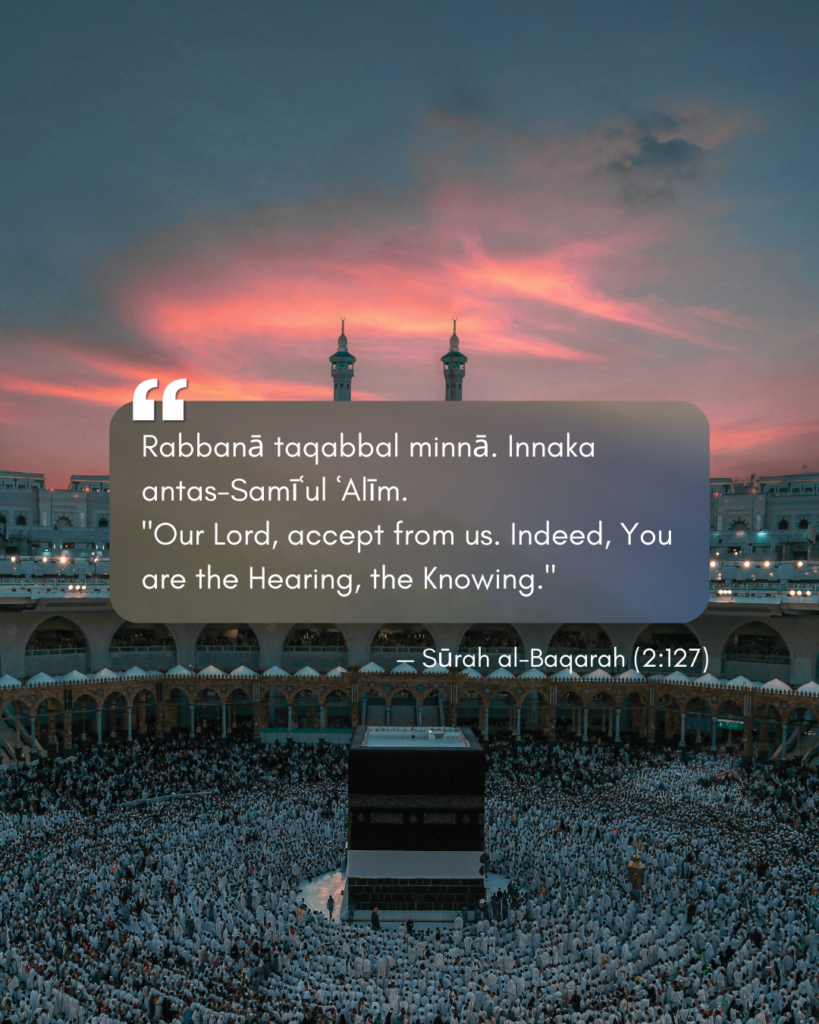
وَإِذْ يَرْفَعُ إِبْرَاهِيمُ الْقَوَاعِدَ مِنَ الْبَيْتِ وَإِسْمَاعِيلُ رَبَّنَا تَقَبَّلْ مِنَّا ۖ إِنَّكَ أَنْتَ السَّمِيعُ الْعَلِيمُ
Wa idh yarfaʿu Ibrāhīmul qawāʿida minal bayti wa Ismāʿīl. Rabbanā taqabbal minnā innaka anta as-Samīʿul ʿAlīm.
“And [mention] when Ibrāhīm was raising the foundations of the House, and Ismāʿīl [with him], [saying], ‘Our Lord, accept [this] from us. Indeed You are the Hearing, the Knowing.'”
— Sūrah al-Baqarah (2:127)
Ibn ʿAbbās raḍiyallāhu ʿanhu narrated the scene itself. Ibrāhīm ʿalayhissalām said to his son, “Allāh has commanded me to build a house for Him here,” pointing to a raised mound of ground. Ismāʿīl ʿalayhissalām answered, “Then obey your Lord.” Ibrāhīm ʿalayhissalām laid the stones while Ismāʿīl ʿalayhissalām carried them to him. And as they went around the structure, stone by stone, Ibn ʿAbbās raḍiyallāhu ʿanhu says:
“Both of them were saying: ‘Rabbanā taqabbal minnā, innaka antas-Samīʿul ʿAlīm.'”
— Ṣaḥīḥ al-Bukhārī (3364), as narrated by Ibn ʿAbbās raḍiyallāhu ʿanhu
This was not a duʿā said once, at the end. It was repeated with every stone. Al-Qurṭubī raḥimahullāh mentions that Ubayy ibn Kaʿb and Ibn Masʿūd raḍiyallāhu ʿanhumā would recite the verse with the added phrase “wa yaqūlāni,” meaning “and the two of them were saying,” to emphasize precisely this: that the duʿā ran continuously beneath the labor of their hands.
The Īmān of Khalīl ar-Raḥmān
The scholar Wuhayb ibn al-Ward raḥimahullāh would recite this verse and weep. Ibn Abī Ḥātim raḥimahullāh narrated that he said:
“O Khalīl of ar-Raḥmān! You are raising the foundations of the House of ar-Raḥmān, and still you fear that it will not be accepted from you?”
— As recorded in Tafsīr Ibn Kathīr, commentary on Sūrah al-Baqarah (2:127)
So why does He ask them to fear? Allāh ʿazza wa jall describes exactly this state in the believers He praises:
وَالَّذِينَ يُؤْتُونَ مَا آتَوا وَّقُلُوبُهُمْ وَجِلَةٌ
Wal-ladhīna yuʾtūna mā ātaw wa qulūbuhum wajilah.
“And those who give what they give while their hearts are fearful.”
— Sūrah al-Muʾminūn (23:60)
This is the Khalīl of Allāh ʿazza wa jall, hand-picked above all others for that title, building by direct command of his Lord, and still uncertain whether the deed will be accepted. What kind of īmān is that? Not the īmān that assumes. The īmān that trembles.
The duʿā does not stop at acceptance. It reaches forward, to a nation not yet born:
رَبَّنَا وَاجْعَلْنَا مُسْلِمَيْنِ لَكَ وَمِن ذُرِّيَّتِنَا أُمَّةً مُسْلِمَةً لَكَ وَأَرِنَا مَنَاسِكَنَا وَتُبْ عَلَيْنَا ۖ إِنَّكَ أَنْتَ التَّوَّابُ الرَّحِيمُ
Rabbanā wajʿalnā muslimayni laka wa min dhurriyyatinā ummatam muslimatal laka, wa arinā manāsikanā wa tub ʿalaynā innaka antat-Tawwābur-Raḥīm.
“Our Lord, make us Muslims [in submission] to You and from our descendants a Muslim nation [in submission] to You. And show us our rites and accept our repentance. Indeed, You are the Accepting of Repentance, the Merciful.”
— Sūrah al-Baqarah (2:128)
Ibn Jarīr al-Ṭabarī raḥimahullāh explains their intent: “Make us submit to Your command and Your obedience, associating no one with You in worship.” He records that ʿIkrimah raḥimahullāh commented on this verse that Allāh ʿazza wa jall responded: “I shall do that,” to each part.
— As recorded in Tafsīr Ibn Kathīr, commentary on Sūrah al-Baqarah (2:128)
This is the same pattern Allāh ʿazza wa jall describes elsewhere among His believing servants:
وَالَّذِينَ يَقُولُونَ رَبَّنَا هَبْ لَنَا مِنْ أَزْوَاجِنَا وَذُرِّيَّاتِنَا قُرَّةَ أَعْيُنٍ وَاجْعَلْنَا لِلْمُتَّقِينَ إِمَامًا
Wal-ladhīna yaqūlūna rabbanā hab lanā min azwājinā wa dhurriyyātinā qurrata aʿyunin wajʿalnā lilmuttaqīna imāmā.
“And those who say, ‘Our Lord, grant us from among our wives and offspring comfort to our eyes and make us an example for the righteous.'”
— Sūrah al-Furqān (25:74)
Rasūlullāh ﷺ tied this concern for future generations directly to what outlives us. He said:
“When the son of Ādam dies, his deeds end except for three: an ongoing charity, knowledge that continues to benefit others, or a righteous child who supplicates for him.”
— Ṣaḥīḥ Muslim (1631)
Ibrāhīm ʿalayhissalām’s duʿā for “an Ummah submitted to You” from his own descendants is, in a sense, the greatest of these three combined into one request.
The duʿā’s final reach goes centuries beyond either of them:
رَبَّنَا وَابْعَثْ فِيهِمْ رَسُولًا مِنْهُمْ يَتْلُو عَلَيْهِمْ آيَاتِكَ وَيُعَلِّمُهُمُ الْكِتَابَ وَالْحِكْمَةَ وَيُزَكِّيهِمْ ۚ إِنَّكَ أَنْتَ الْعَزِيزُ الْحَكِيمُ
Rabbanā wabʿath fīhim rasūlam minhum yatlū ʿalayhim āyātika wa yuʿallimuhumul-kitāba wal-ḥikmata wa yuzakkīhim, innaka antal-ʿAzīzul-Ḥakīm.
“Our Lord, and send among them a messenger from themselves who will recite to them Your verses and teach them the Book and wisdom and purify them. Indeed, You are the Exalted in Might, the Wise.”
— Sūrah al-Baqarah (2:129)
This duʿā was answered thousands of years later. Ibn Kathīr raḥimahullāh records that Rasūlullāh ﷺ, when asked about the beginning of his prophethood, said:
“I am the supplication of my father Ibrāhīm, and the glad tidings of ʿĪsā ibn Maryam.”
— Reported by Ibn Isḥāq raḥimahullāh in al-Sīrah on the authority of Khālid ibn Maʿdān. Graded ḥasan by Shaykh al-Albānī raḥimahullāh, who included it in his Ṣaḥīḥ al-Sīrah al-Nabawiyyah.
Every recitation of the Qurʾān, every ḥadīth learned, every heart purified through the guidance of Muḥammad ﷺ, is the answer to a duʿā made by two men raising stones in an empty valley, centuries before either of them would meet him.
The Foundations That Would Not Move
Ibn Kathīr raḥimahullāh records, from the al-Sīrah of Ibn Isḥāq raḥimahullāh, that generations later, when the Quraysh rebuilt the Kaʿbah before Rasūlullāh’s ﷺ mission began, they reached the original foundations Ibrāhīm ʿalayhissalām had laid. They found green stones stacked upon one another “like a pile of spears.” A man attempted to lift one of the stones with a shovel, and when it moved, the whole of Makkah shook. They left the foundation as it was.
— As recorded in Tafsīr Ibn Kathīr, commentary on Sūrah al-Baqarah (2:127)
What Ibrāhīm ʿalayhissalām and Ismāʿīl ʿalayhissalām built while pleading Rabbanā taqabbal minnā was still holding, unmoved, generations after they had passed.
And What About Us?
Hājar raḍiyallāhu ʿanhā stood inside all five tests at once, in a barren valley, with no caravan on the horizon. And she held. Ibrāhīm ʿalayhissalām left behind everything he loved by direct command, and he held. Ismāʿīl ʿalayhissalām carried stones in his arms until the House was raised, and they both trembled over whether any of it would be accepted.
And then there is us.
We break over far less. And still, somehow, we walk away assuming our deeds are enough. We pray a few rakʿahs and feel entitled. We give a little in charity and expect the mercy of Allāh as though it were a transaction. We do so little, or so close to nothing, and we think we have done so much.
Ibrāhīm ʿalayhissalām, the Khalīl of ar-Raḥmān, the one Allāh took as a close friend, the one who passed every trial placed before him, raised the foundations of the most sacred House on earth with his own hands, and still said: Rabbanā taqabbal minnā. Our Lord, accept from us. He did not assume. He did not feel entitled. He trembled.
That is the standard. Not arrogance in our deeds, but fear over their acceptance. Not entitlement to the mercy of Allāh, but desperate need of it.
So let every ṣalāh end with it. Let every act of charity be followed by it. Let every sujūd before the Lord of Ibrāhīm ʿalayhissalām, the Lord of our beloved Rasūlullāh ﷺ, the Lord of the two Khalīls of ar-Raḥmān, carry within it this trembling.
Yā Rabb, this content is for Your sake. The books I wrote are for Your sake. My ṣalāh is for Your sake. My ṣadaqah is for Your sake. And my life is for Your sake.
رَبَّنَا تَقَبَّلْ مِنَّا ۖ إِنَّكَ أَنْتَ السَّمِيعُ الْعَلِيمُ
Rabbanā taqabbal minnā. Innaka antas-Samīʿul ʿAlīm.
“Our Lord, accept from us. Indeed, You are the Hearing, the Knowing.”
— Sūrah al-Baqarah (2:127)
وَتُبْ عَلَيْنَا ۖ إِنَّكَ أَنْتَ التَّوَّابُ الرَّحِيمُ
Wa tub ʿalaynā. Innaka antat-Tawwābur-Raḥīm.
“And accept our repentance. Indeed, You are the Accepting of Repentance, the Merciful.”
— Sūrah al-Baqarah (2:128)
Āmīn yā Rabb al-ʿĀlamīn, bi-raḥmatika yā Arḥam ar-Rāḥimīn.