There are verses in the Qur’ān that arrive not as general addresses to humanity but as a personal, intimate call. They penetrate the heart not through threat or lengthy argument, but through tenderness. Sūrah al-ʿAnkabūt contains two such verses, side by side, that together form a complete and urgent message. They speak of movement and stillness, of space and time, of worship and death. And they carry within them a profound and practical wisdom that many a soul overlooks.
Yā ʿibādiya alladhīna āmanū inna arḍī wāsiʿatun fa-iyyāya faʿbudūn.
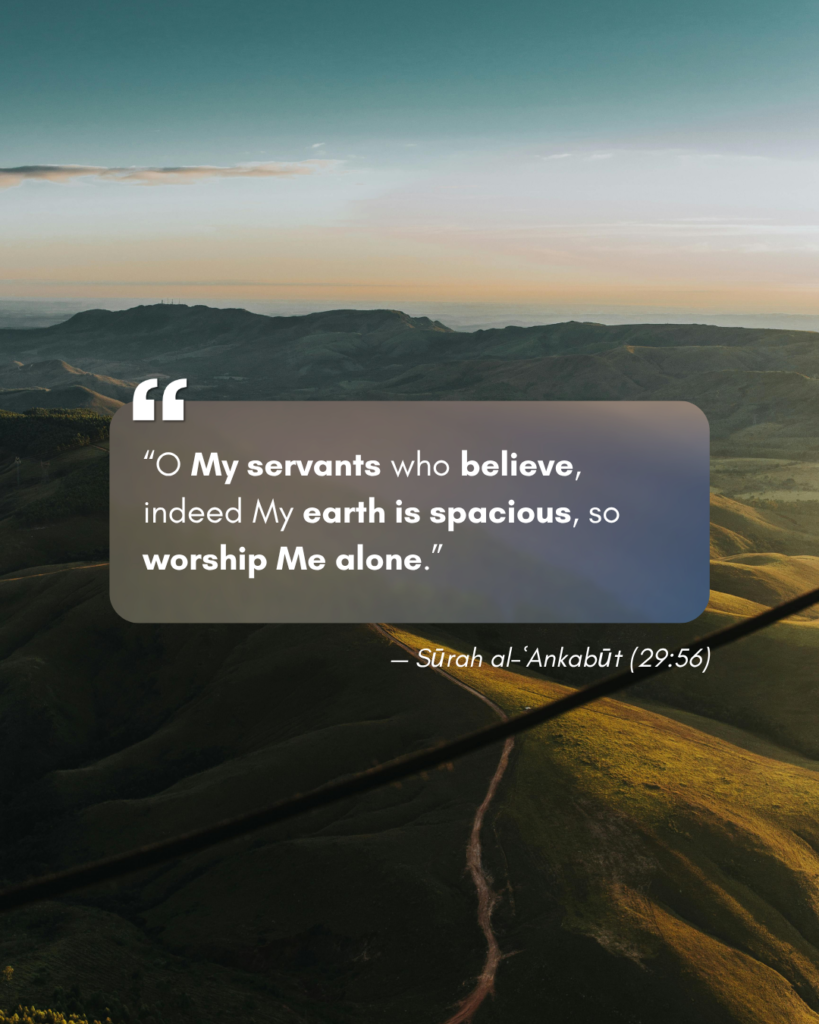
“O My servants who believe, indeed My earth is spacious, so worship Me alone.”
Kullu nafsin dhāʾiqatu al-mawt, thumma ilaynā turjaʿūn.
“Every soul will taste death, and then to Us you will be returned.”
— Sūrah al-ʿAnkabūt (29:56-57)
At first glance, one might wonder what the vastness of the earth has to do with the worship of Allāh, or why the mention of death follows so suddenly. But when these two verses are taken together, they reveal themselves as a divine call to movement and a warning against delay. They are a gentle but firm hand on the shoulder of every believer who has grown comfortable in a place where his faith is either threatened or stagnant.
“Yā ʿIbādiya”: The Intimate Call
The verse begins with Yā ʿibādiya alladhīna āmanū, “O My servants who believe.” This is not the general address Yā ayyuhā alladhīna āmanū found throughout the Qur’ān. Here, Allāh adds the possessive yā ʿibādī, “My servants.” It is an address of closeness, of affection, of reassurance. The scholars of tafsīr note that when Allāh speaks in this manner, what follows is often something that requires comfort before the command, a softening of the heart before a difficult instruction.
And what follows is indeed a command, but it is wrapped in the language of mercy. Allāh does not merely command movement; He promises to accompany the one who moves. Later in the same sūrah, He declares:
“And those who strive for Us—We will surely guide them to Our paths. And indeed, Allāh is with the doers of good.”
— Sūrah al-ʿAnkabūt (29:69)
The call of Yā ʿibādiya is not the call of a distant master. It is the call of a Lord who addresses His servants with love, gives them a command, and then assures them that their striving will be met with His guidance. The One who calls you His servant will also direct your steps when you answer.
The Spaciousness of the Earth: A Call to Move
Inna arḍī wāsiʿatun fa-iyyāya faʿbudūn.
“Indeed, My earth is spacious, so worship Me alone.”
What is the connection between the spaciousness of the earth and the worship of Allāh alone? The answer, as recorded by the mufassirūn, is both historical and timeless.
Al-Imām Ibn Jarīr al-Ṭabarī, raḥimahullāh, records that this verse was revealed concerning the believers in Makkah who were being persecuted and prevented from worshipping Allāh freely. They were suffering at the hands of the mushrikūn, unable to establish their dīn in the land where they were born. And so Allāh gave them a command wrapped in mercy: The earth is vast. If you cannot worship Me in one place, then go. Leave. Move to a land where you can worship Me alone.
— Tafsīr al-Ṭabarī, Sūrah al-ʿAnkabūt, āyah 56
This is the command of hijrah. It is a release from the shackles of circumstance. The believer is never trapped. The earth belongs to Allāh, and He has made it spacious. And for those with the means, no tyrant, no environment, no set of oppressive conditions can prevent from finding a place where it can bow to its Lord in freedom.
But the spaciousness is not only for those fleeing persecution. It is also for those who are called to spread the word. The ṣaḥābah, raḍiya Allāhu ʿanhum, left the most beloved land to them not only when they were forced, but also when they were victorious. After the conquest of Makkah, they scattered across that spacious earth, carrying the message of tawḥīd. The verse is a command to both kinds of movement: the one who leaves a harmful place to save his faith, and the one who leaves a comfortable place to serve his faith. Both are trading the familiarity of their surroundings for the pleasure of Allāh.
And what trade is better? Rasūlullāh ﷺ said:
“Whoever leaves something for the sake of Allāh, Allāh will replace it with something better.”
— Musnad Aḥmad, ḥadīth no. 23074, graded ṣaḥīḥ by Shaykh al-Albānī
The one who leaves his land for Allāh leaves with a promise. The spacious earth is the field of this trade, and the reward is not measured in square meters but in nearness to the Most High.
The Sudden Mention of Death: Why Delay is Not an Option
Immediately after the command to move and worship, Allāh says:
Kullu nafsin dhāʾiqatu al-mawt, thumma ilaynā turjaʿūn.
“Every soul will taste death, and then to Us you will be returned.”
The placement of this verse is precise and purposeful. Why is death mentioned here, right after the command to move? Because the spaciousness of the earth is useless to the one who plans to leave “tomorrow” and never does. Death does not wait for plans to mature. It does not consult our timelines. It comes when the appointed time arrives, and it returns us to the One who issued the command.
Al-Imām al-Qurṭubī, raḥimahullāh, notes in his tafsīr that the mention of death here is a motivation to act quickly. If the earth is vast and movement is possible, then move now. Do not postpone, for you do not know when your time will be up. The same understanding is echoed by al-Ḥāfiẓ Ibn Kathīr, raḥimahullāh, who states that death is the final cutter of all worldly hopes, so let not your hope for a long life delay your obedience.
— Tafsīr al-Qurṭubī, Sūrah al-ʿAnkabūt, āyah 57
— Tafsīr al-Qur’ān al-ʿAẓīm, Sūrah al-ʿAnkabūt, āyah 57
The verse is not a threat. It is a gentle reminder that the window is closing. The one who says, “I will move after marriage, after the children grow up, after I finish this project,” is assuming a tomorrow that is not guaranteed. And the command to worship Allāh alone does not wait for our convenience.
A Call That Echoes Through the Sūrah
The placement of these verses within Sūrah al-ʿAnkabūt is significant. The sūrah speaks of trials, of those who say they believe but are not tested, of the spider’s web that is the frailest of houses. And then, in this late portion of the sūrah, comes this intimate call. It is as if Allāh is saying: You have been told of the trials. Now, here is the way out. The earth is vast. Worship Me. Death is coming. Move.
The verse does not promise that the movement will be easy. Leaving one’s land is one of the hardest things a soul can do. The Prophet ﷺ himself looked back at Makkah as he departed and said:
“By Allāh, you are the most beloved of Allāh’s earth to Allāh, and the most beloved of Allāh’s earth to me, and had your people not driven me out, I would not have left.”
— Jāmiʿ al-Tirmidhī, Abwāb al-Manāqib, Bāb fī faḍl Makkah, ḥadīth no. 3926, ḥasan ṣaḥīḥ
He left the most beloved land because the command to worship Allāh alone was higher than the love of any place. This is the trade. And for the one who makes it, Allāh’s replacement is always better.
We ask You, Yā Rabbi, to make us among those who hear Your call and answer. Grant us the courage to move when movement is needed, and the patience to remain when stillness is better. Make this spacious earth a means for us to worship You alone, and do not let us be delayed by the hopes of a long life. Make us among those who strive, and guide us upon Your paths. Return us to You in a state of striving, having used Your earth for Your sake, and accept us among the ṣābirīn and the ṣādiqīn. Amīn yā Rabb al-ʿĀlamīn, bi-raḥmatika yā Arḥam ar-Rāḥimīn.