There is a struggle that is fought in silence, and its battlefield is the tongue. A word slips, a tone sharpens, and suddenly a conversation that was calm becomes a storm. For the one who longs to speak only what pleases Allāh, these slips are not small. They cut deeply. The believer who knows the weight of words often finds himself asking: Why do I keep returning to this? Where is the cure?
Sūrah al-Muzzammil answers this question with surgical precision. It traces foul speech to its hidden root and then provides a complete divine curriculum for the tongue. The sūrah does not merely command soft speech; it goes deeper, into the night, into the heart, and into the very way we carry our burdens. It reveals that the tongue is a reflection of the soul’s stillness or its agitation, and it places the cure not in behavioral techniques but in the private hours of standing before Al-Aʿlā.
The Root of Foul Speech: Agitation and the Absence of Dhikr
Foul speech does not emerge from nowhere. It is the fruit of a heart that has become agitated and has, in that moment, stopped actively remembering Allāh. When patience is lost, the door opens. Shayṭān finds the gap and whispers, pushing the agitation into aggression, and the tongue follows where the heart has stumbled.
Rasūlullāh ﷺ diagnosed this moment with clarity:
“If a man is angry and says, ‘Aʿūdhu billāh’ (I seek refuge in Allāh), his anger will subside.”
— Ṣaḥīḥ al-Jāmiʿ, ḥadīth no. 695, ṣaḥīḥ
The cure is immediate dhikr. But for the one whose tongue has become accustomed to slipping, a deeper remedy is needed. The habit of foul speech is not broken in the moment of anger alone; it is broken in the hours when the world sleeps and the soul is remade. This is where Sūrah al-Muzzammil begins its work.
The Night Prayer: The Workshop of the Tongue
The sūrah turns to the Messenger ﷺ, wrapped in his garment, and gives a command that is also a remedy:
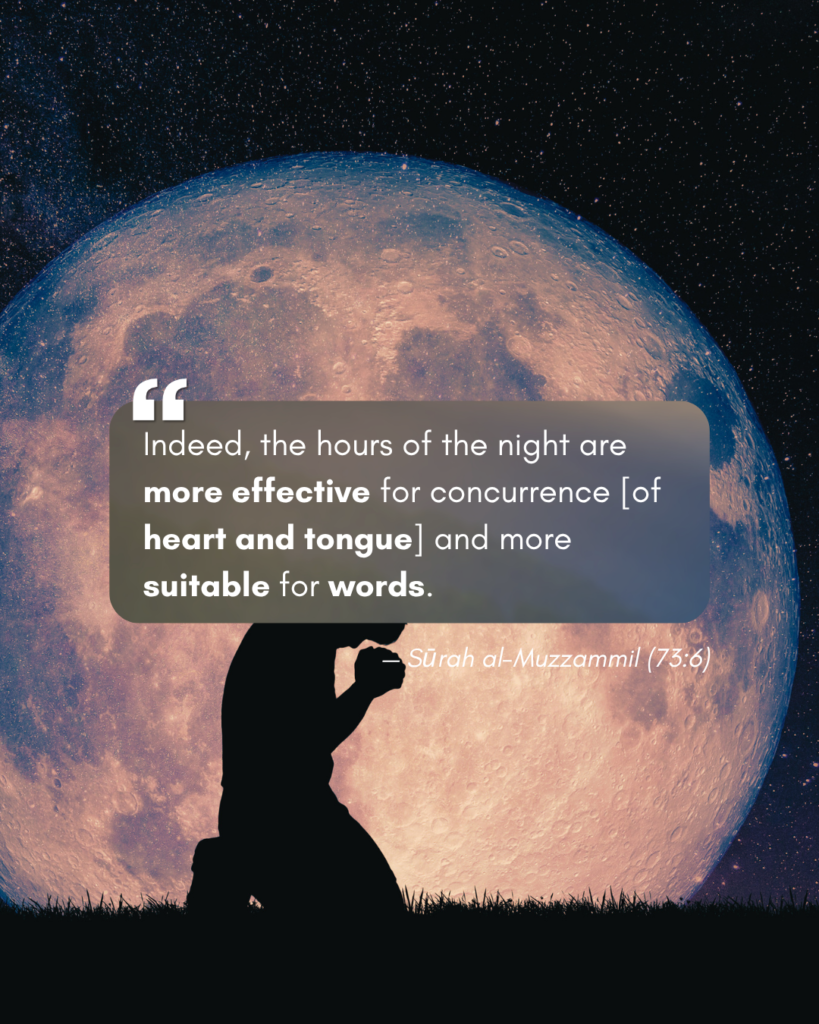
Inna nāshiʾata al-layli hiya ashaddu waṭʾan wa aqwamu qīlā.
“Indeed, the hours of the night are more effective for concurrence [of heart and tongue] and more suitable for words.”
— Sūrah al-Muzzammil (73:6)
The word waṭʾan means to tread heavily, to subdue, to bring into harmony. The classical mufassirūn explain that the night prayer aligns the heart and the tongue. During the day, the tongue often runs ahead of the heart. It speaks words that the heart has not authorized, or the heart feels one thing and the tongue says another. But in the stillness of qiyām al-layl, the tongue and heart are woven together. The tongue recites what the heart contemplates, and the heart is present in every syllable.
The phrase aqwamu qīlā, “more suitable for words,” means that the words uttered in the night are more upright, more likely to hit the mark of truth and goodness. This is the training ground. The tongue that spends the night in synchronized worship with the heart becomes slower to slip in the day. It has tasted a purer speech, and filth becomes foreign to it.
Rasūlullāh ﷺ said:
“Whoever believes in Allāh and the Last Day, let him speak good or remain silent.”
— Ṣaḥīḥ al-Bukhārī ḥadīth no. 6136; Ṣaḥīḥ Muslim ḥadīth no. 47
This standard is high, and it cannot be reached by willpower alone. It is forged in the night. The one who stands before Al-Qayyūm in the dark, reciting His words with a present heart, is training his tongue to speak only what is good when the sun rises.
The Lord of the East and West: Tawakkul as the Anchor of the Tongue
Immediately after describing the night prayer, Allāh reveals the foundation upon which upright speech is built:
“[He is] the Lord of the East and the West; there is no deity except Him, so take Him as Disposer of [your] affairs.”
— Sūrah al-Muzzammil (73:9)
A foul tongue often springs from a heart that is anxious, defensive, or trying to control outcomes. When you fear people, when you worry about provision, when you feel cornered, the tongue lashes out. The cure is tawakkul. He is the Lord of every rising and setting, every beginning and end, every matter beyond your control. Take Him alone as Wakīl. When the heart hands over its burdens to Him, the tongue no longer needs to defend, prove, or attack. It rests. And a rested tongue is far less likely to speak filth.
Rasūlullāh ﷺ said:
“If you were to rely upon Allāh with the reliance He is due, you would be provided for as the birds are provided for: they go out in the morning hungry and return in the evening full.”
— Sunan al-Tirmidhī, Abwāb al-Zuhd, Bāb fī al-tawakkul ʿalā Allāh, ḥadīth no. 2344, ḥasan ṣaḥīḥ
The bird does not curse the wind. It does not scream at the sky for withholding. It goes out and returns, trusting. The tongue that trusts in Al-Wakīl does not need to scream either. It can be still.
Gracious Avoidance and Leaving the Deniers to Him
The sūrah then gives a direct command regarding the speech of others, a command that reshapes how the believer responds to provocation:
“And be patient over what they say and avoid them with gracious avoidance.”
— Sūrah al-Muzzammil (73:10)
The word hajr means abandonment or avoidance, but it is qualified by jamīlā—beautiful, gracious. This is not bitter silence or resentful withdrawal. It is a dignified stepping away from toxic speech. The one who practices hajr jamīl refuses to participate in the cycle of harsh words. And in doing so, their own tongue begins to shed its roughness.
Then comes the release:
“And leave Me with [the matter of] the deniers, those of ease [in life], and allow them respite a little.”
— Sūrah al-Muzzammil (73:11)
Allāh is saying: You do not need to fight every battle. You do not need to avenge every slight or answer every provocation. Leave the deniers—those who mock, those who harm, those who reject—to Me. I am sufficient as the Disposer of all affairs. This is liberation. When the tongue stops carrying the burden of responding, defending, and retaliating, it becomes free. It no longer needs to be sharp. It can be soft.
Rasūlullāh ﷺ said:
“The strong man is not the one who can wrestle others, but the one who controls himself when angry.”
— Ṣaḥīḥ al-Bukhārī, Kitāb al-Adab, Bāb al-ḥadhr min al-ghaḍab, ḥadīth no. 6114; Ṣaḥīḥ Muslim, Kitāb al-Birr wa aṣ-Ṣilah, Bāb faḍl man yamliku nafsahu ʿinda al-ghaḍab, ḥadīth no. 2609
The strong one is not silent because he is weak. He is silent because he has handed his case to the Strongest. The deniers may have ease for a little while, but the Wakīl has not forgotten.
The Command That Seals the Cure: Seek Help Through Patience and Prayer
At the moment of agitation, the believer is given a sword that cuts through the whisper of Shayṭān. It is the command that runs through the entire Qurʾān:
“Yā ayyuhā alladhīna āmanū istaʿīnū bi-aṣ-ṣabri wa aṣ-ṣalāh.”
“O you who believe, seek help through patience and prayer.”
— Sūrah al-Baqarah (2:153)
Agitation rises. The tongue trembles on the edge of a foul word. And the āyah arrives: Innallāha maʿa aṣ-ṣābirīn—Allāh is with the patient. He is not asking you to suppress your anger alone. He is asking you to seek help in Him, through patience and ṣalāh. The one who feels the fire rising should turn to wuḍūʾ, to two rakʿahs, to the private place where the tongue was trained in the night. The agitation will not vanish instantly, but it will be handed over to Al-Wakīl, al-Mawlā an-Naṣīr, and the tongue will be restrained.
The night prayer is the long-term cure. But the short-term shield is the immediate remembrance of Allāh at the moment of anger. Together, they form a complete program for the tongue. The one who practices both will find, over time, that the foul words that once flowed easily now feel foreign and heavy. They no longer belong to a tongue that has learned to say Subḥāna Rabbiya al-Aʿlā in the dark.
We ask You, Yā Al-Ḥayy, Yā Al-Qayyūm, to grant our tongues a life of remembrance and keep them upright in every word.
Yā Al-Laṭīf, gently purify our speech and remove from it every trace of filth.
Yā Al-Qadīr, give us the power to hold our tongues when anger rises.
Yā Al-Mawlā, protect us from foul speech and be the Guardian of our words.
Yā Al-Wakīl, we rely on You as the Disposer of all our affairs, so our hearts may rest and our tongues may be still.
Yā An-Naṣīr, the Best Helper, help us overcome the whispers of Shayṭān and the impulses of our own souls. Make us among those who control themselves when angry, and accept our struggle, for we are weak and You are the Strong.
Amīn yā Rabb al-ʿĀlamīn, bi-raḥmatika yā Arḥam ar-Rāḥimīn.