Regarding the Covenant of Ṣalāh, Rasūlullāh ﷺ said:
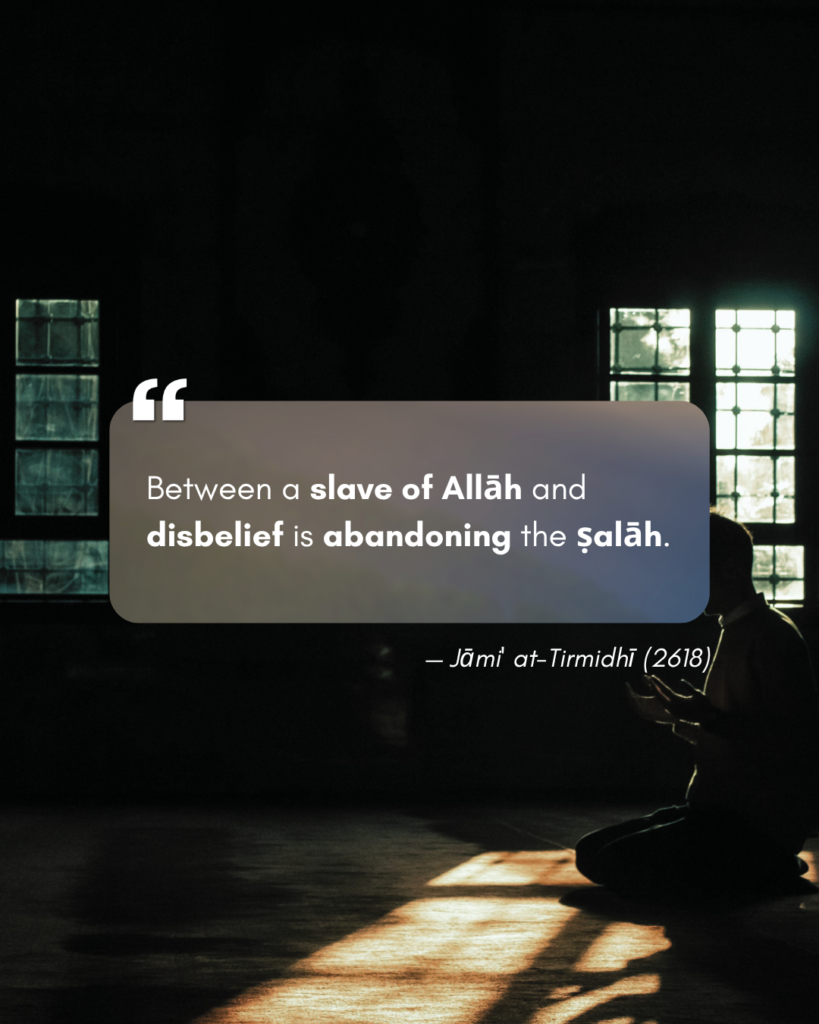
“Between a slave of Allāh and disbelief is abandoning the ṣalāh.”
— Jāmi’ at-Tirmidhī (2618), classed as ṣaḥīḥ by Shaykh al-Albānī
Let the weight of these words settle.
Not “between a slave of Allāh and a hypocrite.” Not “between a slave of Allāh and a sinner.”
Between a slave of Allāh and disbelief itself is abandoning the ṣalāh.
This is not a warning about the one who never prays at all. This is a warning about the boundary line. The moment you leave the ṣalāh, you have stepped away from īmān and toward kufr.
Rasūlullāh ﷺ also said:
“The covenant between us and them is the ṣalāh. Whoever abandons it has committed disbelief.”
— Jāmi’ at-Tirmidhī (2621), classed as ṣaḥīḥ by Shaykh al-Albānī
The word “covenant” here is al-‘ahd. An agreement. A binding contract. The ṣalāh is what separates the believer from the disbeliever. It is the border. It is the line in the sand.
And the Ṣaḥābah understood this completely.
“The Companions of Muhammad ﷺ did not consider leaving anything to be disbelief except for the ṣalāh.”
— Jāmi’ at-Tirmidhī (2622), classed as ṣaḥīḥ by Shaykh al-Albānī
Think about that. Not abandoning fasting. Not abandoning zakāh. Not abandoning ḥajj. Those are grave sins, but they did not remove a person from the fold of īmān in the same way. The one deed that the Ṣaḥābah identified as the boundary line between īmān and kufr was the abandonment of ṣalāh.
Why? Because ṣalāh is not just another deed. It is the anchor of īmān. It is the daily, repeated, intentional standing before Allāh. It is the visible mark of submission. When a person abandons it, they are not just missing a ritual. They are turning away from the very act that defines their relationship with their Creator.
Allāh ʿazza wa jall says:
“And I did not create the jinn and mankind except to worship Me.”
— Sūrah adh-Dhāriyāt (51:56)
The greatest manifestation of that worship is aṣ-ṣalāh. It is the first matter the servant will be questioned about on the Day of Judgment. If it is sound, the rest of the deeds are sound. If it is corrupt, the rest are corrupt. So when a person abandons the ṣalāh, they are not just neglecting a deed. They are abandoning the very purpose of their existence.
And look at us today. We wake up for Fajr and say, “Five more minutes.” Those five minutes become an hour. That hour becomes a missed prayer. Then we tell ourselves, “I’ll make it up later.” But later never comes. We hear the adhān for ʿIshā and we say, “After this episode. After this scroll. After this conversation.” And the prayer time slips away. We live five minutes from the masjid, but we only come for Jumu’ah. We live ten minutes away, and we say “it’s too far.” We have become heedless of aṣ-ṣalāh. And heedlessness is the first step across the line.
Rasūlullāh ﷺ said:
“There are people who pray and get nothing from their prayer but a sleepless night.”
— Sunan Ibn Mājah (1690), classed as ṣaḥīḥ by Shaykh al-Albānī
We rush through our prayers. Our minds are in the marketplace, in our worries, in our phones. We perform the movements but our hearts are absent. But the first step is not perfection. The first step is presence. The first step is showing up. Allāh does not demand that your prayer be perfect. He demands that you pray. That you stand before Him. That you try. And when you fall short, you return. And you return. And you return.
And yet, despite this severe warning, the door of repentance is always open.
Rasūlullāh ﷺ said:
“The one who repents from sin is like one who never sinned.”
— Sunan Ibn Mājah (4250), classed as ḥasan by Shaykh al-Albānī
So if you have abandoned the ṣalāh, do not despair. The door is open. Turn back now. Not tomorrow. Not after this project. Not after this season. Now.
But know this: between you and forgiveness is the ego. The nafs. The whisper that says, “You’ve missed too many. You’re too far gone. What’s the point?” That whisper is from Shayṭān. Do not listen to it.
Allāh ʿazza wa jall says:
“Say, O My servants who have transgressed against themselves, do not despair of the mercy of Allāh. Indeed, Allāh forgives all sins. Indeed, He is the Most Forgiving, the Most Merciful.”
— Sūrah az-Zumar (39:53)
No matter how many prayers you have missed. No matter how long you have been away. The moment you turn back to Allāh, He turns to you. So let the next adhān you hear be the turning point. Not “after this.” Not “tomorrow.” Now.
Stand up. Make wuḍū. Face the Qiblah. And stand before your Lord.
Because between you and disbelief is the ṣalāh. And between you and forgiveness is your own ego. Crush it. Turn back.
May Allāh azza wa jall make us among those who guard their ṣalāh, who pray with presence of heart, and who never cross the line between īmān and kufr. May He forgive us for the prayers we have missed, the prayers we have delayed, and the prayers we have prayed without our hearts. And may He resurrect us with Rasūlullāh ﷺ and the Ṣaḥābah ikrām, and make us among them in Jannah.
Āmīn yā Rabb al-‘Ālamīn, bi rahmatika yā Arḥam ar-Rāḥimīn.