
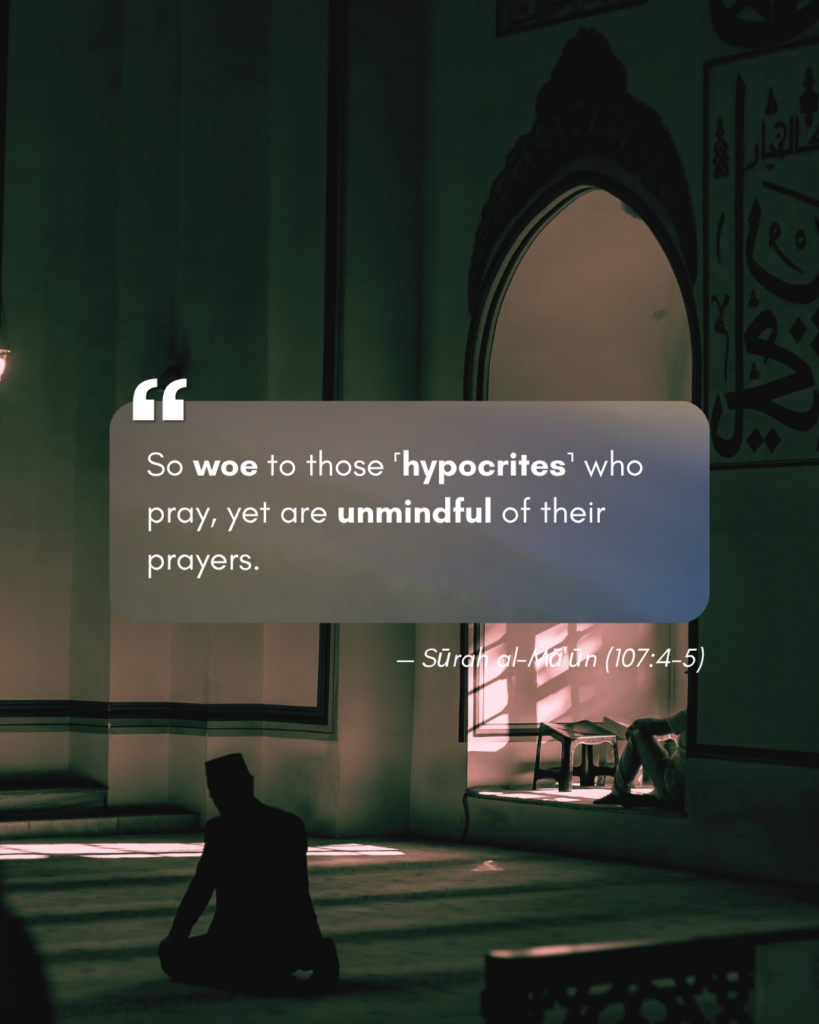
Allāh azza wa jall says in Sūrah al-Mā’ūn:
“So woe to those ˹hypocrites˺ who pray, yet are unmindful of their prayers.”
— Sūrah al-Mā’ūn (107:4–5)
Woe to the Heedless: A warning for those who pray yet are heedless.
Those who perform the actions, but their hearts are absent.
Those who stand before Allāh, yet their minds are elsewhere.
Those who hear the adhān and do not respond.
This is heedlessness. And from its clearest signs is delaying or abandoning the prayer in the masjid without excuse.
Allāh azza wa jall says:
“And I did not create the jinn and mankind except to worship Me.”
— Sūrah adh-Dhāriyāt (51:56)
Not to chase the dunya. Not to be consumed by distractions. Not to build lives that end in dust.
We were created to worship Him. And the greatest pillar of that worship, after tawḥīd, is aṣ-ṣalāh.
And the most complete form of that ṣalāh is the one established in the masjid, in congregation, answering the call of Allāh.
Allāh says:
“By the ˹passage of˺ time. Indeed, mankind is in loss.”
— Sūrah al-‘Aṣr (103:1–2)
Every second that passes is slipping away. Every moment brings us closer to our grave.
And from the greatest losses of time is hearing the adhān and not responding.
Minutes pass. The iqāmah is called. The rows are formed. And still, we delay.
We say, “After this.”
But “after this” becomes never.
But Allāh gives an exception:
“Except those who believe, do righteous deeds, encourage each other to the truth, and encourage each other to patience.”
— Sūrah al-‘Aṣr (103:3)
From the greatest righteous deeds is aṣ-ṣalāh, and it is the first matter the servant will be questioned about on the Day of Judgment. If it is sound, the rest will follow. And if it is corrupted, then the rest will be corrupted.
From encouraging the truth is calling to al-ḥaqq, that the meeting with Allāh is true, that the Day of Judgment is true, and that every soul will stand and be questioned. And from that truth is calling one another to establish the prayer in the masjid before that standing arrives.
And from patience is to persevere through the tests of life and the struggle of obedience, reminding ourselves, “Indeed we belong to Allāh, and indeed to Him we will return.”
— Sūrah al-Baqarah (2:156)
These are the ones saved from loss.
Allāh azza wa jall says:
“The revelation of this Book is—beyond doubt—from the Lord of all worlds.”
— Sūrah as-Sajdah (32:2)
This Qur’ān is not كلام عادي or ordinary. It is tanzīlun min Rabb al-‘Ālamīn.
And this noble Qur’ān calls us, again and again, to establish prayer.
Not as individuals lost in heedlessness, but as a united body responding to the call of Allāh in the masjid.
And Rasūlullāh ﷺ said:
“The Qur’ān will come on the Day of Judgment as an intercessor for its companions who used to act upon it.”
— Ṣaḥīḥ Muslim (804)
From acting upon it is answering its call to prayer. Immediately. Consistently. In the masjid.
Rasūlullāh ﷺ gave a warning that should shake us.
It is narrated in Ṣaḥīḥ Muslim that he ﷺ said:
“By Him in Whose hand is my soul, I considered ordering a fire to be kindled, then I would command a man to lead the people in prayer, then I would go to men who do not attend the congregational prayer and burn their houses down over them.”
— Ṣaḥīḥ Muslim (654)
This is not a light matter.
This is not about extra reward.
This is about a command being neglected.
If absence from the masjid was taken this seriously by Rasūlullāh ﷺ, then what does that say about how lightly we treat it today?
And he ﷺ said:
“Whoever hears the adhān and does not come, there is no prayer for him, unless he has an excuse.”
— Sunan Abī Dāwūd (550)
A severe warning for the one who hears and chooses not to respond.
And by Allāh, I fear for myself and for others that we may begin to hide behind excuses that are not excuses at all. Let each of us ask honestly whether our reasons are truly valid in the sight of Allāh.
We hear the adhān, “Allāhu Akbar, Allāhu Akbar”. And we say, no, it is aṣghar. My shop is akbar. My studies are akbar. And we turn away from the truth because our īmān is weak.
But look how Allāh describes the believers:
“They abandon their beds, invoking their Lord with hope and fear, and spend from what We have provided for them.”
— Sūrah as-Sajdah (32:16)
They leave comfort for the sake of Allāh.
They leave sleep.
They leave ease.
And what about us?
We struggle to leave our beds for Fajr.
We struggle to leave our phones for ‘Ishā.
We live minutes from the masjid, yet delay.
The adhān is called, and we say, “Later.”
But later is not guaranteed.
We recite Sūrah al-Mā’ūn often. We know the words.
But do we feel the warning?
Do we fear being among those who pray, yet are heedless?
Heedlessness is not only distraction within ṣalāh.
It is delaying it.
It is neglecting the masjid.
It is hearing the call of Allāh and choosing something else over it.
So do not be of the heedless.
When you hear the adhān, that is your moment. Your test.
Not tomorrow.
Not after this task.
Not after this scroll.
Will you respond to Allāh, or delay?
And yet, no matter how much we have fallen short, the door is still open.
Allāh azza wa jall says:
“Say, O My servants who have transgressed against themselves, do not despair of the mercy of Allāh. Indeed, Allāh forgives all sins. Indeed, He is the Most Forgiving, the Most Merciful.”
— Sūrah az-Zumar (39:53)
Whatever has passed, has passed.
Missed prayers. Delays. Heedlessness.
All of it can be erased.
Let’s turn back to Allāh. Repent sincerely. Start fresh.
The next adhān you hear can be the beginning of a different life.
A life centered around ṣalāh. A life connected to the masjid. A life lived in obedience to Allāh.
May Allāh azza wa jall make us from those who respond when they are called, establish the prayer in the masjid, and never despair in His mercy.
Āmīn yā Rabb al-‘Ālamīn.
Pingback: The Shade of the 'Arsh – Seven Under the Mercy of Allāh - Paths to Purity
Pingback: The First Question – Why Your Salah is the Anchor of Everything | Paths to Purity