There is a subtle lie we often tell ourselves:
“If I don’t know, then I won’t be held accountable.”
So we avoid learning. We scroll past reminders. We ignore questions that unsettle us. And deep down, we hope that on the Day of Judgment, we can simply say: “I didn’t know.”
But Islam does not accept willful ignorance as an escape from responsibility.
Allāh ﷻ says:
“And do not pursue that of which you have no knowledge. Indeed, the hearing, the sight and the heart—about all those [one] will be questioned.”
— Sūrah Al-Isrā’ (17:36)
This is not only a warning against speaking without knowledge. It is a warning that we are responsible for what we expose ourselves to, and what we deliberately avoid.
And Allāh ﷻ says:
“So ask the people of knowledge if you do not know.”
— Sūrah An-Naḥl (16:43)
Not knowing is not the sin. Remaining in neglect when guidance is accessible is where responsibility begins.
On the Day of Judgment, excuses will not save those who had access to truth.
Allāh ﷻ says:
“Our Lord, we obeyed our leaders and our elders, and they led us astray from the path.”
— Sūrah Al-Aḥzāb (33:67)
They admitted following blindly, but admission without return did not save them.
And the Prophet ﷺ said:
“Seeking knowledge is an obligation upon every Muslim.”
— Ibn Mājah
If seeking knowledge is an obligation, then neglecting it is not neutral. It is something every servant will be questioned about.
And he ﷺ said:
“The feet of a servant will not move on the Day of Resurrection until he is asked about… his knowledge—what did he do with it?”
— Jāmiʿ at-Tirmidhī
Not only what you knew, but what you did with what you were capable of knowing.
So if accountability is real, then what are we meant to do with this life?
Allāh ﷻ answers:
“And I did not create the jinn and mankind except to worship Me.”
— Sūrah adh-Dhāriyāt (51:56)
We were not created for confusion, distraction, or aimlessness. We were created with purpose: to worship Allāh.
So then comes the question: how do we worship Him correctly?
And here, ignorance cannot remain an excuse, because worship is not based on assumption. It is based on knowledge of what pleases Allāh ﷻ.
Allāh ﷻ says:
“We will show them Our signs in the horizons and within themselves until it becomes clear to them that it is the truth.”
— Sūrah Fuṣṣilat (41:53)
The signs are not hidden. They are placed across creation, within ourselves, and through life itself until the truth becomes clear.
So when clarity has reached a person, the question is no longer whether guidance exists.
The question becomes: what will I do with it?
But for those who turn away after clarity, the Qur’an describes regret.
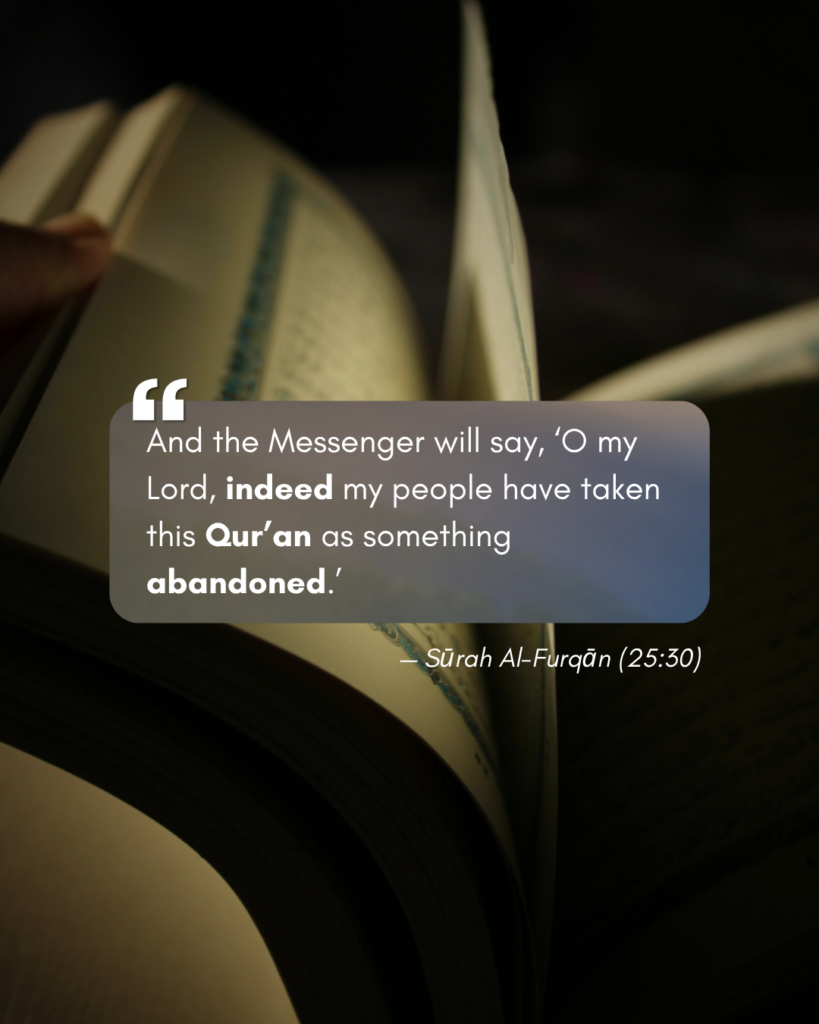
“And the Messenger will say, ‘O my Lord, indeed my people have taken this Qur’an as something abandoned.’”
— Sūrah Al-Furqān (25:30)
“Lest a soul should say, ‘Oh, how great is my regret over what I neglected regarding Allāh…’”
— Sūrah Az-Zumar (39:56)
Regret will not come from lack of exposure.
It will come from neglecting what was already available.
And Allāh ﷻ also says:
“Indeed, those who disbelieve in Our signs, We will drive them into a Fire. Every time their skins are roasted through, We will replace them with other skins so they may taste the punishment.”
— Sūrah An-Nisā’ (4:56)
These are not words to pass over lightly. They are a reminder that the meeting with Allāh is real, and accountability is complete.
It leaves us with honesty.
Because for most of us today, knowledge is not hidden.
The Qur’an is accessible. Reminders reach us constantly. Questions arise and answers are within reach.
So when a person chooses not to look, not to ask, not to learn, that is no longer pure ignorance.
That is avoidance.
And deep down, we know the difference.
The believers are described differently:
“Their sides forsake their beds; they call upon their Lord in fear and hope…”
— Sūrah As-Sajdah (32:16)
They respond when truth reaches them. They move when they are called. They do not delay clarity.
So the real question is not:
“What if I didn’t know?”
It is:
“Why didn’t I try to know?”
And yet, despite everything, Allāh ﷻ keeps the door of return open.
“Say, O My servants who have transgressed against themselves, do not despair of the mercy of Allāh. Indeed, Allāh forgives all sins. Indeed, He is the Most Forgiving, the Most Merciful.”
— Sūrah Az-Zumar (39:53)
No matter how much has passed—delay, negligence, or heedlessness—the door is still open.
Because Allāh is not calling us to despair.
He is calling us back.
And the Prophet ﷺ said in a ḥadīth qudsī that Allāh ﷻ said:
“My mercy prevails over My wrath.”
— Ṣaḥīḥ al-Bukhārī, Ṣaḥīḥ Muslim
And it is written with Him above the Throne.
For the Lord who repeatedly introduces Himself in the Qur’an as Al-Ghafūr ar-Raḥīm over 70 times, and Ar-Raḥmān ar-Raḥīm over 114 times—names that echo throughout His Book—there is always a path back.
So, the one who turns back to Allāh sincerely is never rejected.
No matter how delayed the return was.
No matter how heavy the past feels.
The moment a servant turns back to Allāh, they are met with a mercy greater than what they left behind.
May Allāh azza wa jall protect us from knowledge that does not benefit us, and from hearts that turn away after guidance has reached them. May He forgive our ignorance, our negligence, and our delays. And may He not make us of those who knew the truth but failed to act upon it.
O Allāh, make us people who seek knowledge sincerely for Your sake, and who act upon what they learn with truthfulness and humility. Do not let our shortcomings in the past become a barrier to a better return to You. And do not let what we failed to know become a proof against us on the Day we meet You.
O Allāh, make the Qur’an the light of our hearts, and make us among those who do not abandon it in heedlessness.
And O Most Merciful, Most Forgiving, accept us when we turn back to You.
Āmīn yā Rabb al-‘Ālamīn.