Allāh ʿazza wa jall has always marked certain times and places with unique honour. Rasūlullāh ﷺ explained that the year is made up of twelve months, of which four are sacred. Three come in succession: Dhul Qa‘dah, Dhul Hijjah and Muharram, and the fourth is Rajab. And the greatest among these are the first ten days of Dhul Hijjah.
“The number of months in the sight of Allah is twelve… four of them are sacred. That is the correct religion, so do not wrong yourselves therein.”
— Sūrah al‑Tawbah (9:36)
The Heavier Burden of Sin
The great scholar of the Salaf, Qatādah (rahimahullāh), explained that wrongdoing during these sacred months is more serious and sinful than at any other time. Within this honoured month, the first ten days stand as the pinnacle.
If good deeds are amplified, then sins are equally magnified in their gravity. A wrong action committed now carries a weight far greater than at other times. The very verse that honours these months commands: “Do not wrong yourselves therein.”
This magnification of sin is not meant to push you away from Allāh. Rather, it forces you to confront your own weakness and your need for His mercy.
The Unmatched Mercy of the Day of ‘Arafah
The ninth day of Dhul Hijjah, the Day of ‘Arafah, stands as the pinnacle of these blessed days. For the one not standing on the plain of ‘Arafah, fasting this day is a confirmed Sunnah.
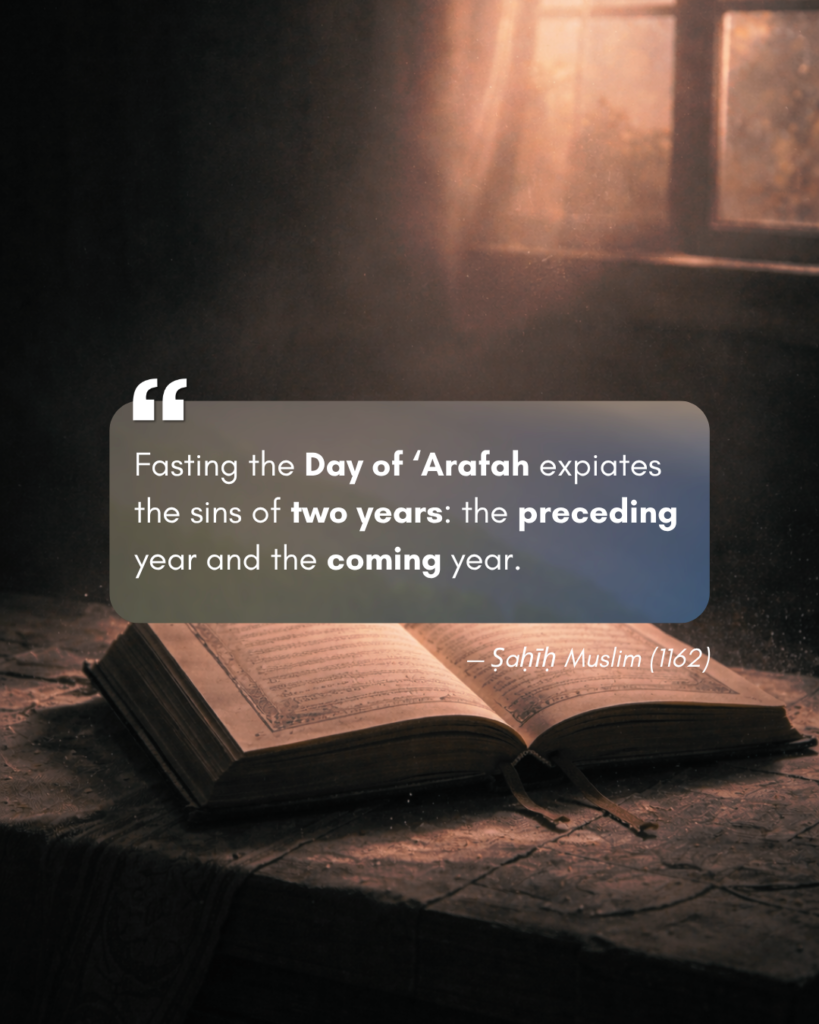
“Fasting the Day of ‘Arafah expiates the sins of two years: the preceding year and the coming year.”
— Ṣaḥīḥ Muslim (1162)
The mercy of Allāh on this day is beyond measure. Rasūlullāh ﷺ said:
“There is no day when Allah sets free more servants from Hell than the Day of ‘Arafah. He draws near, then praises them to the angels, saying: What do these want?”
— Ṣaḥīḥ Muslim (1348)
This is the ultimate gift to the one who turns to Allāh on this day. The sin you abandon for His sake is not just an act of abstinence. By leaving it, you give sadaqah – charity – to your own soul. You purify it. You protect it.
“Verily, you will never leave anything for the sake of Allāh Almighty but that Allāh will replace it with something better for you.”
— Musnad Aḥmad 23074 (classed as ṣaḥīḥ by al‑Albānī)
The gravity of the sin, if committed, is immense. But the reward for abandoning it for His sake is even greater. This is the wisdom of the sacred season: it magnifies your choice, making the contrast between profit and loss starkly visible.
The Multiplication of Rewards
Rasūlullāh ﷺ declared:
“There are no days in which righteous deeds are more beloved to Allah than these ten days.”
— Ṣaḥīḥ al‑Bukhārī (969)
He was asked: “Not even jihād in the Cause of Allah?” He replied:
“Not even jihād, except for a man who goes out with his life and wealth and does not return with any of it.”
— Ṣaḥīḥ al‑Bukhārī (969)
A voluntary prayer or a simple act of charity performed now carries a weight that surpasses even the struggle of jihād, save the most extreme. The small good deed you do in these days is multiplied.
The Most Valuable Dhikr for These Ten Days
Rasūlullāh ﷺ instructed the believers to fill these days with a specific kind of remembrance. He said:
“There are no days in which righteous deeds are more beloved to Allah than these ten days, so you should recite a lot of Tasbīḥ (Subḥānallāh), Taḥmīd (Alḥamdulillāh), Tahlīl (Lā ilāha illallāh) and Takbīr (Allāhu Akbar) therein.”
— Musnad Aḥmad
The Ṣaḥābah (raḍiya Allāhu ‘anhum) would take this instruction literally. Mujāhid narrated that Ibn ‘Umar and Abū Hurayrah (raḍiya Allāhu ‘anhum) used to go out to the marketplace during the first ten days of Dhul‑Hijjah reciting Takbīr, and the people would recite Takbīr along with them. They went to the market only for that purpose. This combination is the most beloved speech to Allāh, words that were recited by Rasūlullāh ﷺ himself and the righteous before us.
The world deceives with its glitter, but these days reveal the truth. The one who truly believes seizes this season to invest in his eternal Hereafter. The one who is heedless delays and says, “Later.” But the angel of death does not wait for the end of the season. Your opportunity is now.
Do not let your own soul be the deceived customer. Give sadaqah to yourself: fast, pray, give charity, remember Allāh abundantly, and above all, abandon every sin for His sake. This is the path that never leads to loss. This is the profit that never ends.
And remember, Rasūlullāh ﷺ said,
“Your Lord is shy and generous, and when His servant raises his hands to Him in du’a (supplication), He is too shy to send them back empty.”
— Sunan Abi Dawud 1488, Sunan at-Tirmidhi 3556 (classed as ṣaḥīḥ by al‑Albānī)
Yā Ghafūr, Yā Raḥīm, forgive us for our sins that are magnified in these sacred days. Yā Nāṣir, Yā Mawlā, Yā Dhā’l-Jalāli wal-Ikrām, grant us the strength to abandon what displeases You and to fill these ten days with deeds beloved to You.
Yā Karīm, accept our small efforts and multiply them. Yā Wadūd, love us despite our weakness, and do not let us leave this season empty‑handed. Make us among those You free from the Fire on the Day of ‘Arafah, and enter us into Your Paradise by Your mercy.
Āmīn yā Rabb al‑‘Ālamīn, bi rahmatika yā Arḥam ar‑Rāḥimīn.