In Sūrah Al-Baqarah, verse 155, Allāh ʿazza wa jall declares:
“We will surely test you with something of fear, hunger, loss of wealth, loss of lives, and loss of provision…”
This is not a possibility. It is a certainty. Every believer will be tested. And SubḥānAllāh, every calamity we experience in life falls within these five categories. No pain is outside of Allāh’s knowledge. No hardship is random.
But Allāh subḥānahu wa taʿālā, in His mercy, does not leave us there, anxious, overwhelmed, wondering how we will endure.
Immediately in the next verse, He says:
“And give glad tidings to the patient.”
Before we can even process the weight of the tests, Allāh places hope right beside hardship. It is as if He is telling us: you will be tested, but there is already a path to success, and there are already people who will succeed.
Then comes the guidance of Al-ʿAlīm, Al-Ḥakīm, Al-Hādī, the One who knows, the Most Wise, the One who guides.
In the very next verse, Allāh teaches us how to become from Aṣ-Ṣābirīn:
“Those who, when calamity strikes them, say: ʾInnā li-llāhi wa-ʾinnā ʾilayhi rājiʿūn.”
SubḥānAllāh, Allāh does not just command patience. He teaches us how to respond in the very moment of pain.
This statement is not مجرد words. It is a complete transformation of perspective.
We belong to Allāh, so nothing we have is truly ours.
And to Him we return, so every loss is temporary.
And the Sunnah of the Messenger ﷺ brings this to life in a way that moves the heart.
The noble companion Abū Salamah (raḍiya Allāhu ʿanhu) once heard the Messenger of Allāh ﷺ teach:
“If any Muslim who suffers a calamity says:
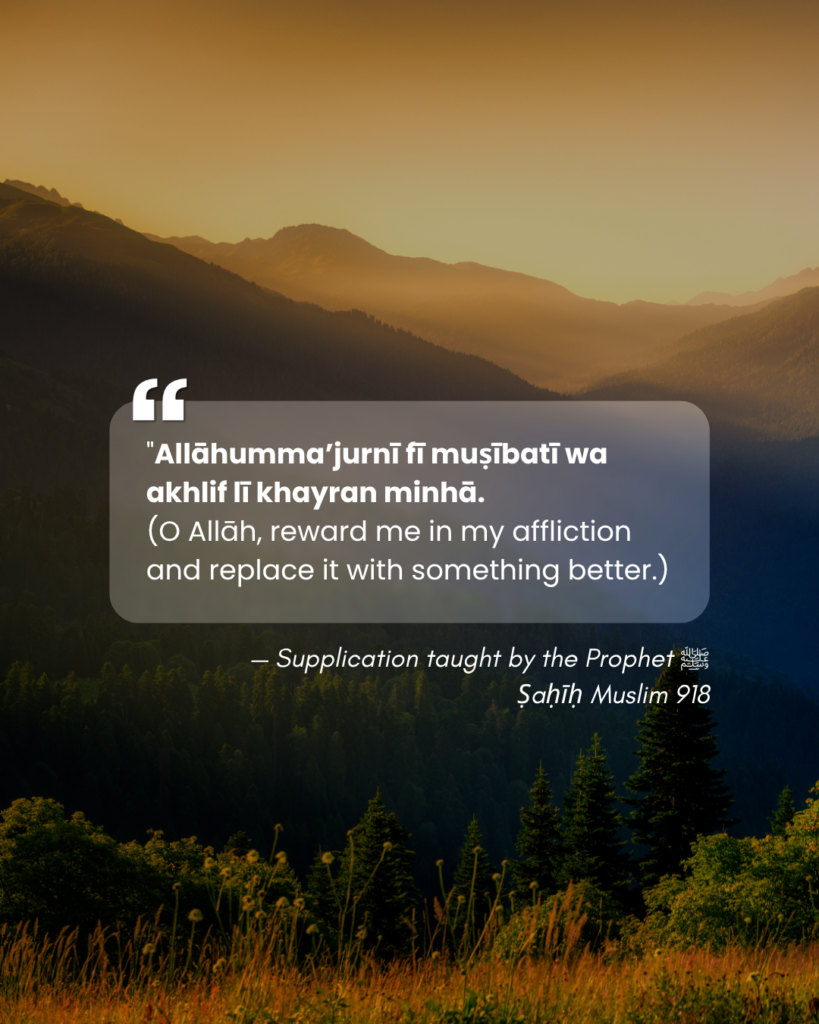
ʾInnā li-llāhi wa-ʾinnā ʾilayhi rājiʿūn. Allāhumma’jurnī fī muṣībatī wa akhlif lī khayran minhā
O Allāh, reward me in my affliction and replace it with something better,
then Allāh will surely grant him something better in return.”
Ṣaḥīḥ Muslim 918
Abū Salamah (raḍiya Allāhu ʿanhu) learned this duʿāʾ and taught it to his wife, Umm Salamah (raḍiya Allāhu ʿanhā).
Then came the test.
Abū Salamah (raḍiya Allāhu ʿanhu) was wounded and later passed away as a martyr. A husband, a companion, a source of love and stability, gone.
In that moment of grief, Umm Salamah (raḍiya Allāhu ʿanhā) did exactly what Allāh described.
She said: ʾInnā li-llāhi wa-ʾinnā ʾilayhi rājiʿūn.
Then she paused.
Her heart questioned: who could possibly be better than Abū Salamah?
But she knew this duʿāʾ came from the Messenger ﷺ. So despite the pain, despite not understanding how, she completed it:
Allāhumma’jurnī fī muṣībatī wa akhlif lī khayran minhā.
And SubḥānAllāh, Allāh fulfilled His promise in a way beyond imagination.
Allāh ʿazza wa jall replaced her loss with the Messenger of Allāh ﷺ, the best of creation, Raḥmatan lil-ʿĀlamīn.
What she could not imagine, Allāh had already decreed.
This is the reality of Allāh’s promise.
Not just patience, but replacement.
Not just endurance, but elevation.
And when we reflect again on the tests:
Fear. The anxieties that shake the heart.
Hunger. Deprivation and discomfort.
Loss of wealth. Financial and worldly loss.
Loss of life. Even illness falls here. A fever weakens you, takes your energy, and takes a day from your full capacity of living.
Loss of provision. Energy, opportunity, and stability.
Every single hardship fits.
So when a believer responds with this dhikr and this duʿāʾ, they are not just coping. They are walking a path already laid out by Allāh, a path that leads to:
“Blessings from their Lord, and mercy, and they are the rightly guided.”
So every calamity is not just pain.
It is an invitation.
An invitation to return.
An invitation to trust.
An invitation to witness Allāh’s waʿd.
An invitation to rise among Aṣ-Ṣābirīn.
May Allāh ʿazza wa jall make us among the Aṣ-Ṣābirīn, resurrect us with the Messenger of Allāh ﷺ and his companions (raḍiya Allāhu ʿanhum), and among the shuhadāʾ, the ṣiddīqīn, and the ṣāliḥīn on the Day of Judgment. And may He grant us the shade of His ʿArsh on the Day when there will be no shade but His shade. And may He guide us from calamity to glad tidings. Āmīn, yā Rabb al-ʿĀlamīn, bi-raḥmatika yā Arḥam ar-Rāḥimīn.