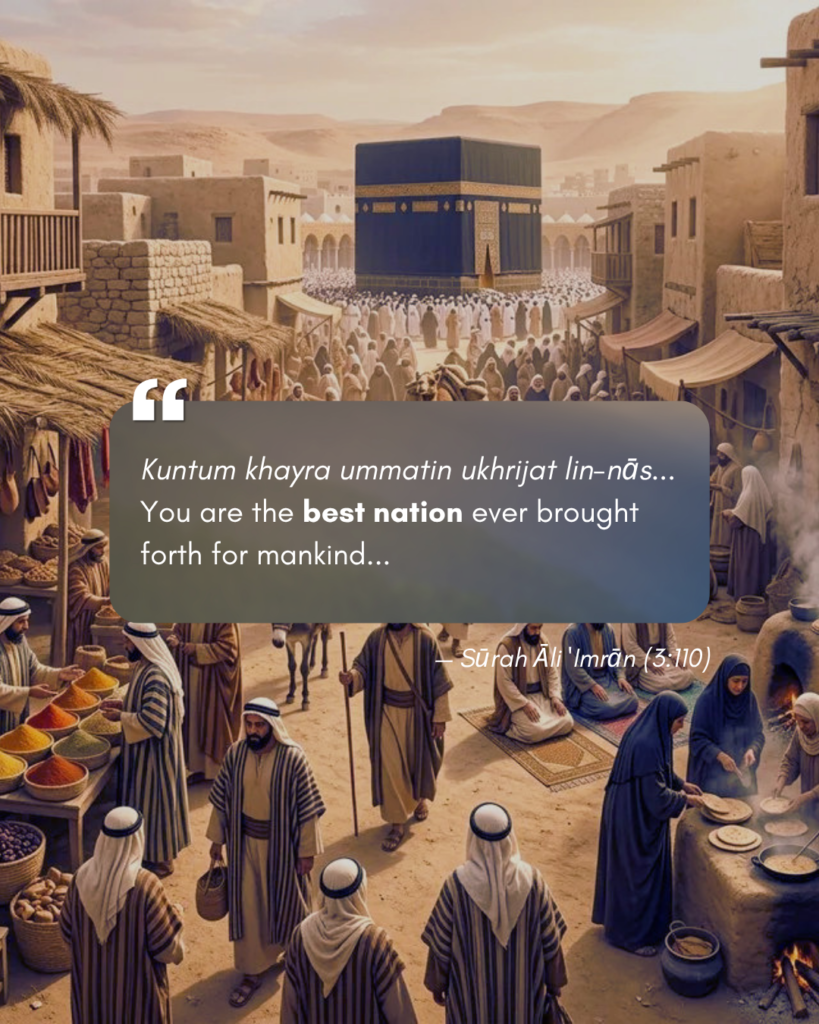
Kuntum khayra ummatin ukhrijat lin-nāsi
You are the best nation ever brought forth for mankindta’murūna bil-ma’rūfi wa tanhawna ‘anil-munkari
you enjoin what is right, forbid what is wrongwa tu’minūna billāh
and believe in Allah— Sūrah Āli ‘Imrān (3:110)
This is how Allāh honored this ummah. Chosen. Honored. Entrusted with the greatest message ever given to humanity.
Not because of your lineage. Not because of your wealth. Not because of your power. Because Allāh chose you. He honored you with carrying His message. This verse is not a badge of arrogance; it is a call to responsibility. It is a divine vote of confidence from the Lord of all worlds.
Who Are the Best Believers?
‘Ā’ishah (raḍiya Allāhu ‘anhā) once asked Rasūlullāh ﷺ about the verse:
“And they who give what they give while their hearts are fearful because they will be returning to their Lord.”
— Sūrah al-Mu’minūn (23:60)
She asked: “Are these the ones who drink alcohol and steal?”
Rasūlullāh ﷺ said:
“No, O daughter of aṣ-Ṣiddīq. They are those who fast, pray, and give charity, yet they fear that it will not be accepted from them.”
Then he recited the next verse:
“It is these who hasten to do good deeds, and they are the foremost of them.”
— Sūrah al-Mu’minūn (23:61)
— Jāmi’ at-Tirmidhī (3175), classed as ṣaḥīḥ by Shaykh al‑Albānī
These are the best believers. They strive in obedience, they race toward good deeds, and yet they still tremble at the thought of disappointing Allāh. They have hope in His mercy and fear of His justice. That is the heart of this Ummah.
The Three Qualities of the Best Nation
Allāh did not give this honor randomly. He attached it to three qualities:
- Commanding the good (amar bil-ma’rūf)
- Forbidding the evil (nahi ‘anil-munkar)
- Belief in Allāh (īmān billāh)
And Allāh says elsewhere:
“Let there be a nation among you who call to good, enjoin what is right, and forbid what is wrong. And it is they who are successful.”
— Sūrah Āli ‘Imrān (3:104)
Notice the wording. It is not optional. It is the mark of the Ummah that Allāh calls the best. And Rasūlullāh ﷺ gave us the practical way to fulfill this:
“Whoever among you sees an evil, let him change it with his hand. If he is unable, then with his tongue. If he is unable, then with his heart—and that is the weakest of faith.”
— Ṣaḥīḥ Muslim (49a)
This is the path of the best nation. You see wrong, you do something. You do not remain silent. You do not normalize it. You do not accept it. You act with your hand, your tongue, or at least your heart.
The Warning from Banu Isra’il
Allāh warns us through the fate of Banu Isra’il. They were given revelation, they were honored with prophets, and yet they fell because they abandoned amr bil ma’rūf wa nahi ‘anil munkar. Allāh says:
“Cursed were those who disbelieved among the Children of Israel by the tongue of David and of Jesus, the son of Mary. That was because they disobeyed and [habitually] transgressed. They did not forbid one another from the evil they committed. Evil indeed was what they used to do.”
— Sūrah al-Mā’idah (5:78-79)
This is a direct warning to this Ummah. The honor of being the best nation is conditional. If we abandon the very qualities that made us the best, we risk the same fate.
Rasūlullāh ﷺ warned in a hadith recorded by Imam Abu Bakr ibn Abi al-Dunya (rahimahullah) on the authority of Sayyiduna ‘Abdullah ibn ‘Umar (radiyallahu ‘anhuma):
“Command righteousness and prohibit evil otherwise Allah will appoint a tyrant ruler over you who will inflict a painful punishment. Your pious men will supplicate [to Allah for aid], but they will not be answered. Command righteousness and prohibit evil otherwise Allah will appoint such a ruler who will not respect your seniors nor show mercy to your little ones.”
— Al-Amr bil Ma’rūf (Hadith: 8)
And in another narration recorded by Imam Tirmidhi (rahimahullah), Sayyiduna Hudhayfah ibn Yaman (radiyallahu ‘anhu) reports that Rasūlullāh ﷺ said:
“You should certainly enjoin good and forbid evil else Allah will swiftly send a punishment, then you will supplicate to Him but your supplication will not be answered.”
— Sunan at-Tirmidhī (2169), classed as ḥasan by Shaykh al‑Albānī
When a people stop commanding good and forbidding evil, they lose the barakah (blessing) of wahy. The scholars explain that being deprived of the barakah of wahy means being deprived of understanding the Qur’ān, as well as being deprived of the enjoyment of its recital, and not taking heed of its teachings—despite mastering its recital and its explanations. ‘Allāmah Munāwī (rahimahullāh) explains:
“Being deprived [of the barakah of wahy means] being deprived of understanding the Quran, as well as being deprived of the enjoyment of its recital in addition to not taking heed of its teachings, despite one mastering its recital and its explanations (tafsīr).”
— Fayḍ al-Qadīr Sharḥ al-Jāmiʿ al-Ṣaghīr (Hadith: 760)
This is exactly what we see in the world today. People recite the Qur’ān beautifully, yet its guidance does not penetrate their hearts. The light of revelation is present, but its blessing is lifted because the people have abandoned their duty to enjoin good and forbid evil.
Banu Isra’il were punished not because they lacked knowledge, but because they failed to act on it. They saw wrongdoing and remained silent. They watched evil spread and did nothing. Their scholars sold their duty for worldly gain, and the people followed their leaders into destruction.
This is the warning for this Ummah. The barakah of the Qur’ān is not automatic. It is tied to our obedience to Allāh’s commands—especially the command to enjoin good and forbid evil. When we abandon this duty, we lose the understanding of the Qur’ān, and we lose the enjoyment of its recital. The words remain, but their light fades.
The Highest Form of Enjoining Good
And the highest, most complete form of this command is da’wah: calling people to Allāh Himself.
Allāh asks a question that should stop every one of us in our tracks:
“Who is better in speech than one who calls to Allāh, does righteousness, and says, ‘Indeed, I am among the Muslims’?”
— Sūrah Fuṣṣilat (41:33)
No one. There is no one better in speech than the one who calls to Allāh. The one who enjoins good and forbids evil is doing something noble. But the one who calls to the very source of all good; who says, “Come to Allāh. Come to your Creator”; that person is elevated above all others in speech.
This is the way of the Prophets; not condemnation, but invitation. Not harshness, but mercy. Not driving away, but drawing close. Rasūlullāh ﷺ said:
“Make things easy and do not make them difficult. Give glad tidings and do not drive people away.”
— Ṣaḥīḥ al‑Bukhārī (69) and Ṣaḥīḥ Muslim (1732)
Allāh describes this path with a subtle, beautiful nuance in Sūrah Yūsuf:
“Say: This is my path. I invite to Allāh with insight, I and those who follow me…”
— Sūrah Yūsuf (12:108)
The verse uses the feminine demonstrative pronoun “hādhihi” rather than the masculine “hādhā”. Some contemporary scholars have reflected that this choice carries a profound message: that the way of da’wah is one of softness, mercy, and refined character. Just as the feminine form conveys tenderness and nurturing, so too must the caller to Allāh embody compassion, patience, and humility.
There is a subtle beauty in the difference between hukm (ruling) and ḥikmah (wisdom). If you ask someone, “What is the ruling for the one who abandons the ṣalāh?” they will likely answer, “Kāfir.” And that may be the legal ruling. But if you ask someone who has been touched by gentleness, they will say, “I will take them with me to the masjid.” This is not hukm. This is ḥikmah. Wisdom. Both words come from the same root, yet one tells you where the line is, and the other tells you how to bring someone back across it.
The Trust of This Ummah
This is the trust placed upon this final Ummah. In previous nations, it was enough to simply worship Allāh:
“I did not create jinn and mankind except to worship Me.”
— Sūrah adh-Dhāriyāt (51:56)
But for this Ummah—the final nation—our role carries a heavier trust. Since Rasūlullāh ﷺ is the last Messenger, the duty of carrying his message continues through us. Da’wah is not merely a noble act; it is a personal obligation (farḍ ‘ayn) upon every believer in some capacity.
Rasūlullāh ﷺ said in his final sermon:
“Convey from me, even if it is a single verse.”
— Ṣaḥīḥ al‑Bukhārī (3461)
This instruction was not for the elite or the learned alone. It was for the Ummah as a whole. Our silence cannot be an excuse when we carry even a word of truth.
Your “one word” might be a gentle reminder of Allāh’s mercy to a disheartened friend. It might be sharing a beneficial hadith. It might be simply embodying the kindness of Islamic character in how you treat others.
Every time you share a verse, a hadith, or a word of sincere advice, you are fulfilling this sacred trust. You become a link in the unbroken chain conveying the light of the Prophet ﷺ to a world in need of it.
And the best way to enjoin good and forbid evil is not to shame people, but to lift them. To show them who they truly are in the sight of Allāh. To remind them: “Look how Allāh sees you. He said you are the best of nations. So act like it.”
That is the most effective way to invite others to good. It appeals to their identity, their honor, and their love for Allāh.
The Honor of Being Chosen
When Allāh says, “You are the best nation,” He is not saying you are already perfect. It is as if He is saying: “I have honored you with this responsibility. Rise to the standard I have set for you.” And the highest examples belong to Allāh.
This is not a burden. It is an honor. Allāh is entrusting you with His message. He is choosing you to be the example for all of humanity. That is a gift beyond measure.
And Allāh promises help for those who carry this responsibility:
“And whoever fears Allāh—He will make for him a way out. And will provide for him from where he does not expect.”
— Sūrah aṭ-Ṭalāq (65:2-3)
So do not fear the people. Do not fear their rejection. Do not fear their mockery. Allāh says:
“That is only Satan who frightens you of his supporters. So do not fear them, but fear Me, if you are believers.”
— Sūrah Āli ‘Imrān (3:175)
When you stand for truth, you stand with Allāh. And you do not fear Nās when you have with you Rabb an-Nās.
When you stand with the Lord of mankind, the people of mankind become insignificant. Their rejection, their mockery, their opposition—none of it matters. Allāh is with you. And that is enough.
Yā Rabb, we thank You for choosing us to be part of this Ummah. We are not worthy of this honor except by Your mercy. Help us to enjoin what is right and forbid what is wrong with wisdom and kindness. Do not let us bring shame to the name of Your Prophet ﷺ or to this Ummah. Forgive us for the times we have fallen short, and grant us the strength to rise again.
Yā Hādī, guide us to the straight path and keep us firm upon it.
Yā Qawī, give us strength when we are weak and courage when we are afraid.
Yā Ghafūr, forgive us for the sins we commit openly and the ones we hide.
Yā Raḥmān, have mercy on us in this life and the next, and do not abandon us to ourselves for even the blink of an eye.
Yā Karīm, accept our small efforts and multiply them. Make us of those who call to You with gentleness and wisdom, who enjoin good and forbid evil with sincerity and love. Unite us with Your Prophet ﷺ and the righteous in the highest gardens of Paradise, not by our deeds, but by Your mercy.
Āmīn yā Rabb al-‘Ālamīn.