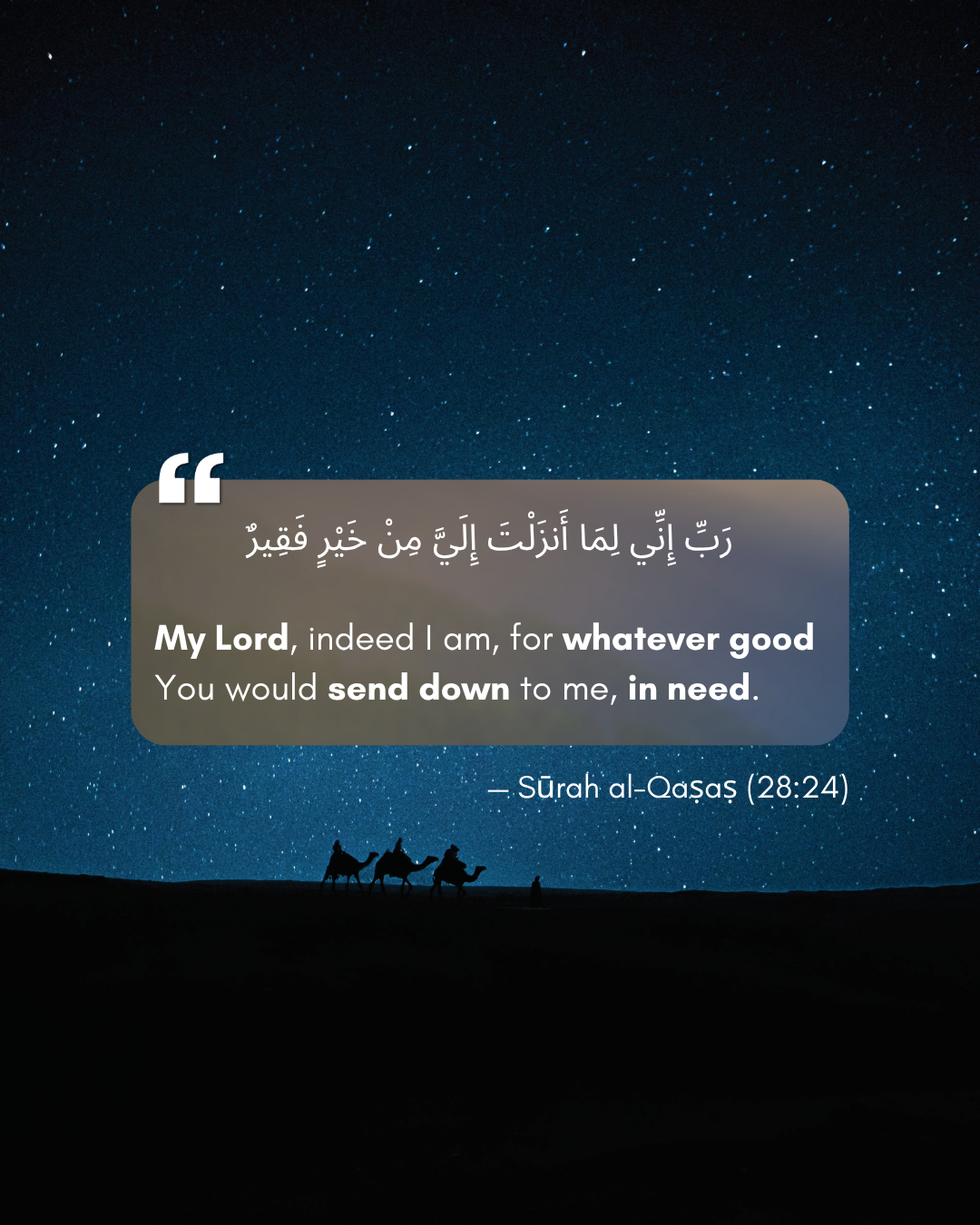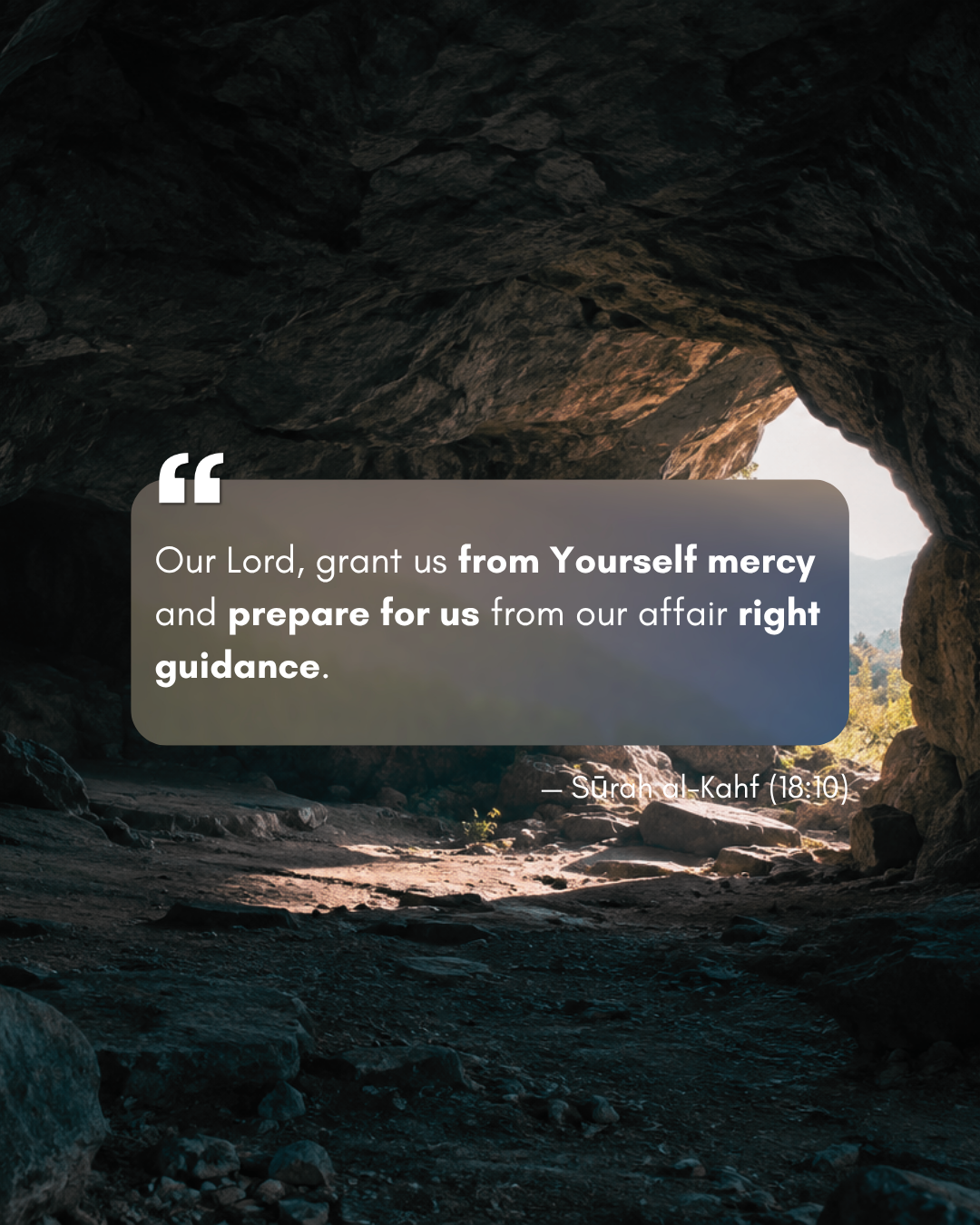

The Du’ā of Mūsā: When Reliance Is Tested

Sūrah Ṭā Hā (20:17)

Before Mūsā ‘alayhissalām was given the heaviest mission on earth, to stand before Fir’awn the tyrant who claimed lordship, he was given a lesson.

At the sacred valley of Ṭuwā, Mūsā ‘alayhissalām has just been called. And Allāh ‘azza wa jall introduces Himself with the foundation upon which everything else rests:

إِنَّنِي أَنَا اللَّهُ لَا إِلَٰهَ إِلَّا أَنَا فَاعْبُدْنِي وَأَقِمِ الصَّلَاةَ لِذِكْرِي
Innanī ana Allāh. Lā ilāha illā anā, faʿbudnī wa aqimiṣ-ṣalāta lidhikrī.
“Indeed, I am Allāh. There is no god except Me, so worship Me and establish prayer for My remembrance.”
— Sūrah Ṭā Hā (20:14)

Tawḥīd. The absolute singularity of Allāh ‘azza wa jall in His essence, His names, and His authority.

Then, after this declaration, Allāh ‘azza wa jall turns His attention to the object in Mūsā’s hand.

وَمَا تِلْكَ بِيَمِينِكَ يَا مُوسَىٰ
Wa mā tilka bi-yamīnika yā Mūsā?
“And what is that in your right hand, O Mūsā?”
— Sūrah Ṭā Hā (20:17)

And here we must pause. Because Allāh ‘azza wa jall knows. He has ʿilm al-ghayb. He knows what was, what is, and what will be. He knows the atoms of the staff. He knows the thoughts racing through Mūsā’s heart. He knows the future: the snake, the fear, the grasping, the return, the mission, the staff striking the sea, the staff splitting rocks. He knows it all.

So why does He ask?

He asks so that Mūsā ‘alayhissalām may speak. He asks so that Mūsā may articulate his reliance. He asks so that the servant may utter the very word that will later be tested.

And Mūsā ‘alayhissalām, the Kalīm of Allāh, replies with full honesty:

قَالَ هِيَ عَصَايَ أَتَوَكَّأُ عَلَيْهَا وَأَهُشُّ بِهَا عَلَىٰ غَنَمِي وَلِيَ فِيهَا مَآرِبُ أُخْرَىٰ
Qāla hiya ʿaṣāya. Atawakka’u ʿalayhā wa a-hushshu bihā ʿalā ghanamī, wa liya fīhā ma’āribu ukhrā.
“It is my staff. I lean on it, and I beat down leaves for my sheep, and I have other uses for it.”
— Sūrah Ṭā Hā (20:18)

Notice the word. Atawakka’u: I lean on it. I rely on it. In the Arabic language, tawakkul is reliance, trust, the leaning of the heart upon something with full confidence. And here, Mūsā ‘alayhissalām uses that very root to describe his relationship with a stick. A branch of a tree. Dead wood.

So Allāh ‘azza wa jall, al-ʿAlīm al-Ḥakīm, the One who corrects and purifies, says:

أَلْقِهَا يَا مُوسَىٰ
Alqihā yā Mūsā.
“Throw it down, O Mūsā.”
— Sūrah Ṭā Hā (20:19)

He throws it. And that dead wood, that object of tawakkul, becomes a living, slithering snake. Moving with life. A threat. A harm. Something to flee from.

فَلَمَّا رَآهَا تَهْتَزُّ كَأَنَّهَا جَانٌّ وَلَّىٰ مُدْبِرًا وَلَمْ يُعَقِّبْ
Falammā ra’āhā tahtazzu ka-annahā jānnun wallā mudbiran wa lam yuʿaqqib.
“And when he saw it moving as if it were a snake, he turned away in flight and did not look back.”
— Sūrah al-Qaṣaṣ (28:31)

He feared. He fled. That which he relied upon became that which he feared.

Then Allāh ‘azza wa jall commands him:

خُذْهَا وَلَا تَخَفْ ۖ سَنُعِيدُهَا سِيرَتَهَا الْأُولَىٰ
Khudh-hā wa lā takhaf. Sanu’īduhā sīratahā al-ūlā.
“Grasp it and do not fear. We will return it to its former state.”
— Sūrah Ṭā Hā (20:21)

He grasps it. It becomes a staff again. And the lesson is complete.

What was dead became alive. What was a means of harm became a means of comfort. The staff was never the source. Allāh ‘azza wa jall is the source. Wa huwa ‘alā kulli shay’in qadīr. And Allāh ‘azza wa jall brings life out of death, and death out of life.

يُخْرِجُ الْحَيَّ مِنَ الْمَيِّتِ وَيُخْرِجُ الْمَيِّتَ مِنَ الْحَيِّ
Yukhrijul ḥayya minal mayyit, wa yukhrijul mayyita minal ḥayy.
“He brings the living out of the dead, and He brings the dead out of the living.”
— Sūrah al-An’ām (6:95)

This is not a footnote. This is the thesis of the entire scene. The means (asbāb) are dead without Him. The staff is dead wood. It has no power to move, to harm, or to benefit. The snake is alive, but only because Allāh ‘azza wa jall willed it. Then it returns to dead wood, again, because Allāh ‘azza wa jall willed it.

إِنَّمَا أَمْرُهُ إِذَا أَرَادَ شَيْئًا أَنْ يَقُولَ لَهُ كُنْ فَيَكُونُ
Innamā amruhu idhā arāda shay’an an yaqūla lahū kun fa-yakūn.
“His command is only that when He wills a thing, He says to it, ‘Be,’ and it is.”
— Sūrah Yā-Sīn (36:82)

Allāh ‘azza wa jall is above the means. Wa huwa ‘alā kulli shay’in qadīr. He is al-Qadīr, the All-Powerful. Over all things competent. He is al-Khāliq, the Creator of the means and their effects.

Now, and only now, after the lesson is internalized, Allāh ‘azza wa jall gives the mission:

اذْهَبْ إِلَىٰ فِرْعَوْنَ إِنَّهُ طَغَىٰ
Idh-hab ilā Fir’awn. Innahū ṭaghā.
“Go to Fir’awn. Indeed, he has transgressed.”
— Sūrah Ṭā Hā (20:24)

The one who claimed to be a god. The one who drowned children. The one who said: ana rabbukum al-aʿlā — “I am your lord, the most high.” Mūsā ‘alayhissalām is told to go to him. Alone. Without an army. Without his brother. Without a weapon.

And Mūsā ‘alayhissalām, despite the lesson, despite his firm īmān, despite knowing Allāh ‘azza wa jall is al-Nāfi’ (the One who brings benefit) and al-Ḍārr (the One who brings harm), feels the weight. He feels the fear. He knows his weakness. His throat tightens. His chest constricts. His tongue stumbles.

The staff was in his hand. But his tawakkul is no longer there. It has shifted, fully and finally, from the object he could see to the One who cannot be seen. He leans now, not on dead wood, but on al-Ḥayyal-Qayyūm. And that reliance finds its voice.

Subḥānallāh. Consider the humility of the ambiyā’. They did not shield themselves behind claims of self-sufficiency. They laid their weakness before the One who created them, teaching us that true strength lies in acknowledging one’s need for Allāh ‘azza wa jall. They expressed their vulnerability to the One who alone can remove it.

And here is another layer. A hidden depth.

Mūsā ‘alayhissalām did not have the treasure that was saved for the Ummah of Muḥammad ﷺ. He did not possess “Lā ḥawla wa lā quwwata illā billāh.” That was stored for this final nation, a treasure from beneath the Throne, a door to Jannah, a cure for anxiety and sorrow. The Messenger of Allāh ﷺ said:

“Shall I not teach you a word that is a treasure from the treasures of Paradise? Lā ḥawla wa lā quwwata illā billāh.”
Ṣaḥīḥ al-Bukhārī (6384)

Mūsā ‘alayhissalām did not have that. So instead of a formula, he gave his Lord raw, unfiltered honesty. He laid his soul bare.

The Du’ā of Mūsā ‘alayhissalām:

رَبِّ اشْرَحْ لِي صَدْرِي. وَيَسِّرْ لِي أَمْرِي. وَاحْلُلْ عُقْدَةً مِنْ لِسَانِي. يَفْقَهُوا قَوْلِي.
Rabbi ishraḥ lī ṣadrī. Wa yassir lī amrī. Waḥlul ʿuqdatam min lisānī. Yafqahū qawlī.
“My Lord, uplift my chest for me. And make my task easy for me. And remove the impediment from my tongue so they may understand my speech.”
— Sūrah Ṭā Hā (20:25-28)

Three requests. Three keys to every impossible task.

First: Ishraḥ lī ṣadrī — Uplift my chest.

The root is sharḥ, which means to cut open, to expand, to remove constriction and tightness. It is the opposite of ḍīq, the feeling of suffocation, of being boxed in.

Allāh ‘azza wa jall uses the same root when He addresses His own Rasulullah ﷺ:

أَلَمْ نَشْرَحْ لَكَ صَدْرَكَ
Alam nashraḥ laka ṣadrak?
“Did We not open your chest for you?”
— Sūrah al-Inshirāḥ (94:1)

The same divine action. The same divine mercy. Mūsā ‘alayhissalām asked for what Muḥammad ﷺ was already given. And Allāh ‘azza wa jall answered both.

When fear constricts your heart, when anxiety makes you feel trapped, when the task ahead feels impossible, say this du’ā. Ask Allāh ‘azza wa jall to cut open the tightness. To breathe into your soul. To replace fear with courage.

Second: Wa yassir lī amrī — And make my task easy.

The root is yusr, the opposite of ʿusr (difficulty). Allāh ‘azza wa jall says:

فَإِنَّ مَعَ الْعُسْرِ يُسْرًا. إِنَّ مَعَ الْعُسْرِ يُسْرًا
Fa-inna maʿal-ʿusri yusrā. Inna maʿal-ʿusri yusrā.
“For indeed, with hardship comes ease. Indeed, with hardship comes ease.”
— Sūrah al-Inshirāḥ (94:5-6)

Mūsā ‘alayhissalām did not ask for the mission to be removed. He did not ask for a different assignment. He asked for it to be made easy. He accepted the mission. He just needed help carrying it.

When you are overwhelmed, do not ask for escape. Ask for ease within the task. Ask Allāh ‘azza wa jall to smooth the road, to open doors, to remove obstacles.

Third: Waḥlul ʿuqdatam min lisānī — And remove the knot from my tongue.

The root is ʿaqada, meaning to tie, to tangle, to form a knot. Mūsā ‘alayhissalām had a real impediment. There is a reason for this.

As recorded in Tafsīr Ibn Kathīr, commentary on Sūrah Ṭā Hā (20:25-28):
Ibn Kathīr (raḥimahullāh) relates the story: When Mūsā ‘alayhissalām was a child, Fir’awn brought him forward. The courtiers suspected he might be the child who would destroy Fir’awn’s kingdom. To test him, they placed a piece of glowing-hot coal and a ruby in front of him. If he took the ruby, he was intelligent and dangerous. If he took the coal, he was foolish and harmless. An angel guided Mūsā’s hand to the coal. He took it, put it in his mouth, and his tongue was burned. That burn, that knot, remained with him for life.

He had a physical impediment. But Allāh ‘azza wa jall chose him anyway.

And the knot is not just physical. It is the knot of hesitation, of second-guessing, of anxiety before speaking. It is the stutter of the soul. Mūsā ‘alayhissalām asks for it to be untied. He asks for clarity.

And note: the request is not for rhetorical performance. Some translations render yafqahū qawlī as “so that they may understand my speech,” while others emphasize “eloquence” or “clarity of expression.” At its core, the du’ā is for the removal of the barrier — whether it is a physical knot, a psychological hesitation, or a lack of linguistic clarity. The purpose is to ensure the message reaches its target, not to impress the listener with rhetorical flourish.

The Answer

Allāh ‘azza wa jall responds:

قَالَ قَدْ أُوتِيتَ سُؤْلَكَ يَا مُوسَىٰ
Qāla qad ūtīta su’laka yā Mūsā.
“He said, ‘You have been given your request, O Mūsā.'”
— Sūrah Ṭā Hā (20:36)

This is Al-Karīm, the Most Generous, who does not turn away a servant who calls upon Him with sincerity.

Mūsā ‘alayhissalām was given:
A heart that knew no fear against Fir’awn.
A mission that was made smooth, step by step, miracle by miracle.
A tongue that spoke the words that broke the tyrant’s arrogance.

And what about us?

We have not been given a snake or a staff. But we have been given something greater. We have been given “Lā ḥawla wa lā quwwata illā billāh.” A treasure. A weapon. A cure.

But we also have his du’ā. And we are permitted to say it.

When the test feels impossible. When the conversation with a difficult person feels paralyzing. When your chest tightens before da’wah, or before standing for truth.

Say:

Rabbi ishraḥ lī ṣadrī. Wa yassir lī amrī. Waḥlul ʿuqdatam min lisānī. Yafqahū qawlī.

Your Lord is the same Lord of Mūsā ‘alayhissalām. Al-Karīm. Al-Mujīb (the Responsive). Al-Qarīb (the Near).

وَإِذَا سَأَلَكَ عِبَادِي عَنِّي فَإِنِّي قَرِيبٌ ۖ أُجِيبُ دَعْوَةَ الدَّاعِ إِذَا دَعَانِ
Wa idhā sa-alaka ʿibādī ʿannī fa-innī qarīb. Ujību daʿwata ad-dāʿi idhā daʿān.
“And when My servants ask you about Me, indeed, I am near. I respond to the invocation of the supplicant when he calls upon Me.”
— Sūrah al-Baqarah (2:186)

He answered Mūsā ‘alayhissalām. He will answer you.

The means are dead without Him. But with Him, a staff can part a sea. A shepherd can break a king. And a trembling tongue can bring down a throne.

And so, before I close, I pour my heart out to my Lord.

Yā Rabb, we confess to You what Mūsā confessed — that we have leaned on our staffs. We have placed our tawakkul in our wealth, our plans, our connections, our health, and our own understanding. We have called it reliance, but it was only wood. Forgive us for the times we forgot that the means are dead without Your command, and that You alone are al-Muḥyī and al-Mumīt.

Yā Shāriḥ aṣ-Ṣudūr, open our chests as You opened the chest of Mūsā ‘alayhissalām, and as You opened the chest of Rasūlullāh ﷺ. When fear constricts us and the task ahead feels impossible, cut open the tightness. Replace the ḍīq with courage. Replace the anxiety with certainty in You.

Yā Muyassir, make easy for us every affair we dread. We do not ask You to remove the mission. We ask You to smooth the road. Open the doors we cannot open. Remove the obstacles we cannot move. And when we feel the weight of what You have placed upon us, remind us that with every ʿusr comes yusr — and that the yusr is already decreed.

Yā Muqīl, untie the knots from our tongues. The knots of fear, of hesitation, of second-guessing. Let our words be clear, our arguments be strong, and our message reach the hearts of those who hear us — not by our eloquence, but by Your permission.

Yā Rabb, You answered Mūsā when he laid his weakness before You. You did not turn him away. You said: Qad ūtīta su’laka yā Mūsā — you have been given your request. We come to You with the same weakness, the same fear, the same need. We have been given what Mūsā did not have: Lā ḥawla wa lā quwwata illā billāh. Make us of those who utter it with certainty, and who live by it with action. And do not let us stand before the Fir’awn of our own nafs and retreat.

Āmīn yā Rabb al-ʿĀlamīn, bi-raḥmatika yā Arḥam ar-Rāḥimīn.

Scroll to Top