
﷽
Allāh ʿazza wa jall says:
Wa mā khalaqtu al-jinna wa al-insa illā liyaʿbudūn
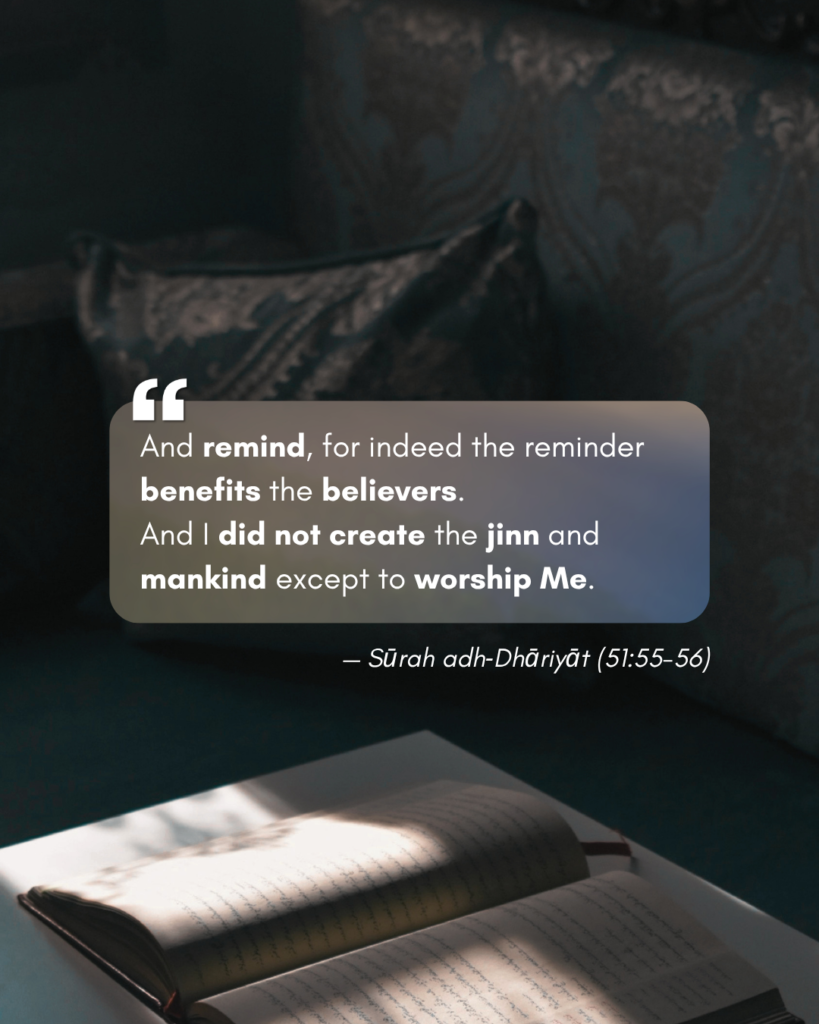
“And I did not create the jinn and mankind except to worship Me.”
— Sūrah adh‑Dhāriyāt (51:56)
This is the purpose of creation. You were not created to accumulate wealth, to chase status, or to build empires that will crumble. You were created to worship Allāh.
But what does it mean to worship? Ibn ‘Abbās (raḍiya Allāhu ‘anhumā), the great scholar of the Ṣaḥābah, said: “Li ya’budūn” means “li ya’rifūn” – to know Me.
Worship is not merely ritual. It is the expression of knowing Allāh. When you truly know Him, your submission is not forced. It flows from the heart. It is the natural response of a servant who has come to understand who his Lord is. Imām al‑Baghawī said: “Had He not created them, they would never have known of His existence or divinity.”
We do not worship Allāh for what He does for us. We worship Him for who He is. He is al‑Khāliq, the Creator. al‑Razzāq, the Provider. al‑Qayyūm, the Self‑Subsisting. He is al‑Wadūd, the Loving. al‑Ghafūr, the All‑Forgiving. al‑Karīm, the Generous.
This is not sentiment. It is tawḥīd. If Allāh is ar‑Razzāq, there is no razzāq but Him. Your job, your effort, your connections are only the veil; the Doer behind them is Allāh alone. When you truly know Him this way, you stop turning to the makhlūq for what only the Khāliq can give.
For a deeper look at how this negation and affirmation shapes the believer’s entire worldview, see Lā Ilāha Illallāh – Negating the World, Affirming the Ghayb.
Knowing these names transforms worship from obligation to love, from ritual to relationship. The more you know, the more you submit. The knowledge deepens the submission, and the submission deepens the knowledge.
Knowing Allāh Compels Us to Call Others
When you truly know Allāh, you cannot remain silent. You cannot keep this knowledge to yourself. The one who knows the truth feels a responsibility to share it. This is not optional. It is the natural consequence of knowing.
Allāh commands:
Wa dhakkir fa inna al-dhikrā tanfaʿu al-mu’minīn.
“And remind, for indeed the reminder benefits the believers.”
— Sūrah adh‑Dhāriyāt (51:55)
The command to remind is not a suggestion. It is a directive from Allāh. The reminder is for all of humanity, but its benefit is only tasted by those who have faith. And the reminder itself is the same as the purpose: “I did not create the jinn and mankind except to worship Me.”
This is the message. This is the trust.
Rasūlullāh ﷺ said:
“Convey from me, even if it is a single verse.”
— Ṣaḥīḥ al‑Bukhārī (3461)
And he ﷺ said:
“Those present today, inform those who are not present today.”
— Ṣaḥīḥ al‑Bukhārī (67)
This is the command. This is the trust placed upon this Ummah. We are not just worshippers. We are the representatives of Rasūlullāh ﷺ.
The Method of Carrying the Message
The previous nations were given a simpler command. For them, worship alone was enough. But for this Ummah, the purpose is greater. We are the ones who must carry the message of the final Prophet ﷺ to the ends of the earth.
And the Qur’ān teaches us how. It does not go into excessive detail about rituals or specific forms of dhikr. Instead, it goes into immense detail about the lives of the prophets. It narrates their struggles, their patience, their conversations, their victories, and their defeats. Why? Because the Qur’ān is not just a book of laws. It is a book of pedagogy. It is a book of minhaj—a way, a methodology.
Muʿādh ibn Jabal (raḍiya Allāhu ʿanhu) embodied this when he stood before Banū Awd and said: “Innī Rasūlu Rasūlillāhi ilaykum” – “I am the messenger of the Messenger of Allāh to you.”
— Ibn Kathīr, Tafsīr al-Qurʾān al-ʿAẓīm, commentary on Qur’an 3:28
Think about the weight of that statement. You are not speaking on your own behalf. You are representing Rasūlullāh ﷺ himself. You carry his authority. You carry his responsibility.
And when you represent him, you inherit his uslūb—his method, his approach, his gentleness. Allāh placed at the very heart of the Qur’ān a word that defines this approach: “walyatalaṭṭaf” – let him be gentle.
The Qur’ān tells the story of the People of the Cave, and when they sent one of them to the city, Allāh instructed:
“Let him be gentle (walyatalaṭṭaf).”
— Sūrah al‑Kahf (18:19)
Gentleness. Subtlety. Kindness in approach.
And Allāh commands Rasūlullāh ﷺ to declare his path:
“Say: This is my path. I invite to Allāh with insight, I and those who follow me…”
— Sūrah Yūsuf (12:108)
Qul hadhihi sabīlī.
The word sabīl (path) is grammatically masculine, yet the Qur’ān uses the feminine demonstrative pronoun hadhihi. Brother Ousama Alshurafa, a dā’ī and student of knowledge, explains one of the wisdoms behind this choice. The feminine form conveys gentleness, nurturing, and compassion. Allāh is telling Rasūlullāh ﷺ—and through him, all those who follow him—that the path of da’wah is not one of harshness, aggression, or force. It is a path of rifq. The caller to Allāh must embody tenderness, patience, and care.
This is the way of the final Ummah. You do not call people to Allāh by shouting at them. You do not invite them by shaming them. You draw them close with gentleness, just as Rasūlullāh ﷺ drew people close.
The Concern of the Caller
This is why the Qur’ān mentions the tiniest details about those who carried the message of Allāh. It does not overlook even the smallest creatures.
Take Sūrah an‑Naml. What was the ant doing when it saw the army of Sulaymān approaching? It warned its fellow ants. It said:
“O ants, enter your dwellings so that Sulaymān and his armies do not crush you while they are unaware.”
— Sūrah an‑Naml (27:18)
The ant had fikr—concern—for others. It was not focused only on its own survival. It was a caller in its own way, warning its community. And Allāh preserved this moment forever. He named an entire chapter of the Qur’ān after a single ant. A namla. A tiny creature with a mighty lesson.
And what about the hoopoe of Sulaymān? It was not a prophet. It was not even a human. But it brought news of a people who were worshipping the sun instead of Allāh. It reminded Sulaymān of something he had not known. It carried a message. It was a conveyer.
And then there is the man who came rushing from the farthest part of the city. He was not a prophet either. But he heard the message of the messengers and he ran to warn his people. Allāh says:
“And there came from the farthest part of the city a man, running. He said, ‘O my people, follow the messengers.'”
— Sūrah Yā‑Sīn (36:20)
He was a dā’ī. He was a reminder. He had concern for his people.
The ant, the hoopoe, the man—none of them were prophets. They were just beings who cared enough to speak. And Allāh honored them by preserving their stories forever.
This is the minhaj of the Qur’ān. Carrying the message is not reserved for prophets. It is for everyone who has concern for others.
Worship and Da’wah Are One
Knowing Allāh leads to worship. Worship leads to da’wah. And da’wah is the expression of concern.
We do not worship Allāh for what He does for us. We worship Him for who He is. And when we know Him, we cannot keep that knowledge to ourselves. We become like the ant, warning others. We become like the hoopoe, bringing news of the truth. We become like the man who ran, urging his people to follow the messengers.
Rasūlullāh ﷺ said:
“The one who guides to something good has a reward similar to that of its doer.”
— Ṣaḥīḥ Muslim (1893)
Remind. Call. Convey. Even if it is a single verse. This is the trust of the final Ummah. This is the purpose of your existence.
Yā Rabb, we thank You for creating us and giving us the purpose of knowing and worshipping You. Help us to fulfill that purpose with sincerity and devotion. Forgive us for the times we have been distracted from our purpose and neglected our duty to remind others.
Yā Hādī, guide us to the straight path and keep us firm upon it. Yā Qawī, give us the strength to convey Your message with wisdom and kindness. Yā Raḥmān, have mercy on us and on those who have not yet understood their purpose. Open their hearts to the reminder and make us a means of their guidance.
Yā Wadūd, fill our hearts with love for You so that we cannot remain silent. Yā Karīm, accept our small efforts and multiply them. Yā Ghafūr, forgive us for the times we knew and did not share, and for the times we saw and did not speak.
Make us of those who carry the message of Tawḥīd to all of mankind, who remind the believers of their purpose, and who call others to the worship of You alone.
Āmīn yā Rabb al‑’Ālamīn.