
﷽
Rasūlullāh ﷺ said:
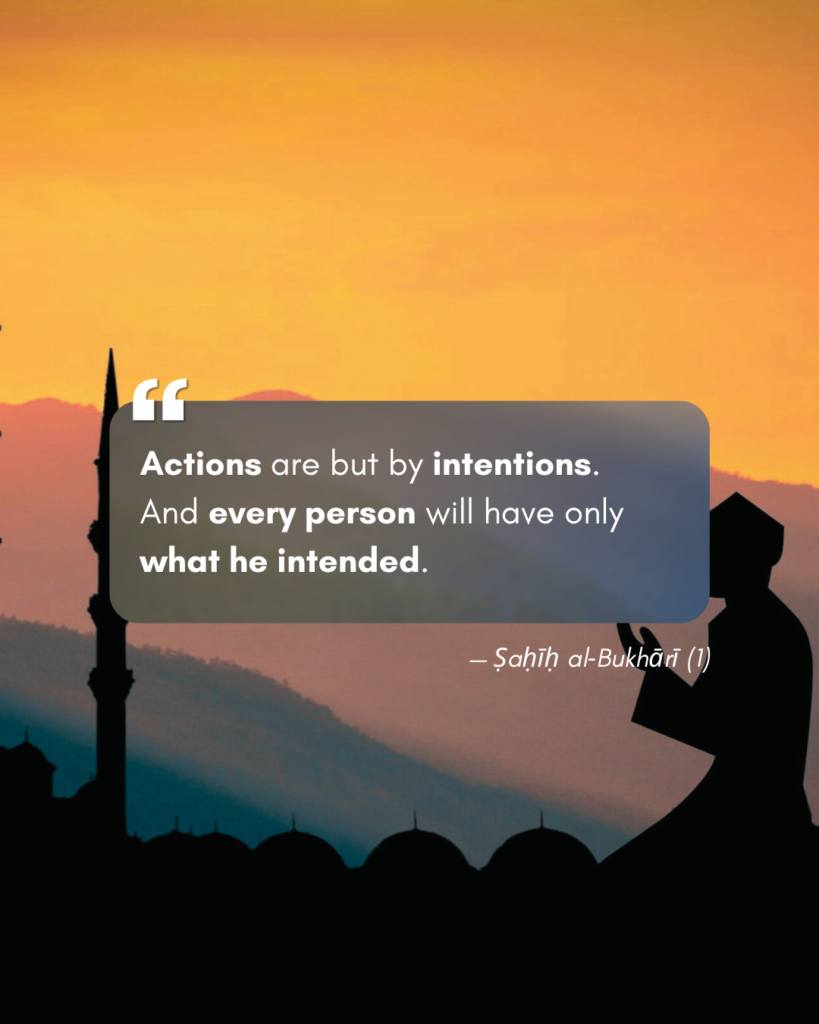
“Actions are but by intentions. And every person will have only what he intended.”
— Ṣaḥīḥ al‑Bukhārī (1) and Ṣaḥīḥ Muslim (1907)
This is not just a hadith about sincerity in worship. It is the foundation of a complete worldview. It is the key that transforms an ordinary life into an act of worship, and a believer from being result‑oriented to command‑oriented.
The world teaches us to measure everything by outcomes. Success is judged by results. Happiness is tied to achievements. The believer operates differently. He does not ask: “Will this succeed?” He asks: “Did Allāh command this?” His criterion is not the outcome. It is the command.
When you understand this, you realize that you have not failed when the result is not what you wanted. You have only failed if you disobeyed. Your job is to act upon the command. The outcome belongs to Allāh. Hence, the believer is command oriented.
Turning Every Moment Into Worship
Allāh ʿazza wa jall says:
“O you who have believed, eat from the good [i.e., lawful] things which We have provided for you and be grateful to Allāh if it is [indeed] Him that you worship.”
— Sūrah al‑Baqarah (2:172)
Eating is a command. Kulū: eat. When you eat with the intention of obeying Allāh’s command, seeking strength to worship Him, and being grateful for His provision, your eating becomes an act of worship. It is no longer a biological necessity. It is ‘ibādah.
Rasūlullāh ﷺ taught this principle in the most comprehensive way:
“The son of Ādam does not fill a vessel worse than his stomach. It is sufficient for the son of Ādam to eat a few morsels to keep his back straight. If he must eat more, then let him fill a third with food, a third with drink, and a third with air.”
— Sunan at‑Tirmidhī (2380), classed as ṣaḥīḥ by Shaykh al‑Albānī
Even the way you eat, with moderation, with gratitude, with the intention of obeying the command, is an act of worship.
And this principle extends to every aspect of life.
When you sleep, intending to rest so that you may wake for Fajr and serve Allāh, your sleep is worship. When you work, intending to provide for your family and fulfill your duty, your work is worship. When you speak, intending to bring benefit or to remain silent from harm, your speech is worship. When you spend on your family, Rasūlullāh ﷺ said:
“You will be rewarded for whatever you spend for the sake of Allah, even for the morsel of food you lift to your wife’s mouth.”
— Ṣaḥīḥ al‑Bukhārī (56) and Ṣaḥīḥ Muslim (1628)
When you walk to the masjid, every step is a good deed. The intention makes it worship.
The believer’s entire day becomes a continuous act of worship, not because he is in the masjid all day, but because his intention is fixed on Allāh in everything he does.
The Command Is Greater Than the Outcome
Rasūlullāh ﷺ said:
“If you ask, ask of Allāh. If you seek help, seek help from Allāh.”
— Jāmiʿ at‑Tirmidhī (2516), classed as ḥasan by Shaykh al‑Albānī
You do not rely on the outcome. You rely on the One who commands the outcome. When you act upon a command, you have already succeeded, regardless of what follows.
Mūsā ‘alaihissalam was commanded to strike the sea with his staff. He did not ask: “Will it split?” He struck. The command was his responsibility. The result was Allāh’s.
Ibrāhīm ‘alaihissalam was commanded to leave his wife and infant son in a barren valley. He did not ask: “Will they survive?” He left. The command was his responsibility. The result was Allāh’s.
The Ṣaḥābah were commanded to convey the message. They did not ask: “Will they accept?” They conveyed. The command was their responsibility. The result was Allāh’s.
The believer acts upon the command and leaves the outcome to Allāh. He is not result‑oriented. He is command‑oriented.
There is a powerful lesson often shared by the scholars that illustrates this perfectly. A man came to a shaykh and said that he wanted to sell his car and be successful in the sale. The shaykh advised him to start by disclosing any defect the car had, even if it had been fixed. The man followed the advice. When a buyer came, he said: “I just wanted to be transparent that my car had this defect, but we fixed it and now it’s all good.”
Later, the man returned to the shaykh and said: “You lied. You said my sale would be successful, but the buyer left when he heard about the defect.”
The shaykh replied: “Your understanding of success is conditional on whether you made the sale or not. My understanding of success is conditional on whether you fulfilled Allāh’s commands or not. You started with the defect, and so irrespective of the result, you are successful.”
This is the heart of the matter. The believer’s success is not in the outcome. It is in the obedience. You may not get the sale. You may not get the job. You may not get the marriage. You may not get the results you wanted. But if you acted upon the command of Allāh, you have succeeded.
I heard this second story from a dā’ī brother,
Once, a man purchased something from a shopkeeper. The next day, the buyer returned and asked to cancel the sale. The shopkeeper took the item back without any questions or hesitation.
Later, the buyer passed by and noticed the shop was closed. Concerned that his return had caused a loss, he went looking for the owner. When he found him, he asked: “Did my returning the item cause you to close your shop?”
The shopkeeper replied: “No. I only opened this shop with the intention of fulfilling the ḥadīth of Rasūlullāh ﷺ:
‘Allāh admitted to Paradise a man who was easygoing in buying and selling, when paying off debt and when asking for a debt that was owed to him.’
— Musnad Aḥmad (508), classed as ṣaḥīḥ by Shaykh al‑Albānī
Once I was able to fulfill that ḥadīth, the shop had no further purpose for me. I closed it.”
This story perfectly illustrates the believer’s mindset. The shopkeeper did not measure success by profit or loss. He measured it by whether he fulfilled the command of Rasūlullāh ﷺ. Once he had done that, the shop had no further purpose. He was not result‑oriented. He was command‑oriented.
Allāh ʿazza wa jall says:
“And whoever obeys Allah and His Messenger has attained a great triumph.”
— Sūrah al‑Aḥzāb (33:71)
Not “whoever gets the result he wanted.” Not “whoever succeeds in his plans.” Whoever obeys. The triumph is in the obedience itself.
A Life of Worship
The famous ḥadīth of Jibrīl ‘alaihissalām teaches us that Allāh is worshipped through īmān, Islām, and iḥsān. And Rasūlullāh ﷺ defined iḥsān as:
“To worship Allāh as if you see Him, and if you do not see Him, He sees you.”
— Ṣaḥīḥ Muslim (8)
When you live with this awareness, every action becomes worship. You are always seen. You are always accountable. You are always standing before Him.
The believer does not need to be in the masjid to be worshipping. He is in a constant state of worship because his intention is for Allāh in everything he does. He eats for Allāh. He sleeps for Allāh. He works for Allāh. He speaks for Allāh. He remains silent for Allāh. His entire life is an act of ‘ibādah.
This is the meaning of the verse:
“Say: Indeed, my prayer, my sacrifice, my living, and my dying are for Allah, Lord of the worlds.”
— Sūrah al‑An’ām (6:162)
Your living and your dying. Your entire existence. When you align your intention with the command of Allāh, even the most mundane moment becomes a moment of worship.
And in Sūrah al‑Baqarah, the believers are described with the quality of obedience,
“They say, ‘We hear and we obey. [We seek] Your forgiveness, our Lord, and to You is the [final] destination.'”
— Sūrah al‑Baqarah (2:285)
You are not a slave to results. You are a servant of Allāh. Your success is not in what you achieve. It is in whose command you follow.
Yā Rabb, we are so easily deceived by outcomes. We measure our success by what we achieve, and we despair when we do not see the results we wanted. Teach us to see as You see. Teach us to measure our lives by obedience, not by outcomes.
Yā Hādī, guide us to the straight path. Yā Qawī, give us the strength to act upon Your commands even when we cannot see the outcome. Yā Ḥafīẓ, protect us from the whispers that distract us from Your commands and make us anxious about results.
Yā Nāṣir, help us to hear and to obey whatever command of Yours manifests in the moment. Do not let us hesitate, do not let us question, do not let us delay. Let our response to every call be: “We hear and we obey.”
Yā Ghafūr, forgive us for the times we were consumed by outcomes instead of obedience. Forgive us for the times we disobeyed because we thought the result would not be worth it. Forgive us for the times we abandoned Your commands because we feared the result would not be in our favor.
Yā Karīm, accept our small efforts and multiply them. Yā Wadūd, love us despite our weakness. Yā Raḥmān, have mercy on us and do not let us be of those who despair of Your mercy. Make us of those who live by the intention, act upon the command, and trust completely in You.
Āmīn yā Rabb al-‘Ālamīn.