There are verses of the Qur’ān that unsettle the soul in a way that feels almost physical. You do not merely hear them; you feel them in the chest. Sūrah al-Aʿlā contains one such verse. It describes the final state of the one who turns away from the Reminder and rejects the message. He will be cast into the Great Fire. And there, in that fire, he will reach a condition that defies all earthly experience:
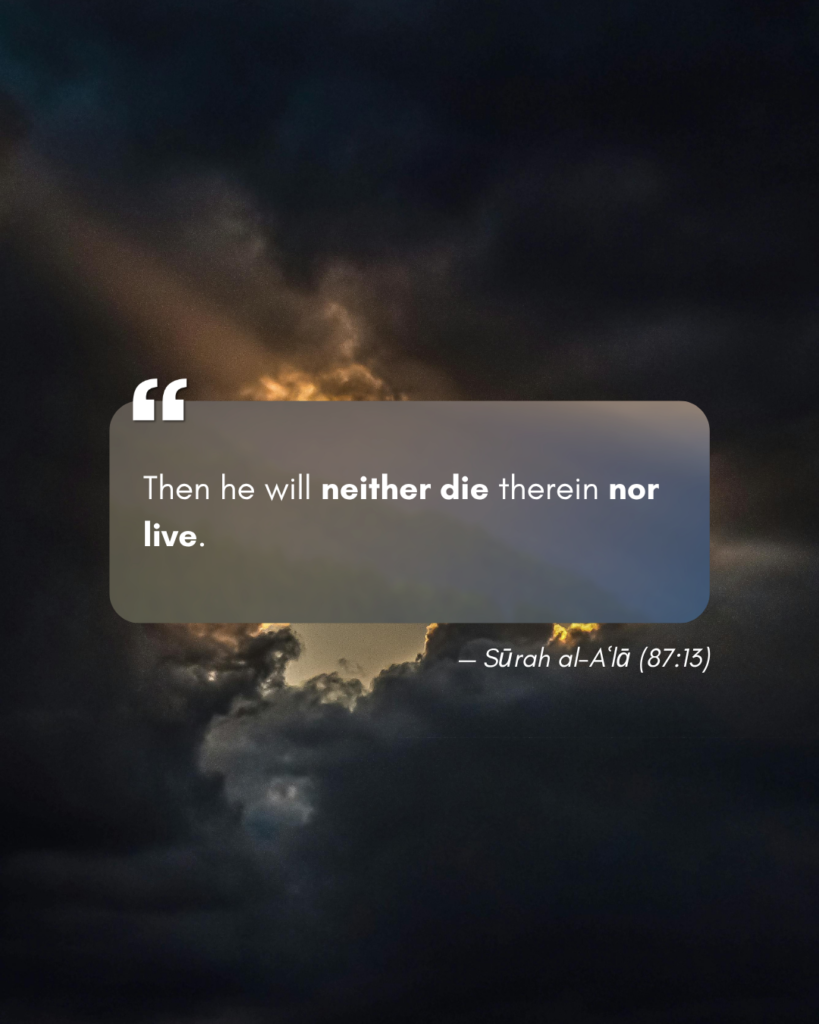
Thumma lā yamūtu fīhā wa lā yaḥyā.
“Then he will neither die therein nor live.”
— Sūrah al-Aʿlā (87:13)
The terror of this verse lies not in the description of pain, but in the description of a frozen, suspended existence. Death, which in this world is the end of all suffering, becomes an impossibility. And life, which even at its most painful carries moments of consciousness and hope, is withdrawn. The one in the Fire is trapped between two doors, both locked. This is not annihilation; it is something far worse. It is eternal deprivation from the source of all life.
Ḥayāh and Ḥayā’: When Life and Modesty Are One
The word yaḥyā comes from the Arabic root ḥā’-yā’-yā’ (ح ي ي), which carries the meaning of life. From this same root comes ḥayāh (life) and, profoundly, ḥayā’ (modesty, shyness, a sense of shame before Allāh). In the Arabic language, life and modesty are linguistically and spiritually intertwined. The one who has no ḥayā’ is, in a very real sense, not fully alive.
Rasūlullāh ﷺ said:
“Indeed, from what people have learned from the words of the earlier prophecies is: If you feel no shame, then do as you wish.”
— Ṣaḥīḥ al-Bukhārī, Kitāb Aḥādīth al-Anbiyā’, Bāb mā dhukira ‘an Banī Isrā’īl, ḥadīth no. 3483
This is not a license; it is a diagnosis. The removal of ḥayā’ is the removal of the barrier between a person and their lower desires. And when that barrier is gone, the soul begins to die, even while the body breathes. The Qur’ān speaks of people who have hearts that do not understand, eyes that do not see, and ears that do not hear.
“They have hearts with which they do not understand, they have eyes with which they do not see, and they have ears with which they do not hear. Those are like livestock; rather, they are more astray. It is they who are the heedless.”
— Sūrah al-Aʿrāf (7:179)
They are among us, moving and speaking, but they are not truly alive. Their ḥayāh is a biological fact, not a spiritual reality.
The Fire, then, is the logical conclusion of a life lived without ḥayā’ before Allāh. The one who refused to feel shame before the All-Seeing in the dunyā is placed in a state where neither ḥayāh nor ḥayā’ is possible. He is stripped of both, forever.
But what is the severity of this Fire that Allāh calls al-‘uẓmā, the Greatest? Rasūlullāh ﷺ placed its terror into perspective with a single comparison:
“Your fire is one part of seventy parts of the fire of Hell.” They said, “O Messenger of Allāh, this fire would have been enough.” He said, “It has been preferred over it by sixty-nine parts, each of them as hot as this one.”
— Ṣaḥīḥ al-Bukhārī, Kitāb Bad’ al-Khalq, Bāb ṣifat an-nār wa annahā makhlūqah, ḥadīth no. 3265
The fire of this world, which melts stone and consumes flesh, is but a single fraction of what awaits. And within that fire, the punishment is not only heat. It is a state of neither life nor death. The great scholar of tafsīr, al-Imām Ibn Jarīr al-Ṭabarī, raḥimahullāh, records from Qatādah, raḥimahullāh, regarding this verse: “He does not die so as to find relief, and he does not live with a life that benefits him.”
— Tafsīr al-Ṭabarī, Sūrah al-Aʿlā, āyah 13
Al-Ḥāfiẓ Ibn Kathīr, raḥimahullāh, similarly notes that the dweller of the Fire will experience neither a death that brings rest, nor a life that brings any benefit or pleasure.
— Tafsīr al-Qur’ān al-‘Aẓīm, Sūrah al-Aʿlā, āyah 13
They Prefer the Worldly Life
Why does a soul end up in such a state? The sūrah itself answers, with a diagnosis that cuts through every excuse:
“But you prefer the worldly life, while the Hereafter is better and more enduring.”
— Sūrah al-Aʿlā (87:16-17)
This is the root cause. The heart that loves the dunyā more than the ākhirah gradually loses its ḥayā’. It stops feeling the weight of sin. It abandons the Reminder. And its final destination is the Fire where one neither dies nor lives. The preference for the fleeting over the eternal is not a minor tilt; it is the axis on which one’s end turns.
In a narration that scholars have cited as supporting evidence for this very reality, Rasūlullāh ﷺ described a type of person deeply immersed in the world and utterly heedless of the Hereafter:
“Indeed Allāh despises every such person who is harsh in nature, who over-eats, and is rowdy in the market place. He sleeps like a dead carcass at night and tires himself like a donkey by day. He is knowledgeable of worldly matters, but ignorant of the matters of the Hereafter.”
— Ṣaḥīḥ Ibn Ḥibbān, ḥadīth no. 72. The grading of this narration has been discussed by scholars; Shaykh al-Albānī initially authenticated it and later considered it weak due to a break in the chain, so it serves as supporting evidence rather than a primary proof.
The image is striking: a carcass at night, a donkey by day. At night, when the believers stand before their Lord, this man lies dead, without a thought of the ākhirah. By day, he exhausts himself for the dunyā as though he will live forever. He has knowledge of the markets but ignorance of the Meeting. This is the very preference that Sūrah al-Aʿlā warns against, and its end is the state of lā yamūtu fīhā wa lā yaḥyā.
Al-Ḥayy and Yaḥyā: The Source and the Sign
And yet, within the Qur’ān, the very word yaḥyā is also the name of a Nabī. A Nabī who was killed, and who nevertheless lives.
Allāh says:
“O Zakariyyā, indeed We give you glad tidings of a boy whose name is Yaḥyā. We have not assigned this name to anyone before.”
— Sūrah Maryam (19:7)
Allāh Himself chose the name Yaḥyā, “he lives.” This was not a name given by his parents; it was a name given by the One who knows all outcomes. Allāh knew that Yaḥyā ‘alayhi al-salām would be martyred for the sake of truth, his blood spilled by tyrannical hands. And yet, Allāh named him Yaḥyā.
This is because those who are killed in the path of Allāh are not dead. The Qur’ān is explicit:
“And do not say about those who are killed in the way of Allāh, ‘They are dead.’ Rather, they are alive, but you perceive [it] not.”
— Sūrah al-Baqarah (2:154)
Yaḥyā ‘alayhi al-salām is the living proof of this verse. His name is his reality. The one who gave his life for Al-Ḥayy was granted true ḥayāh, a life that the sword could not touch, a life that continues in the presence of his Lord, a life that we, with our earthly eyes, cannot perceive. The same root that describes the frozen agony of the Fire also describes the vibrant, eternal life of the martyr. The Arabic language itself becomes a map of the two ultimate destinations.
And what is the nature of this life? Rasūlullāh ﷺ gave us a glimpse:
“The souls of the martyrs are in green birds, roaming freely in Paradise wherever they wish, then taking shelter in lamps suspended under the Throne.”
— Ṣaḥīḥ Muslim, Kitāb al-Imārah, Bāb arwāḥ ash-shuhadā’ fī al-jannah, ḥadīth no. 1887
The martyr does not merely exist. He lives, truly and fully, in a state of freedom and nearness that the people of the dunyā cannot comprehend. Yaḥyā ‘alayhi al-salām is among them, a living witness that the one who chooses the ākhirah over the dunyā is granted a ḥayāh that the Fire can never touch.
And the source of all life is Allāh. The greatest verse of the Qur’ān, Āyat al-Kursī, opens with His Name:
“Allāh—there is no deity except Him, the Ever-Living, the Self-Sustaining.”
— Sūrah al-Baqarah (2:255)
To be near Al-Ḥayy is to be alive. To be cut off from Him is to be dead, even if the heart still beats. Yaḥyā ‘alayhi al-salām chose nearness to Al-Ḥayy over the safety of the dunyā, and so his name became his eternal reality. The one who turns away and disbelieves chose the dunyā over Al-Ḥayy, and so his reality becomes lā yaḥyā.
And Yaḥyā ‘alayhi al-salām is not only the proof of the verse; he is the model of how to attain that life. Allāh describes him in terms that mirror the very path laid out in Sūrah al-Aʿlā:
“[Allāh said], ‘O Yaḥyā, take the Scripture with determination.’ And We gave him wisdom while yet a boy, and affection from Us and purity, and he was fearing of Allāh. And dutiful to his parents, and he was not a disobedient tyrant. And peace be upon him the day he was born, the day he dies, and the day he is raised alive.”
— Sūrah Maryam (19:12-15)
Look at the final words: “the day he is raised alive.” Yaḥyā ‘alayhi al-salām was given ḥukm as a child, he was chaste, he was devoted, and he was kind to his parents. When the moment of trial came, he did not choose the dunyā over the ākhirah. He chose the better and more lasting. And so he lives. Truly lives. He is the walking answer to the warning of lā yaḥyā.
Sabbiḥi Isma Rabbika al-Aʿlā: The Command That Protects
If the disease is preferring the dunyā and losing ḥayā’, then the sūrah itself provides the cure. And it begins with a single command:
“Glorify the Name of your Lord, the Most High.”
— Sūrah al-Aʿlā (87:1)
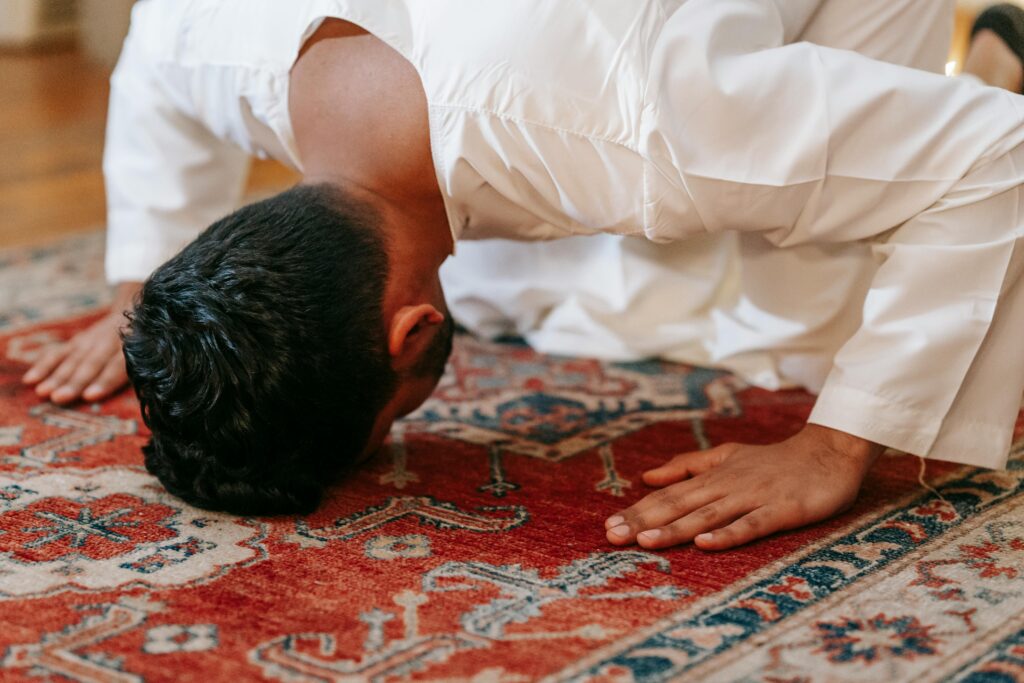
This is not a casual instruction. It is the divine medicine. The one who fills his tongue with Subḥāna Rabbiya al-A‘lā, who places his forehead on the ground for the Most High, is engaging in an act that reorients his entire being. He is declaring, with his body and his voice, that the Highest is Allāh—not his desires, not his wealth, not the approval of creation. The tasbīḥ pulls him away from the gravity of the dunyā and places him in orbit around the Eternal.
Rasūlullāh ﷺ said:
“The closest a servant is to his Lord is when he is prostrating.”
— Ṣaḥīḥ Muslim, Kitāb aṣ-Ṣalāh, Bāb mā yuqālu fī ar-rukūʿ wa as-sujūd, ḥadīth no. 482
In sujood, the slave is physically at his lowest and spiritually at his highest. The forehead that touches the earth for Al-Aʿlā is being purified from the love of the dust. This is why the sūrah immediately follows the command to glorify with the description of success:
“He has certainly succeeded who purifies himself, and remembers the Name of his Lord and prays.”
— Sūrah al-Aʿlā (87:14-15)
Purification, remembrance, prayer. These three are the practical unfolding of Sabbiḥi isma Rabbika al-A‘lā. The one who glorifies Al-Aʿlā will purify his soul from the filth of sins, fill his heart with His remembrance, and let his body fall into ṣalāh. And in doing so, he is protected from the Fire of lā yaḥyā. The command is the shield. The cure is in the very first verse.
In the Company of the Mala’ikah and ar-Rūḥ
Every time we say Subḥāna Rabbiya al-A‘lā, we are not worshipping in isolation. We are joining the mala’ikah wa ar-Rūḥ, for ar-Rūḥ is one of the names of Jibrīl ‘alayhi al-salām, the most honored of the angels, who glorify the Most High without ceasing. We are being enrolled in a tasbīḥ that has been ascending to the Throne since before our creation.
And this private glorification, this secret sujood performed when no human eye watches, will determine our state on the Day when all veils are lifted. Rasūlullāh ﷺ described that Day with a promise and a warning:
“Our Lord will reveal His Shin, and every believing man and woman will prostrate to Him. But there will remain those who used to prostrate in the worldly life for show and reputation. They will try to prostrate, but their backs will become a single rigid plate.”
— Ṣaḥīḥ al-Bukhārī, Kitāb al-Tafsīr, Bāb qawlihi ta‘ālā: “Yawma yukshafu ‘an sāqin”, ḥadīth no. 4919; Ṣaḥīḥ Muslim, Kitāb al-Īmān, Bāb ma‘rifat ṭarīq ar-ru’yah, ḥadīth no. 7439
Why will the hypocrites not be able to prostrate? Because they did not prostrate to Al-Aʿlā in the dunyā with sincerity and ḥayā’. Their lack of ḥayāh in this world will become a physical paralysis in the next. But the believers, those who glorified Al-Aʿlā in private and in public, will fall into sujood with ease, just as they did in the darkness of the night when no one was watching. They joined the mala’ikah wa ar-Rūḥ in the dunyā, and so on that Day, their prostration will be accepted while others are frozen upright, unable to bend.
And we ask Allāh ʿazza wa jall to protect us from becoming one of them.
We ask You, O Al-Ḥayy, O Al-Qayyūm, O Al-Aʿlā, O Al-Karīm, to grant us true ḥayāh, a life filled with ḥayā’ before You. Make us among those who glorify Your Highest Name, who purify themselves, who remember You, and who pray. Protect us from the Fire where none dies and none lives, and gather us with Your Nabī Yaḥyā and Your Khalīl Muḥammad, ṣallallāhu ‘alayhimā wa sallam, in the Gardens of eternal life.
Amīn yā Rabb al-‘Ālamīn, bi-raḥmatika yā Arḥam ar-Rāḥimīn.