Allāh ʿazza wa jall has opened doors of mercy for those who long for Hajj and Umrah but cannot reach Makkah. Illness, poverty, family responsibilities, or other valid reasons prevent many sincere believers from making the journey. Yet Rasūlullāh ﷺ announced that certain everyday acts, performed with sincere intention, carry the rewards similar to these great pilgrimages. What follows are four authentic aḥādīth that bring similar rewards of Hajj and ‘Umrah within reach of almost every believer.
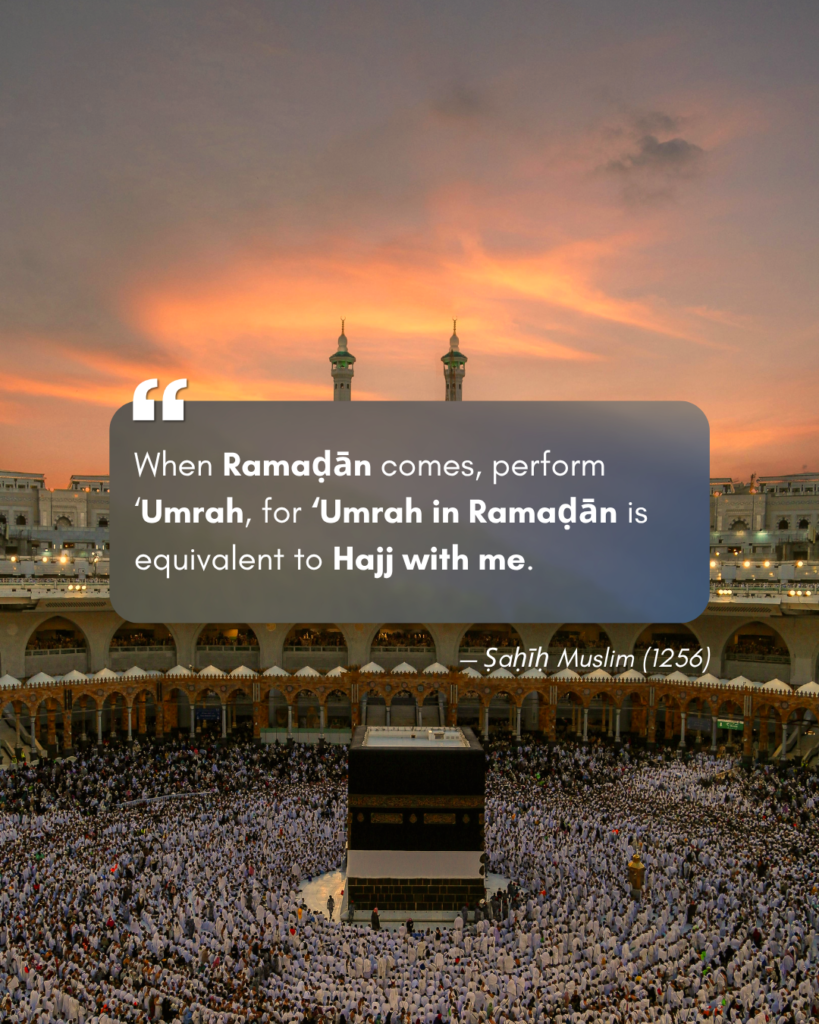
‘Umrah in the Month of Ramaḍān
A woman named Umm Sinān al‑Anṣāriyyah (raḍiya Allāhu ‘anhā) could not join Rasūlullāh ﷺ on the Farewell Hajj. She explained that her husband had only two camels. One he took for his own Hajj, the other was needed for their land. Rasūlullāh ﷺ gave her a lasting gift.
“When Ramaḍān comes, perform ‘Umrah, for ‘Umrah in Ramaḍān is equivalent to Hajj.”
— Ṣaḥīḥ al‑Bukhārī (1863)
And in another narration:
“Performing ‘Umrah in Ramaḍān is equivalent to Hajj with me.”
— Ṣaḥīḥ Muslim (1256), Jāmi‘ at‑Tirmidhī (939), Sunan Abī Dāwūd (1990)
The scholars explain that this refers to the reward, not that it substitutes for the obligatory Hajj. Whoever performs ‘Umrah in Ramaḍān with sincere intention receives the reward of Hajj. And when Rasūlullāh ﷺ said “Hajj with me,” he indicated a reward that brings the one who performs it into his company in terms of its recompense.
Fajr in Congregation, Dhikr Until Sunrise, and Duḥā
Rasūlullāh ﷺ said:
“Whoever prays Fajr in congregation, then sits remembering Allāh until the sun has risen, then prays two rak‘ahs, will have a reward like that of a Hajj and ‘Umrah. Complete, complete, complete.”
— Jāmi‘ at‑Tirmidhī (586), classed as ḥasan by Imām at‑Tirmidhī and ḥasan by Shaykh al‑Albānī
The repetition of tāmmah, tāmmah, tāmmah – “complete, complete, complete” – removes any doubt about the fullness of the reward.
Walking to the Mosque for Obligatory and Voluntary Prayers
Rasūlullāh ﷺ said:
“Whoever goes out from his house after performing ablution for saying the prescribed prayer in congregation, his reward will be like that of one who goes for Hajj pilgrimage after wearing iḥrām. And he who goes out to say the mid‑morning (Duḥā) prayer, and takes the trouble for this purpose, will take the reward like that of a person who performs ‘Umrah.”
— Sunan Abī Dāwūd (558), classed as ḥasan by Shaykh al‑Albānī
Every journey after performing ablution toward an obligatory prayer in the masjid carries the reward similar to Hajj, and walking to the masjid for Duḥā carries the reward similar to ‘Umrah.
Going to the Masjid to Learn or Teach Something Good
Rasūlullāh ﷺ said:
“Whoever goes to the masjid for the purpose of learning or teaching knowledge, he receives the reward of a Hājj whose Hajj was perfect.”
— Al‑Mu‘jam al‑Kabīr (7473) (al‑Ṭabarānī), classed as Ṣaḥīḥ by ‘Shaykh al‑Albānī
Attending a circle of knowledge with sincere intention brings the reward of a complete, perfect Hajj.
When Rasūlullāh ﷺ spoke about these deeds, he did not want to restrict our Islām to a single journey. Hajj is once a year, but these deeds can be performed daily, weekly, and throughout the year. Also, notice how Rasūlullāh ﷺ emphasized in immense rewards for things that are directly related to the masjid? That is from the immense mercy that Allāh ʿazza wa jall bestowed upon His houses. So, let us take advantage of these great rewards from His infinite generosity.
And remember, Rasūlullāh ﷺ said:
“Actions are but by intentions.”
— Ṣaḥīḥ al‑Bukhārī (1), Ṣaḥīḥ Muslim (1907)
Sincerity transforms a small deed into a mountain of reward. And none of us truly knows how many Hajj and Umrah Allāh ʿazza wa jall may grant us from these consistent and small daily habits on the Day of Judgement. For His sincere servants, the number may be truly surprising. And we ask Allāh ʿazza wa jall to make us among His sincere servants.
Yā Hādī, Yā Mu‘īn, grant us tawfīq to perform an accepted obligatory Hajj and ‘Umrah before we die. Make us of those who stand on ‘Arafah, begging like the beggars we truly are, asking for Your mercy and forgiveness.
Yā Karīm, Yā Jawād, do not deprive us of the reward of these small deeds. Accept them from us as if we had performed Hajj and ‘Umrah. And when the Day of Judgment comes, do not enter us into Jannah by our deeds, for none will enter it through their deeds. Enter us by Your mercy, Yā Arḥam ar‑Rāḥimīn.
Yā Ghafūr, forgive us and conceal our sins. Yā Raḥīm, have mercy on us. Yā Wadūd, love us despite our shortcomings and failures. And grant us ikhlāṣ and taqwā in every act of worship.
Āmīn yā Rabb al‑‘Ālamīn.
For a deeper exploration of the paths to forgiveness, the power of sincere repentance, and the authentic doors to Allah’s mercy found in the Qur’an and Sunnah, read the full book for free at:
🔗 https://www.pathstopurity.org/
Password: Alhamdulillah