﷽
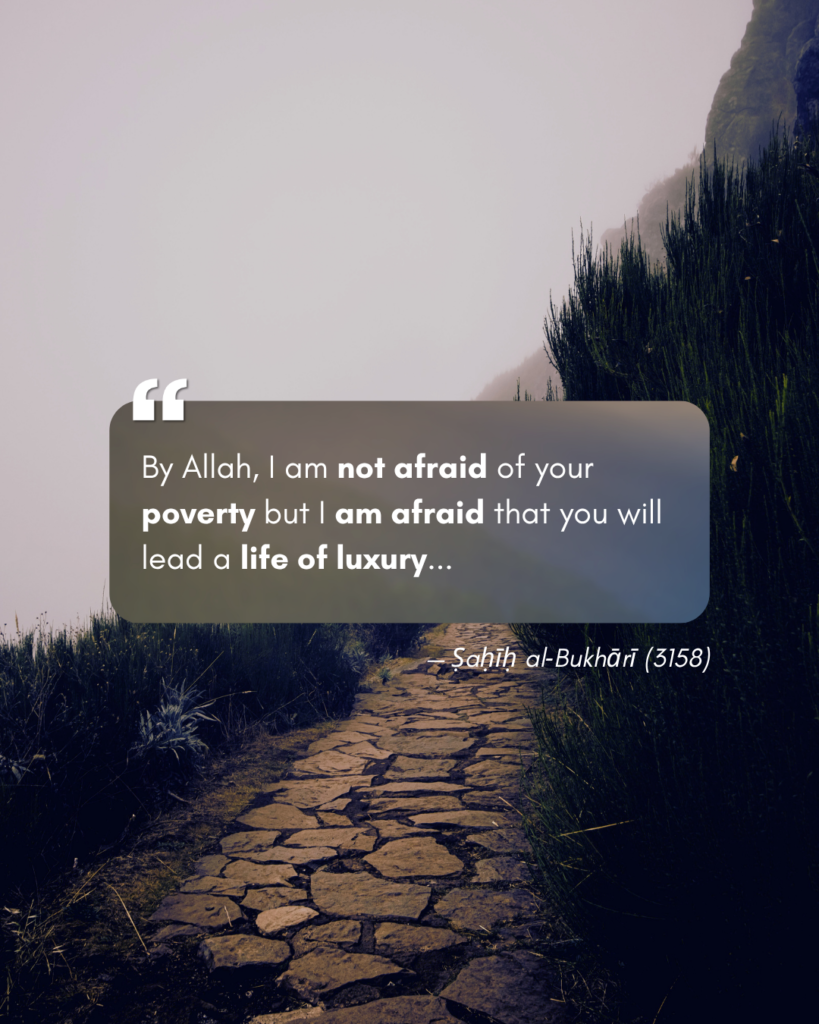
Rasūlullāh ﷺ once sent Abū ‘Ubaydah ibn al-Jarrāḥ (raḍiya Allāhu ‘anhu) to Bahrain to collect the jizyah. When Abū ‘Ubaydah returned with wealth, the Anṣār heard of his arrival and gathered after Fajr prayer. When Rasūlullāh ﷺ saw them, he smiled and said:
“I think you have heard that Abū ‘Ubaydah has brought something.”
They said: “Yes, O Rasūlullāh.”
He said: “Rejoice and hope for that which will please you. By Allāh, it is not poverty that I fear for you, but I fear that this world will be opened up with its wealth for you as it was opened to those before you; and you vie with one another over it as they did and eventually it will ruin you as it ruined them.”
— Ṣaḥīḥ al‑Bukhārī (3158)
Subḥānallāh. Rasūlullāh ﷺ did not fear poverty for his Ummah. He feared the abundance of the world. He feared that when the doors of wealth and comfort opened, the Ummah would forget its purpose and compete for the fleeting pleasures of this life.
And this is directly connected to the approach of the Hour. Wealth increases. People compete for it. They become mashghūl—consumed, occupied, distracted. They stop seeking beneficial knowledge. They stop learning what Jāhiliyyah was. And when a generation grows up not knowing Jāhiliyyah, the bonds of Islam come undone, one by one. And the Hour draws closer.
The Opening of the World
Rasūlullāh ﷺ said:
“Verily, amongst the things I fear for you after my life is the lushness and charm of this world opening up to you.”
— Ṣaḥīḥ Muslim (1052)
This is a prophecy that has been fulfilled in ways that would have been unimaginable to those who first heard it. The Muslim world has seen immense wealth—oil, trade, resources, and economic power. Nations that were once poor now sit on mountains of gold. And with that wealth came what Rasūlullāh ﷺ warned against: competition, greed, division, and a preoccupation with the world that distracts from the dīn. The very abundance that was meant to be a blessing became a trial that has consumed the hearts of many.
In a related narration, Abū Sa’īd al-Khudrī (raḍiya Allāhu ‘anhu) reported that Rasūlullāh ﷺ said:
“The thing I am afraid of most for your sake is the worldly blessings which Allāh will bring forth to you.”
It was asked: “What are the blessings of this world?”
He said: “The pleasures of the world.”
A man asked: “Can good bring forth evil?”
Rasūlullāh ﷺ kept quiet, then said: “Good never brings forth but good. This wealth is like green and sweet fruit. All the vegetation which grows on the bank of a stream either kills or nearly kills the animal that eats too much of it, except the animal that eats the Khadira (a kind of vegetation). Such an animal eats till its stomach is full and then faces the sun and starts ruminating and then passes out dung and urine and goes to eat again. This worldly wealth is sweet, and if a person earns it in a ḥalāl way and spends it properly, then it is an excellent helper. And whoever earns it in a ḥarām way, he will be like the one who eats but is never satisfied.”
— Ṣaḥīḥ al‑Bukhārī (6427)
The world is not evil in itself. Wealth can be a blessing—a means to help others, to build families, to give charity, and to strengthen the community. But the danger is in how it is pursued and how it is used. Those who earn wealth unlawfully or who are consumed by it are destroyed by it, just as an animal that eats too much of the lush vegetation by the river is killed by it. The abundance that could have been a source of elevation becomes a source of destruction when the heart becomes attached to it.
The Distraction That Leads to Destruction
The scholars explain that Rasūlullāh ﷺ feared that when wealth and countries were conquered, the Ummah would be prevented from righteous deeds and occupied from acquiring beneficial knowledge of the dīn. The consequence would be decadent morals: hubris, vanity, haughtiness, love for wealth and fame, and an aversion to preparing for death and the Hereafter.
When a person is mashghūl, they are not just busy—they are consumed. Their mind, their time, their energy, their focus all become absorbed by the pursuit of the world. And when the Ummah is mashghūl collectively, it ceases to be a force for good. It ceases to be the best nation brought forth for mankind. It loses its purpose and its direction.
‘Umar ibn al-Khaṭṭāb (raḍiya Allāhu ‘anhu) warned of the same danger from a different angle. He said:
“The bonds of Islam will be undone, one by one, when there grows up in Islam one who does not know Jāhiliyyah.”
— ‘Umar ibn al-Khaṭṭāb, as quoted by Ibn Taymiyyah in Majmūʿ al-Fatāwā (15/54)
This occupation, consumption, and act of being mashghūl is the reason a generation is growing up in this world that has no clue what even the word Jāhiliyyah means anymore. They do not know what it was like to worship idols, to bury daughters alive, to live in darkness. They do not recognize the evil that Islam rescued them from. And when you do not know what evil looks like, you cannot recognize it when it returns in a new form. You cannot fight what you do not see.
Ibn al-Qayyim (raḥimahullāh) explained the gravity of this warning in I’lām al-Muwaqqi’īn:
“For if he does not know Jāhiliyyah and shirk, and what the Qur’ān criticized and condemned, he will fall into it, affirm it, call to it, consider it correct, and deem it good—without realizing that it is what the people of Jāhiliyyah were upon, or something similar, or worse. Thus the bonds of Islam will be undone from his heart, and the known will become unknown, and the unknown will become known; innovation will become Sunnah, and Sunnah will become innovation.”
— Ibn al-Qayyim, I’lām al-Muwaqqi’īn (4/127)
And when a generation grows up not knowing Jāhiliyyah, the next generation will not even know it existed. The bonds of Islam are undone, one by one. And the Hour approaches closer.
Rasūlullāh ﷺ said:
“The Hour will not come until knowledge is taken away, earthquakes increase, time passes quickly, trials appear, and there is much harj—and harj is killing.”
— Ṣaḥīḥ al‑Bukhārī (1036)
Knowledge is taken away in two ways: by the death of the scholars who carry it, and by the distraction of the people who no longer seek it. When the people become mashghūl, they stop acquiring beneficial knowledge. And when they stop acquiring knowledge, they lose the ability to distinguish truth from falsehood, right from wrong, Sunnah from innovation. The signs of the Hour become manifest, and the world moves closer to its end.
The Hour Approaches – Glad Tidings to the Strangers
Rasūlullāh ﷺ said:
“Islam began as something strange, and it will return to being something strange as it began. So glad tidings to the strangers.”
— Ṣaḥīḥ Muslim (145)
This hadith is not a prophecy of defeat. It is a description of what happens when the world becomes the goal. When wealth consumes, when competition distracts, when the Ummah forgets its purpose, Islam becomes strange again. The one who holds onto it becomes a stranger among his own people.
And Rasūlullāh ﷺ said:
“Ahead of you there lie days of patience, during which being patient will be like grasping a hot coal. The one who does good deeds then will have a reward like that of fifty men who do such deeds.”
— Sunan Abī Dāwūd (4341), classed as ṣaḥīḥ by Shaykh al‑Albānī
And so, the one who holds onto the Sunnah finds himself in a world that no longer recognizes it. He goes to the masjid and people judge him. He wears garments following the Sunnah and the world judges him. He leaves the beard untouched, obeying Rasūlullāh ﷺ, and the world judges him. Even if he takes fifteen minutes longer in salah because of khushū’, people question him: “What took you so long?”
Although it is heartbreaking, it is a reality we live in today. People are ashamed to admit or even affirm some things that Allah made ḥalāl, and openly, proudly do things that Allah made ḥarām. The one who holds onto the Sunnah becomes a stranger among his own people. The one who speaks the truth becomes isolated. The one who remembers Allāh in a world that has forgotten Him becomes odd.
But even in this strangeness, there is hope. Rasūlullāh ﷺ said:
“I wish I could see my brothers.”
The Companions asked: “Are we not your brothers, O Rasūlullāh?”
He said: “You are my Companions. My brothers are those who will come after me, who believe in me without having seen me.”
— Ṣaḥīḥ Muslim (249)
He longed for you. He wept for you. He prayed for you. And he gave you glad tidings.
The “strangers” are not foreigners. They are the ones who hold onto the dīn when everyone else has let it go. They are the ones who remember what Jāhiliyyah was, who recognize evil even when it wears new clothes, and who refuse to be consumed by the world.
So glad tidings to the strangers of today. Glad tidings to the one who holds onto the Sunnah when everyone else has abandoned it. Glad tidings to the one who feels the burn of the hot coal but does not let go. Glad tidings to the one whom Rasūlullāh ﷺ longed to see. You are not alone. You are seen. You are loved. And your reward is with Allāh.
Yā Rabb, we seek refuge in You from the lushness and charm of this world that distracts us from You. We seek refuge in You from the wealth that makes us forget our purpose and the abundance that leads us to compete and destroy one another. We seek refuge in You from the poverty that prevents us from doing good deeds in abundance and from the occupation that makes us mashghūl.
Yā Hādī, guide us to earn wealth lawfully and spend it in Your path. Protect us from competing with one another for the pleasures of this world. Do not let us be destroyed as those before us were destroyed.
Yā Ghafūr, forgive us for the times we have been consumed and distracted by the world. Forgive us for the times we have prioritized wealth over worship, and competition over brotherhood. Forgive us for the times we knew and did not share, and for the times we saw and did not speak.
Yā Raḥmān, do not let a generation grow up among us that does not know Jāhiliyyah. Do not let the bonds of Islam be undone in our hearts. Make us of the strangers who hold onto Your dīn when it becomes strange, and who correct what the people have corrupted of the Sunnah.
Yā Rabb, make us of the brothers who believed in Rasūlullāh ﷺ without seeing him, the ones he longed for and wept for. Grant us the honor of being resurrected with him and his noble Companions. Grant us shelters in Jannah with them, so that we may be their companions in the next life, for we could not be their companions in this life.
Yā Karīm, make this world a means of drawing closer to You, not a barrier. And do not let us leave this world without having used what You gave us for Your sake. And when the Hour approaches, let us be among those who are prepared, among those who are gathered with Rasūlullāh ﷺ and the righteous.
Āmīn yā Rabb al‑’Ālamīn, bi‑raḥmatika yā Arḥam ar‑Rāḥimīn.