﷽
Allāh ʿazza wa jall says:
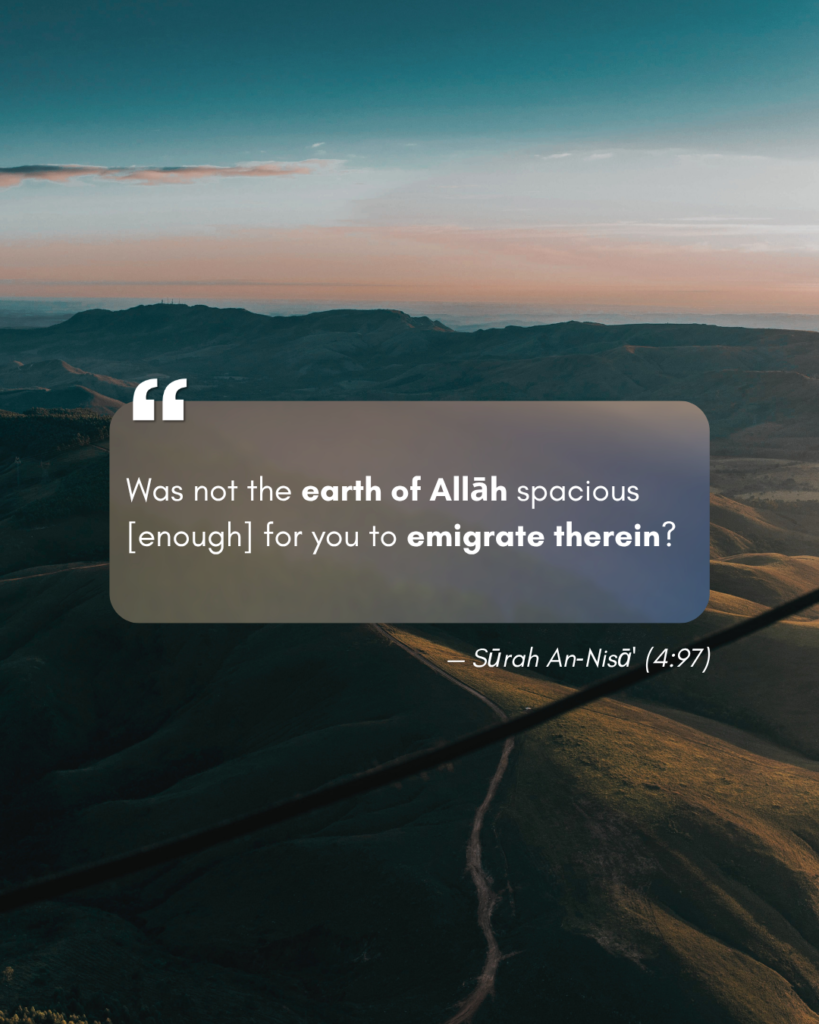
“Indeed, those whom the angels take [in death] while wronging themselves—[the angels] will say, ‘In what [condition] were you?’ They will say, ‘We were oppressed in the land.’ They [the angels] will say, ‘Was not the earth of Allāh spacious [enough] for you to emigrate therein?’ For those, their refuge is Hell—and evil it is as a destination.”
— Sūrah An‑Nisā’ (4:97)
This is a severe verse. It is a warning that should shake every believer who lives in a land where they cannot practice their religion freely.
Hijrah, migration for the sake of Allāh, is not just a historical event that happened once. It is not merely a recommendation. In certain circumstances, the obligation of hijrah appears in the lives of the believers. When a Muslim lives in a place where they are forced into disbelief, where they are prevented from practicing Islām, where their faith is under threat, and they have the ability to move to a place where they can worship freely—then hijrah becomes mandatory.
The angels question them at the moment of death: “In what condition were you?” Their response: “We were oppressed in the land.” But the angels’ reply cuts through every excuse: “Was not the earth of Allāh spacious for you to emigrate therein?”
This verse clarifies that remaining in a land of oppression while having the means to leave is not neutrality. It is a form of self‑wrongdoing. The one who stays, when they could have left, has wronged their own soul. And the destination of such a person, unless they repent and turn back, is Hell.
Rasūlullāh ﷺ said:
“I am innocent of every Muslim who lives among the polytheists.”
— Sunan Abī Dāwūd (2645), classed as ṣaḥīḥ by Shaykh al‑Albānī
The Right of the Self
Allāh ʿazza wa jall says:
“O you who have believed, protect yourselves and your families from a Fire whose fuel is men and stones, over which are angels stern and severe, who do not disobey Allāh in what He commands them and do what they are commanded.”
— Sūrah al‑Taḥrīm (66:6)
The scholars explain that the greatest right of the self (haqq al‑nafs) is to save it from the Hellfire. You have a duty to your own soul. You cannot abandon it to destruction. You cannot leave it in a situation where its faith is being eroded, its worship is being prevented, and its salvation is at risk. To do so is to neglect the very right that Allāh has placed upon you.
As recorded in Tafsīr Ibn Kathīr, commentary on Sūrat al-Taḥrīm (66:6):
Ibn ‘Abbās (raḍiya Allāhu ‘anhumā) said regarding this verse: “Work in the obedience of Allāh, avoid disobedience of Allāh, and order your families to remember Allāh, then Allāh will save you from the Fire.”
Mujāhid (raḥimahullāh) said: “Have taqwā of Allāh and order your family to have taqwā of Him.”
And Qatādah (raḥimahullāh) said: “He commands obedience to Allāh, to not disobey Allāh, he orders his family to obey His orders and helps them to act upon His orders. When one sees disobedience, he stops them and forbids them from doing it.”
This is the right of the self. To protect it. To guard it. To remove it from harm. And when that harm is a land where you cannot worship Allāh freely, the right of your self demands that you leave.
The Attachment to This World
Often, people do not move because of worldly attachments. They are tied to their wealth, their property, their family, their homeland. Allāh warns in Sūrah al‑Tawbah:
“Say, [O Muḥammad], ‘If your fathers, your sons, your brothers, your wives, your relatives, wealth which you have obtained, commerce wherein you fear decline, and dwellings with which you are pleased are more beloved to you than Allāh and His Messenger and jihād in His cause, then wait until Allāh executes His command. And Allāh does not guide the defiantly disobedient people.'”
— Sūrah al‑Tawbah (9:24)
The verse lists eight attachments: fathers, sons, brothers, wives, relatives, wealth, commerce, and dwellings. The scholars refer to these as the “beloved eight”—the things that most often hold a person back from obeying Allāh. When these become more beloved than Allāh and His Messenger, they become a barrier to obedience. The one who prioritizes the world over the command of Allāh has placed themselves in a dangerous position. They have chosen the temporary over the eternal, the created over the Creator.
Hijrah requires sacrifice. It requires leaving behind what is beloved for the sake of Allāh.
The Promise and the Help of Allāh
“And whoever emigrates for the cause of Allāh will find on the earth many [alternative] locations and abundance. And whoever leaves his home as an emigrant to Allāh and His Messenger and then death overtakes him—his reward has already become incumbent upon Allāh. And Allāh is ever Forgiving and Merciful.”
— Sūrah An‑Nisā’ (4:100)
This is the promise. Allāh will provide a way out, a place of safety, and abundance. And if death overtakes you during the journey, your reward is already secured. You have already succeeded. Allāh will not let your effort go to waste.
Rasūlullāh ﷺ said:
“Whoever leaves something for the sake of Allāh, Allāh will replace it with something better.”
— Musnad Aḥmad (23074), classed as ṣaḥīḥ by Shaykh al‑Albānī
Allāh ʿazza wa jall also addresses the believers in a more intimate tone in Sūrah al‑’Ankabūt:
Yā ʿibādiya alladhīna āmanū inna arḍī wāsiʿatun fa-iyyāya faʿbudūn.
“O My servants who believe, indeed My earth is spacious, so worship Me alone.”
— Sūrah al‑’Ankabūt (29:56)
Notice the address: Yā ʿibādiya – “My servants.” This is an address of closeness, of affection, of reassurance. Allāh adds the possessive yā ʿibādī, expressing His care for those who believe. And what follows is a command: “Indeed, My earth is spacious, so worship Me alone.”
The command is wrapped in mercy. Allāh does not merely command movement; He promises His help. Later in the same sūrah, He declares:
“And those who strive for Us—We will surely guide them to Our paths. And indeed, Allāh is with the doers of good.”
— Sūrah al‑’Ankabūt (29:69)
The one who leaves for Allāh is never abandoned. The earth is vast, the help is near, and the reward is secure.
Immediately after this command, Allāh says:
“Every soul will taste death, and then to Us you will be returned.”
— Sūrah al‑’Ankabūt (29:57)
Why is death mentioned here, right after the command to move? Because the spaciousness of the earth is useless to the one who plans to leave “tomorrow” and never does. Death does not consult our timelines. It comes when the appointed time arrives. The command to move is urgent. Do not postpone, for you do not know when your time will be up.
The Exception and the Mercy of Allāh
Allāh, in His mercy, makes an exception for those who are truly powerless:
“Except for the oppressed among men, women, and children who cannot devise a plan nor are they guided to a way. For those, it is expected that Allāh will pardon them, and Allāh is ever Pardoning and Forgiving.”
— Sūrah An‑Nisā’ (4:98-99)
This verse covers the elderly, the women, the children, those who have no means of escape, no resources, no way to plan or navigate a path to safety. They are not held accountable for remaining because they had no choice.
And Allāh reminds us:
“Allāh does not burden a soul beyond that it can bear.”
— Sūrah al‑Baqarah (2:286)
He does not hold them accountable for what they cannot do. His mercy is vast. He is al‑’Afuww, the Pardoner. al‑Ghafūr, the All‑Forgiving.
But the exception proves the rule. If you are not among those who are utterly powerless, if you have the means, the ability, and the opportunity to migrate to a place where you can practice your religion freely, then the command applies to you.
Yā Rabb, we ask You to protect our faith and keep us firm upon Your religion. If we are ever in a land where we cannot worship You freely, grant us the strength and the means to leave for Your sake. Do not let us be of those who wrong themselves by remaining where they cannot practice Your religion.
Yā Hādī, guide us to the straight path. Yā Qawī, give us the strength to make difficult choices for Your sake. Yā Raḥmān, have mercy on the oppressed among us who cannot find a way out. Open a path for them and provide for them from where they do not expect.
Yā Ghafūr, forgive us for the times we prioritized this world over our faith. Yā Karīm, accept our efforts and multiply them. Yā Nāṣir, help us to leave behind everything that distracts us from You.
Make us among those who hear Your call and answer. Grant us the courage to move when movement is needed, and the patience to remain when stillness is better. Make this spacious earth a means for us to worship You alone, and do not let us be delayed by the hopes of a long life. Return us to You in a state of striving, having used Your earth for Your sake, and accept us among the ṣābirīn and the ṣādiqīn.
Āmīn yā Rabb al‑’Ālamīn, bi‑raḥmatika yā Arḥam ar‑Rāḥimīn.