The Qur’ān does not lecture us about death. It shows us death, every year, in the turning of the seasons. It places before our eyes a metaphor so ordinary that we walk past it without a second thought. A green field flourishes after rain, bright and full of life. Then it yellows, darkens, and crumbles into stubble. The wind scatters it. The ground is bare again. This is the arc of vegetation. And Allāh tells us it is also the arc of our own existence. The one who understands the pasture understands himself. The one who does not will continue to prefer the green while the black approaches.
Sūrah al-Aʿlā opens with a command, moves through the attributes of the Creator, and then delivers this metaphor in two verses that carry the weight of an entire life:
Wa alladhī akhraja al-marʿā, fa-jaʿalahu ghuthāʾan aḥwā.
“And He who brings forth the pasture, then makes it blackened stubble.”
— Sūrah al-Aʿlā (87:4-5)
These two verses are not merely a description of vegetation. They are a mirror. The pasture is you. It is every human being Allāh brings forth from the earth, causes to flourish for a time, and then turns into withered debris that returns to the soil. To understand the pasture is to understand why the Hereafter is better and more lasting. And to understand the One who brings forth the pasture is to understand why glorifying His Name is the only rational response.
The One Who Creates, Proportions, and Guides
Before the metaphor arrives, the sūrah establishes who is speaking and who is acting. The command to glorify is immediately followed by a description of the One being glorified:
“Glorify the Name of your Lord, the Most High, who creates and proportions, and who decrees and guides.”
— Sūrah al-Aʿlā (87:1-3)
Allāh is Al-Aʿlā, the Most High, beyond anything the senses can reach. And He is the One who khalaqa fa-sawwā—creates and proportions, gives every created thing its form, its measure, its balance. He is the One who qaddara fa-hadā—decrees and guides, appoints a term and a destiny for every creature and then guides it along the path He has written.
The plant is given its proportion. It pushes through the soil toward the sun without being taught. It greens when the rain comes and withers when its term expires. It follows the decree without deviation. The human being is also given proportion. He is also decreed a term. He is also guided through revelation, through the fitrah within, through the signs on the horizon and in the soul. His withering is as certain as the plant’s. His death is as decreed. The difference is not in the outcome. The difference is that the human being can forget.
The great scholar of tafsīr, al-Imām Ibn Jarīr al-Ṭabarī, raḥimahullāh, explains that khalaqa fa-sawwā means He created everything in exact proportion, giving each creature its form and its limits. And qaddara fa-hadā means He decreed the lifespan, the actions, and the provision of each creature, then guided it to its path.
— Tafsīr al-Ṭabarī, Sūrah al-Aʿlā, āyah 2-3
Al-Ḥāfiẓ Ibn Kathīr, raḥimahullāh, citing Mujāhid, explains that the guidance here includes the guidance of the animals to their pastures, the birds to their migration, and the human being to the knowledge of his Lord through the signs of creation and revelation.
— Tafsīr al-Qur’ān al-ʿAẓīm, Sūrah al-Aʿlā, āyah 3
The One who created you with such precision, who decreed your term and your provision, who guided you to this very moment—this is the One you are commanded to glorify. And this is the One who now places before you the image of the pasture.
The Pasture Is You
Wa alladhī akhraja al-marʿā, fa-jaʿalahu ghuthāʾan aḥwā.
“And He who brings forth the pasture, then makes it blackened stubble.”
— Sūrah al-Aʿlā (87:4-5)
The word al-marʿā is the pasture, the green vegetation that springs from the earth after rain. It is what animals graze upon. It is sustenance, beauty, and life. The word ghuthāʾ is the dry, withered debris that floods carry away; the chaff, the stubble, the lifeless remains of what was once green. And aḥwā means dark, blackened, sometimes with a hint of green still lingering in the black, like plants that have rotted and turned to sludge.
Imām al-Ṭabarī, raḥimahullāh, records from the early scholars that this is an image of the life of this world. Allāh brings forth the pasture vibrant and flourishing, and then He makes it wither and darken until it is as if it never existed. The same is true of every living thing. The same is true of the human being. You are the pasture. You appear from the earth, you green for a time, and then your body blackens and returns to the soil while your rūḥ is taken and placed in the Barzakh, awaiting the Resurrection.
— Tafsīr al-Ṭabarī, Sūrah al-Aʿlā, āyah 4-5
The plant does not pretend it will stay green forever. It does not deny the withering. It submits to its fitrah because its fitrah is Islam; submission to the decree of its Creator. The human being alone, among all creation, is given the capacity to look at the pasture, to know that he is the pasture, and still to live as if the withering is not coming. He can lose himself in the green and refuse to look toward the black. He can prefer what he sees now over what he knows awaits him.
This is not a failure of the mind. It is a failure of the heart to be moved by what it knows.
Preferring What Withers
Later in the same sūrah, Allāh names the disease that the pasture metaphor has already exposed:
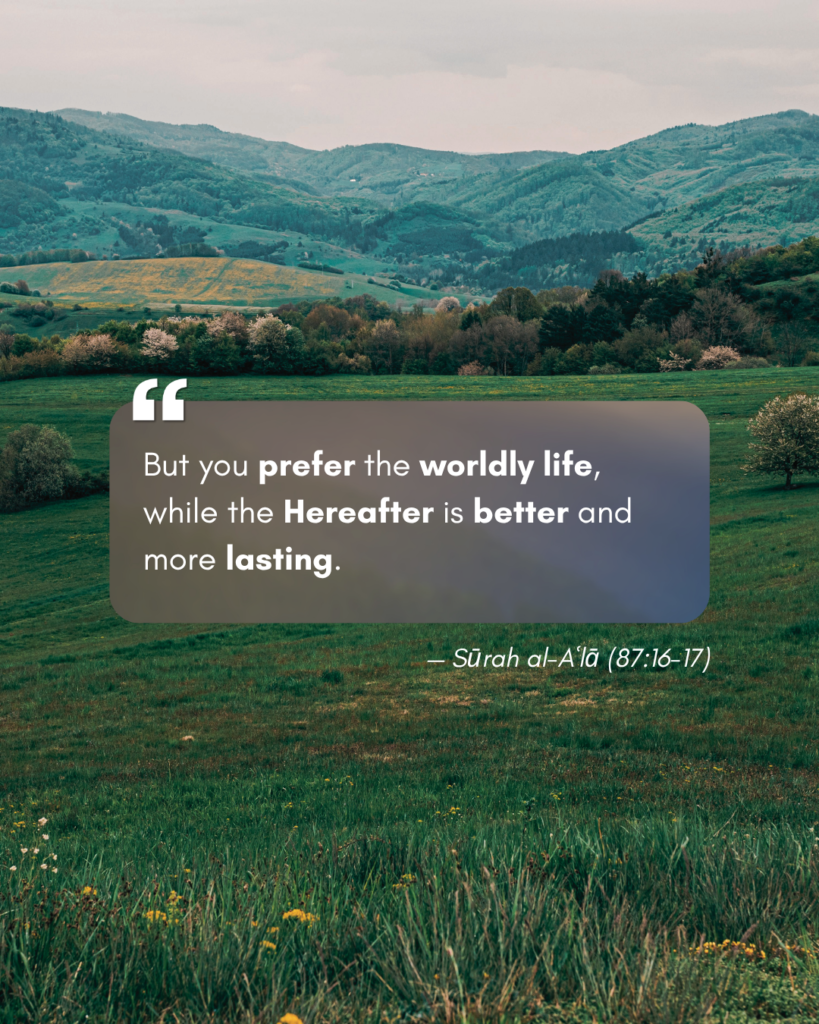
“But you prefer the worldly life, while the Hereafter is better and more lasting.”
— Sūrah al-Aʿlā (87:16-17)
The word tu’thirūna means you give preference, you choose one thing over another. You see the green of your own life and the eternal Garden promised by your Lord, and you choose the green. You know the green will become stubble. You know the Garden is everlasting. And still you cling.
Why does this happen? Because the green is visible and the Garden is unseen. Because the green is now and the Garden is later. Because the green can be touched and the Garden is known only through Tanzīlun min Rabbi al-ʿĀlamīn—a revelation from the Lord of the worlds. The one who does not truly believe in the revelation will always choose the visible over the unseen, the immediate over the eternal.
Rasūlullāh ﷺ described the man who embodies this preference with an image that is impossible to forget:
“Indeed Allāh despises every such person who is harsh in nature, who over-eats, and is rowdy in the market place. He sleeps like a dead carcass at night and tires himself like a donkey by day. He is knowledgeable of worldly matters, but ignorant of the matters of the Hereafter.”
— Ṣaḥīḥ Ibn Ḥibbān, ḥadīth no. 72. The grading of this narration has been discussed by scholars; Shaykh al-Albānī initially authenticated it and later considered it weak due to a break in the chain, so it serves as supporting evidence rather than a primary proof.
The image is precise and unsparing. A carcass at night: no qiyām, no remembrance, no turning to the Lord of the pasture. A donkey by day: exhausting himself for the green that he knows will blacken. Knowledgeable of the markets, ignorant of the Meeting. This is the man who has understood the dunyā perfectly and missed the ākhirah entirely. He has preferred what withers, and his preference has made him dead to what lasts.
And then there is the believer. Rasūlullāh ﷺ described him with an image that is the mirror opposite:
“The world is the prison of the believer and the paradise of the disbeliever.”
— Ṣaḥīḥ Muslim, Kitāb al-Zuhd wa al-Raqāʾiq, Bāb al-mu’min fī al-dunyā ka-anna fī sijn, ḥadīth no. 2956
The believer lives in the dunyā as if in a prison, not because the dunyā is evil, but because he knows it is not his home. His own life, his youth, his health, his strength is the pasture he sees greening and knows will wither. He does not build his palace in the pasture. He takes from it what sustains his journey, and then he looks beyond it. The disbeliever sees the green and thinks it is everything. He does not look at the black that is coming. He does not look at the Garden that is waiting.
The Command That Saves: Glorify Al-Aʿlā
The sūrah does not leave us in the tragedy. It begins with the cure. Sabbiḥi isma Rabbika al-Aʿlā. Glorify the Name of your Lord, the Most High. The one who glorifies Al-Aʿlā is the one who remembers, in the midst of the green, that the One who made him green is greater than the green. The One who will turn his body into stubble is the One who will raise him from that stubble and bring him into a Garden that never withers.
The tasbīḥ reorients the heart. Every Subḥāna Rabbiya al-Aʿlā is a declaration that the Highest is not the pasture, not the wealth, not the youth, not the health; but the One who created them. And when the heart is anchored in that glorification, the withering of the pasture does not destroy it. The believer who has spent his life saying Subḥāna Rabbiya al-Aʿlā will see his own body fading and say: Indeed, we belong to Allāh, and indeed to Him we will return. The pasture was never his. It was always a loan. The Giver remains.
The sūrah will later describe the one who succeeds: Qad aflaḥa man tazakkā, wa dhakara isma Rabbihi fa-ṣallā. “He has succeeded who purifies himself, and remembers the Name of his Lord and prays.” The purification, the remembrance, the prayer; these are the means by which the heart is weaned from the love of the stubble.
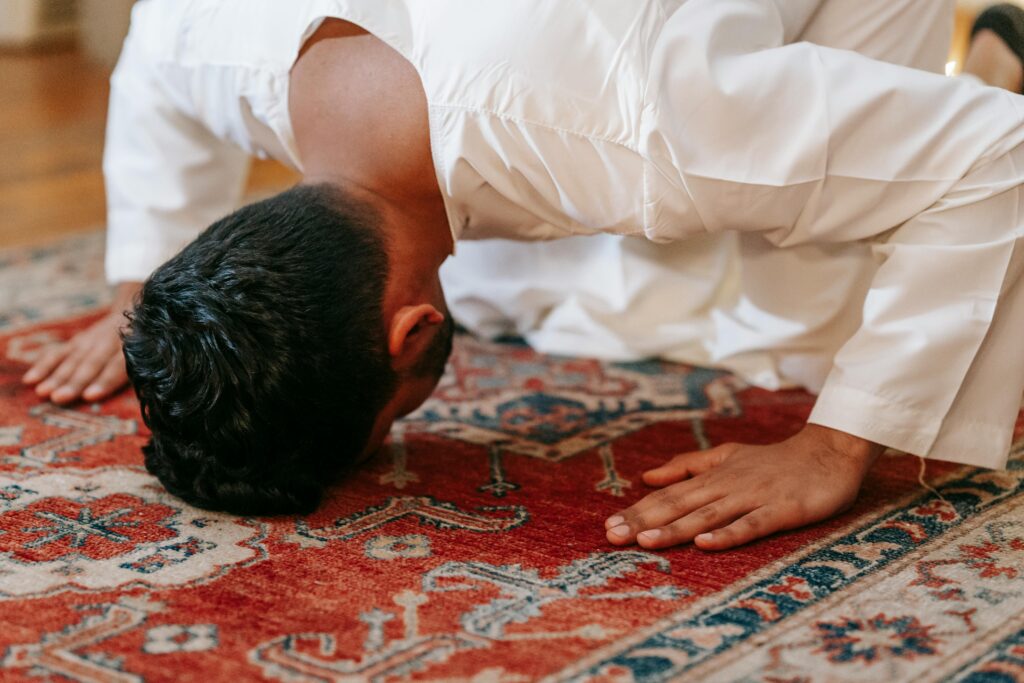
The one who prays is the one who leaves the pasture five times a day and stands before the Lord of the pasture. The one who remembers is the one whose tongue is moist with the Name that outlasts every green thing. The one who purifies himself is the one who sheds the love of the dunyā from his heart as water sheds dirt from the limbs.
That is the path. Not to despise the pasture, for it is Allāh who brought it forth. But to take from it what is needed, to glorify the One who gave it, and to prepare for the day when the green will be replaced by what is better and more lasting.
We ask You, Yā Aʿlā, Yā Khāliq, Yā Hādī, to make us among those who see the pasture and remember the withering. Do not let us be deceived by the green, and do not let us be destroyed by heedlessness of the black. Make our hearts attached to what is better and more lasting, and make our tongues constant in glorifying Your Highest Name. Grant us the success of those who purify themselves, remember You, and pray, and do not make us among those who prefer the fleeting over the eternal. Amīn yā Rabb al-ʿĀlamīn, bi-raḥmatika yā Arḥam ar-Rāḥimīn.